Japanese Standard Solar Cable is a useful buying term for cables intended for the Japanese solar market, but it is not one certificate. Japanese photovoltaic cable approval is therefore a route-and-evidence question, not a product-name shortcut. Buyers must connect the legal scope, cable designation, third-party evidence, electrical design, route conditions and shipment records before approving an order.
Prepared by the JINYOU Cable Technical Content Team. Public authority, standards-catalogue and manufacturer evidence was reviewed on 10 September 2026.
Quick Answer
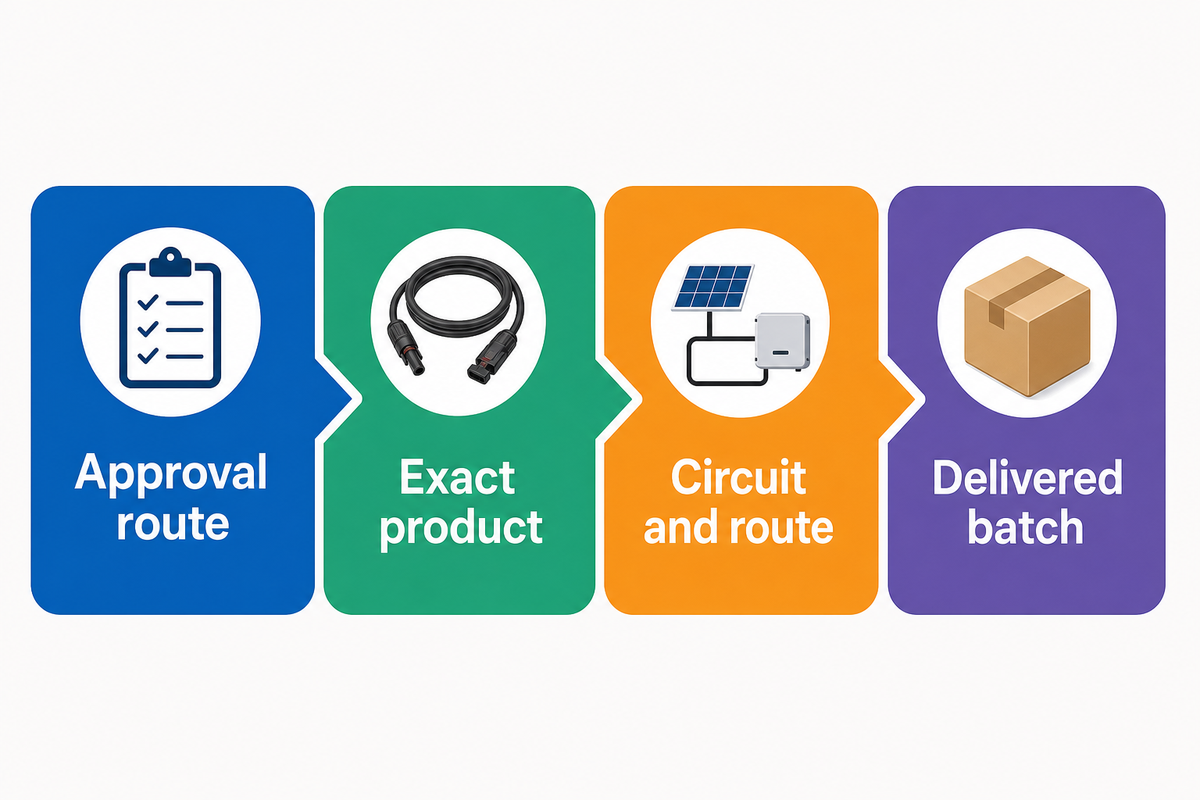
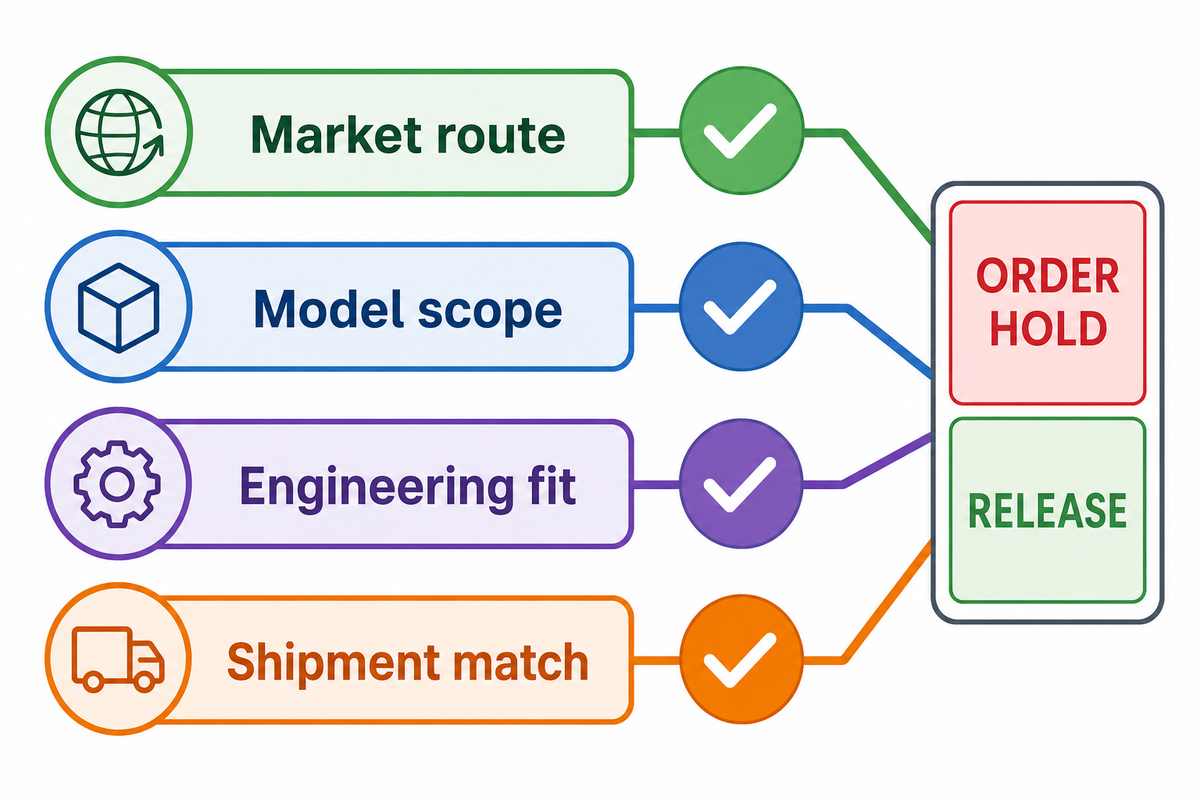
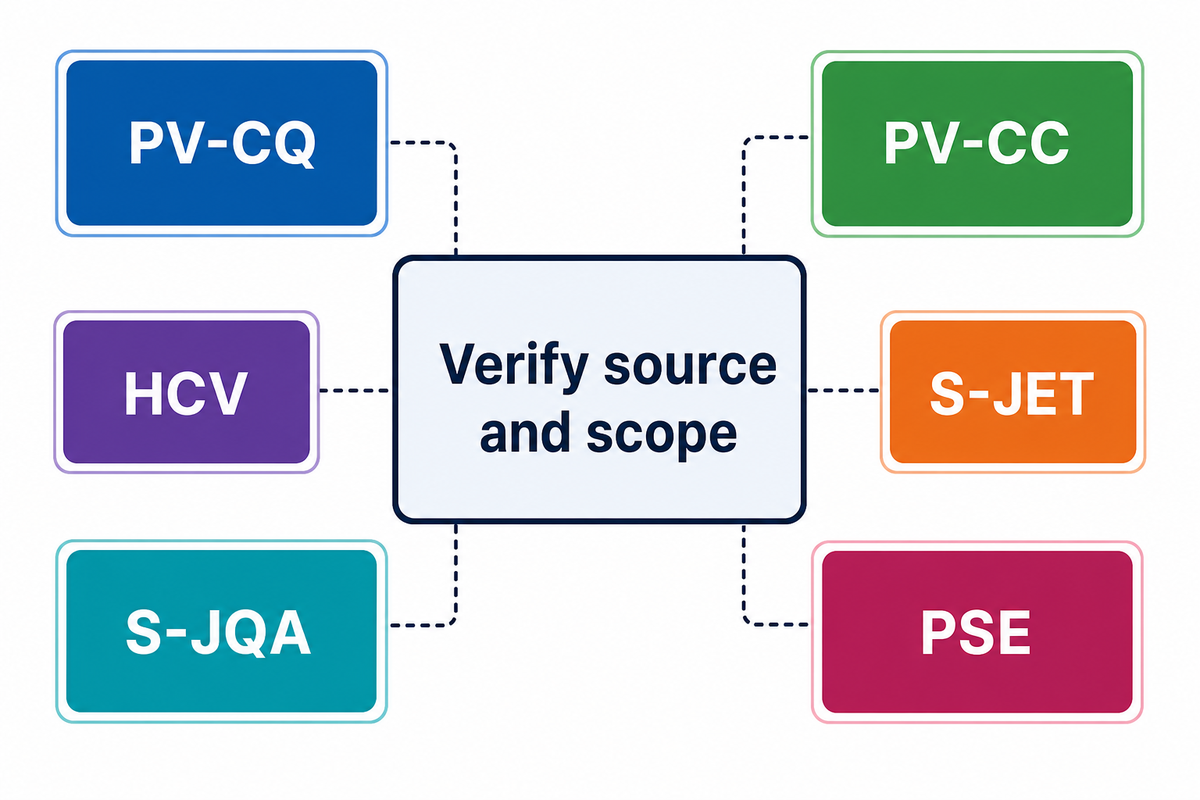
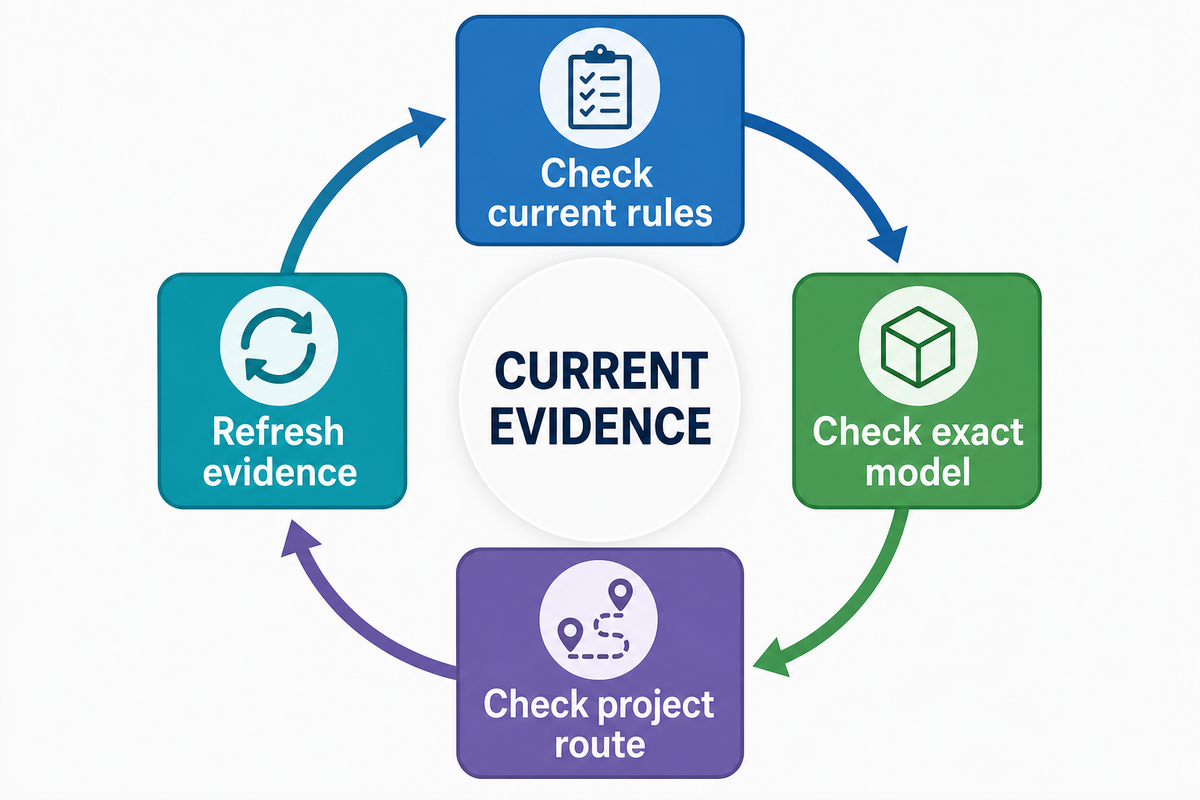
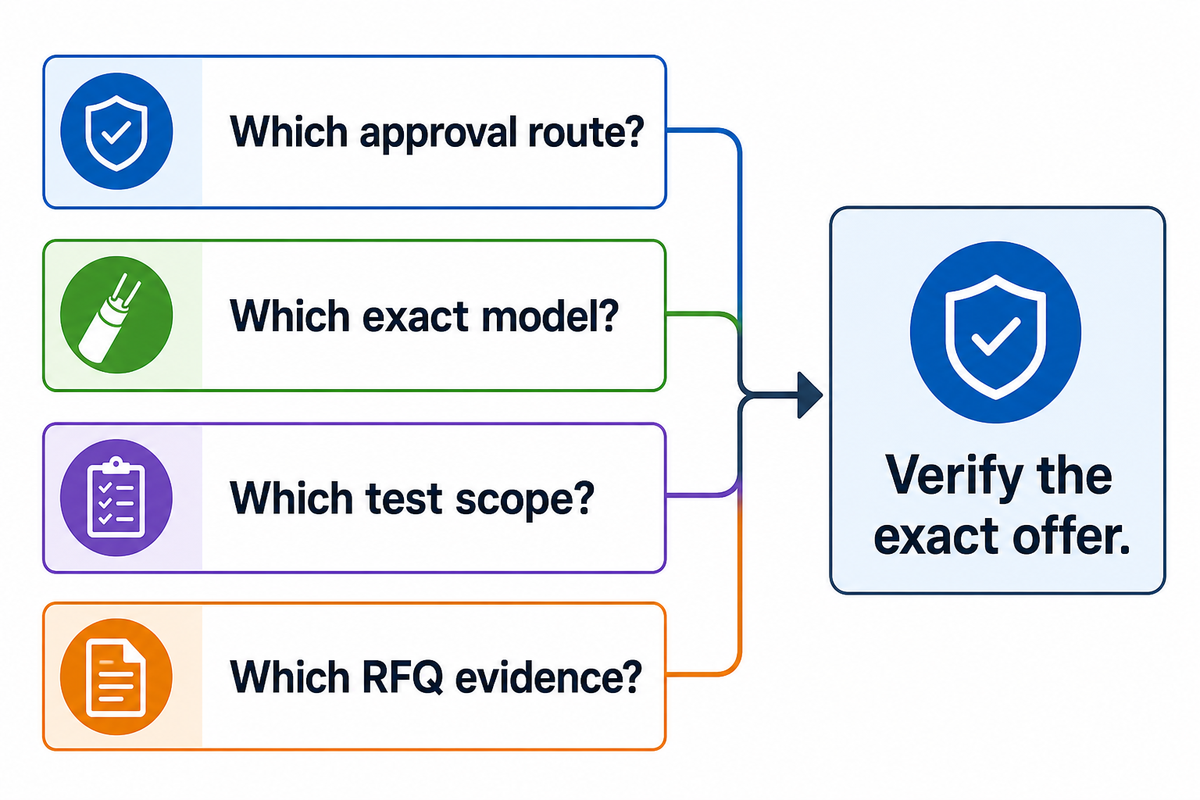
Approve a Japanese-market photovoltaic cable only after four checks: identify the applicable legal and market route, verify the exact product and third-party evidence, confirm the electrical and installation fit, then tie the accepted evidence to the factory and shipment. A label such as PV-CQ, HCV, S-JET or PSE would not validate all four steps.
Engineering boundary: this guide structures buyer questions and evidence. It does not select a conductor or provide legal approval. The project designer, the applicable authority, the quality team, and the installation contractor must confirm the latest requirements for the site. Treating a supplier description as a design decision creates an approval risk that can surface only after the order is placed. Use the cable selection inputs to define the request, then match the supplier evidence pack and test report to one offered model.
Japanese Standard Solar Cable: The Short Answer
A Japanese Standard Solar Cable procurement decision is a combination of route, product, and project. Check the applicable law and requested voluntary certification or designation; confirm that the issuer report covers the quoted model and size; then verify the circuit, environment, installation and delivered batch against the approved specification.
The distinction matters because Japan Electrical Safety & Environment Technology Laboratories (JET) describes its S-JET route for photovoltaic-system direct-current cable as a voluntary certification system and publishes separate criteria for 1,500 V and low-voltage cable. This isn’t the same as whether a cable falls within a statutory PSE product category.
When determining a quotation, begin with the project specification and acceptance owner, not a search result title. If the quotation states PV-CQ, ask which document assigns the designation to the offered product. If it states S-JET or PSE, ask for the issuer record, the exact scope and marking. If those links are absent, hold the approval.
Decision rule: one familiar mark can support one part of the decision. It cannot silently stand in for model identity, cable sizing, route suitability, factory scope or batch release.
The 4-Layer Japanese PV Cable Approval Route
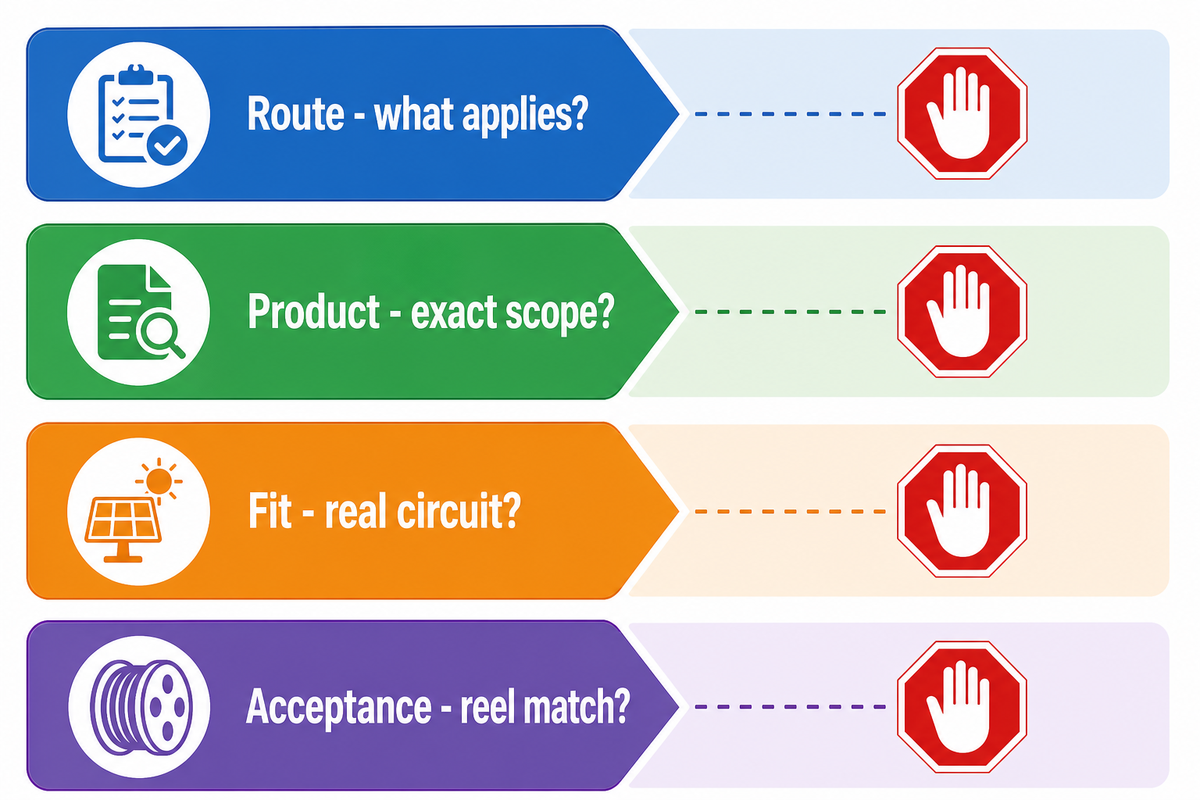
The four-layer route assigns every approval question to an owner. Layer 1 covers statutory and market requirements. Layer 2 covers the exact cable and its third-party evidence. Layer 3 covers circuit and route fitness. Layer 4 covers project acceptance, batch traceability and change control.
4-Layer Japanese PV Cable Approval Route
Layer
Question
Evidence and owner
Hold trigger
1. Route
Which law, voluntary scheme, buyer specification or authority decision applies?
Current regulator or certification-body source; compliance owner
PSE, S-JET or another route is assumed from the word “solar”
2. Product
Does the certificate or report cover the exact designation, model, conductor, rating and factory?
Issuer record, certificate, report and drawing; supplier quality team
A family certificate is offered without model-level linkage
3. Fit
Can this construction serve the electrical circuit and actual installation route?
Design calculation, route survey and termination data; project engineer
Size or material is chosen from a catalogue range alone
4. Acceptance
Does the delivered reel match the approved evidence and purchase order?
Approved submittal, reel record and change notice; procurement and project quality
Factory, construction, marking or report revision changed after approval
METI’s product-scope page is a reminder that PSE applicability is defined by the electrical product categories and limits of technology, and should be checked for the actual conductor and construction, cores and voltage, and shouldn’t be inferred from photovoltaic use. JET’s separate voluntary route addresses a different question.
Route plurality is visible elsewhere too. JQA documents a dated S-JQA photovoltaic-cable example for specified PV-CV product families, based on JECTEC testing and other cited technical bases. Use this JQA page to understand that an alternate route exists, but do not extend its scope beyond the named PV-CV families or transfer it to a PV-CQ quotation.
The buyer’s safest sequence is Layer 1 to Layer 4. Starting with Layer 2 and a certificate file may obfuscate the most basic question of whether that certificate is the route the project requires.
PV-CQ, PV-CC, HCV, S-JET, S-JQA and PSE Are Not Interchangeable
The following terms can mean a product, family of cables, optional certification routing or statutory marking. PV cable certification and cable marking still need exact issuer, model and scope checks. Don’t assume that translation from one to another is allowed. Record the claim as shown, identify the controlling source, check the model scope, and leave it to the owner of project acceptance to decide whether it meets the specification.
Claim seen
Source to verify
What remains unproved
Buyer action
PV-CQ
Issuer definition, certificate record and product marking
Equivalence to PV-CC, HCV, S-JET or PSE
Request the governing document and exact certificate scope
PV-CC
Product standard, third-party route and exact construction
Universal voltage, material or PSE status
Verify the offered model, not a competitor example
HCV
Manufacturer drawing, applicable standard and rating
That HCV alone means 1,500 V PV cable
Check voltage and intended-use scope line by line
S-JET or S-JQA
Certification body, scheme criteria and registration entry
Statutory status, every size or every installation
Match holder, factory, model, rating and validity
PSE
METI product-category scope and product evidence
Applicability to all photovoltaic DC cables
Have the responsible compliance party classify the exact product
A useful counterexample comes from Onamba. Its public page separates CV, HCV and EM CE/F products rated to 750 V DC from a PV-CC product rated to 1,500 V DC. That PV-CC table lists 2 mm², 3.5 mm² and 5.5 mm² conductors, 5.8 mm, 6.4 mm and 7.0 mm finished diameters, a 1.2 mm sheath and a 90 °C rating. The example references JCS 4517 and S-JET. In the English notes below its structural table, Onamba says that this PV-CC product doesn’t bear PSE because it’s outside the Act.
That example doesn’t define every supplier’s PV-CC or PV-CQ cable. It also demonstrates the danger of label stacking. Products shown on a single page can have very different standards, ratings and marking routes.
Comparator rule: never give a quote extra credit merely because it displays more acronyms. Give credit when each acronym has an issuer, scope, current record, matching model and clear project purpose.
What JIS C 3660, JIS C 3665 and JIS K 7350 Evidence Can Prove
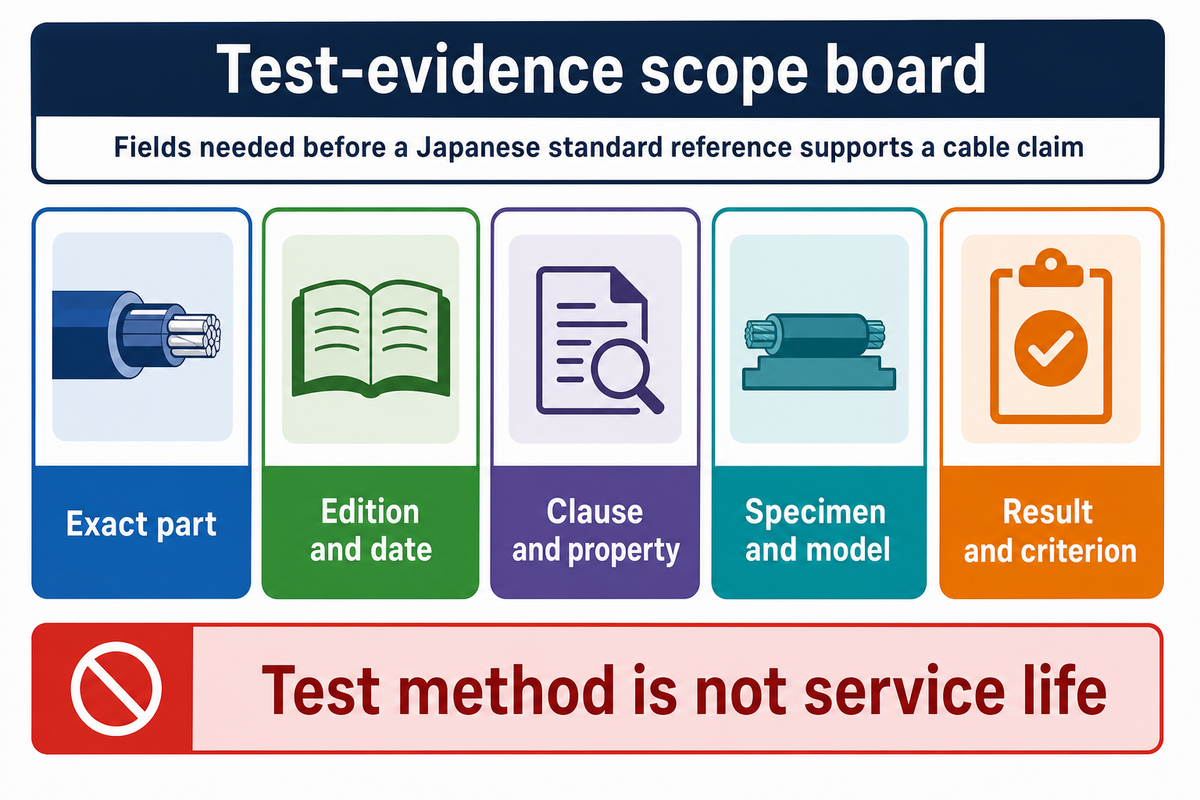
A JIS number on a datasheet is a pointer and not a fully satisfied conclusion. That label-by-label distinction is why the exact JIS part matters. Ask for the exact part, edition, clause, specimen, tested model, result and report date. Only then can the quality reviewer decide whether the cited method supports insulation dimensions, flame behaviour, weathering or another stated requirement.
Public catalog metadata demonstrate the need for a part number. JIS C 3660-201:2019 is titled around measurement of insulation thickness. A different, older JIS C 3660-3-1 catalog item describes a test for PVC compounds. Thus, a broad “JIS C 3660” doesn’t give the reviewer any information on the tested requirement, the material, or the result. For an international scope cross-check, ISO 4892-3:2024 covers fluorescent-ultraviolet exposure of plastics under radiation, heat and water.
Evidence field
Why it matters
Reject or clarify when
Exact document and part
Identifies the test-method scope
Only a family number is listed
Edition and date
Links the report to a controlled requirement
The edition is absent or differs from the project file
Clause and claimed property
Stops a method from being stretched to unrelated claims
A flame test is used to imply weathering or service life
Specimen and exact model
Connects the tested sample to the quotation
Material, size or construction differs
Result and acceptance criterion
Shows what passed and against which limit
Only a report cover or logo is supplied
Don’t transform JIS K 7350 as a reference for accelerated exposure testing into a claimed outdoor lifetime. Test conditions can compare material behaviour under defined exposure, but the field route also brings temperature cycles, water, bending, abrasion, chemicals, installation damage and termination effects. ASTM G154 also explains that its apparatus practice does not by itself deliver a product-specific result. Neither source assigns Japanese cable approval.
Public catalogue pages support scope checking. JINYOU’s solar cable standards overview can organize the site-level review, while the purchased controlled documents remain authoritative. They do not replace purchased standards. Before approving the claim, quality teams are expected to read the current controlled document and the associated laboratory report.
The 7-Input Cable Selection Gate Before Choosing a Size
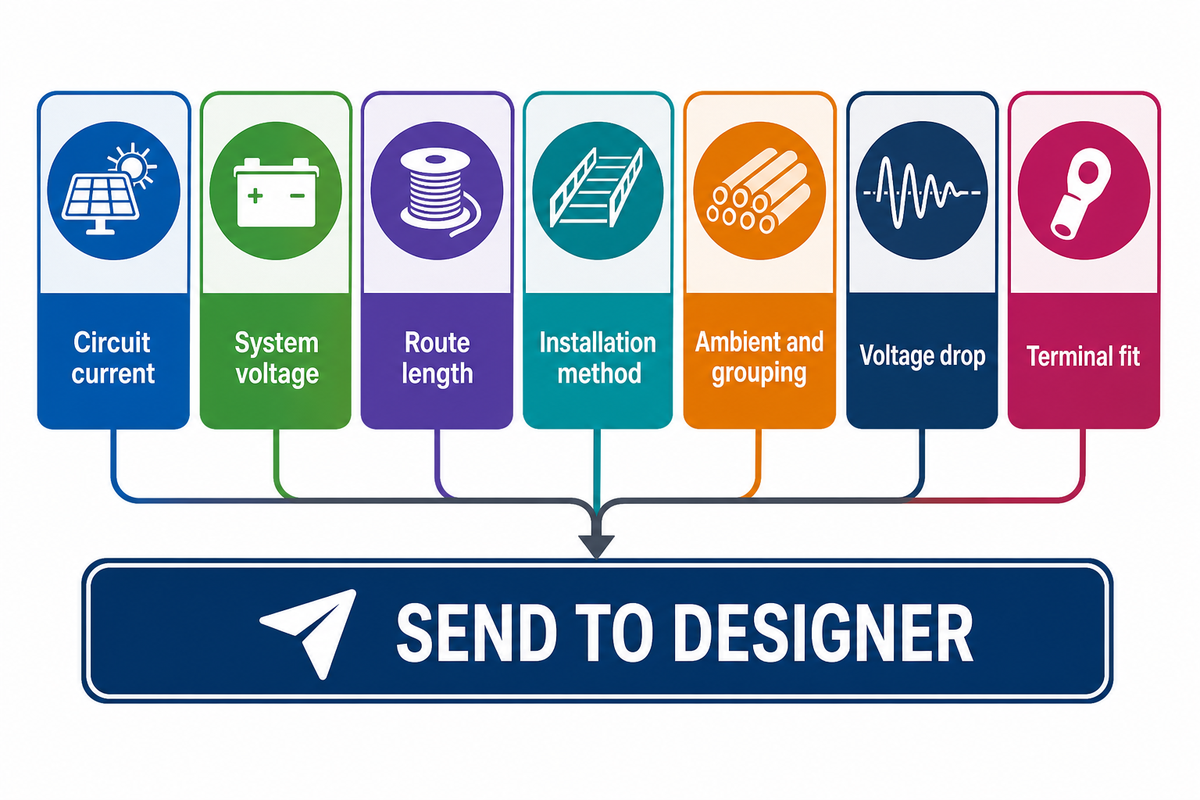
A supplier’s size range isn’t a design answer. Before requesting 2.0, 3.5, 5.5, 6.0 or 8.0 mm², seven inputs need to be documented: current, system voltage, one-way length, installation method, ambient and grouping conditions, permitted voltage drop, and terminal or connector compatibility.
Circuit current: use the designer’s maximum-current basis and protective-device context.
System voltage: record operating and maximum direct-current conditions, not just the cable’s printed ceiling.
One-way route length: measure the real path, including changes between module, combiner and inverter.
Installation method: note free air, conduit, tray, roof contact, enclosed space, buried section or other route condition.
Ambient and grouping: identify temperature and adjacent loaded circuits that affect current capacity.
Permitted voltage drop: use the project criterion and calculation method approved by the designer.
Terminal and connector fit: confirm conductor class, diameter, strip length, crimp tooling and compatible component family.
Southwire’s public voltage-drop tool illustrates the input logic: distance, current load, voltage and allowed drop are separate fields. It isn’t a Japanese compliance calculator, but it makes one point clear. Changing route length or load can change the result even when the supplier’s rated voltage stays the same.
Worked decision example: a buyer receives a quote for 5.5 mm² because the size sits inside a published 2.0 to 8.0 mm² range. The current and voltage are known, but route length, grouping and connector data are missing. Gate result: HOLD. Engineering fills the missing inputs, calculates the circuit and then issues the approved size to procurement.
JINYOU’s Japanese Standard Solar Cable page lists DC 1,500 V and 2.0 to 8.0 mm² as offered product attributes. Treat them as first-party scope to verify against certificate JQ10896-1 and the final technical file. They don’t make every size suitable for every 1,500 V system.
Stop/go threshold: seven green inputs plus named use conditions and an acceptance owner permit the calculation to proceed. One missing input keeps the conductor line item on hold.
The 9-Field PV-CQ Approval Pack Comparator
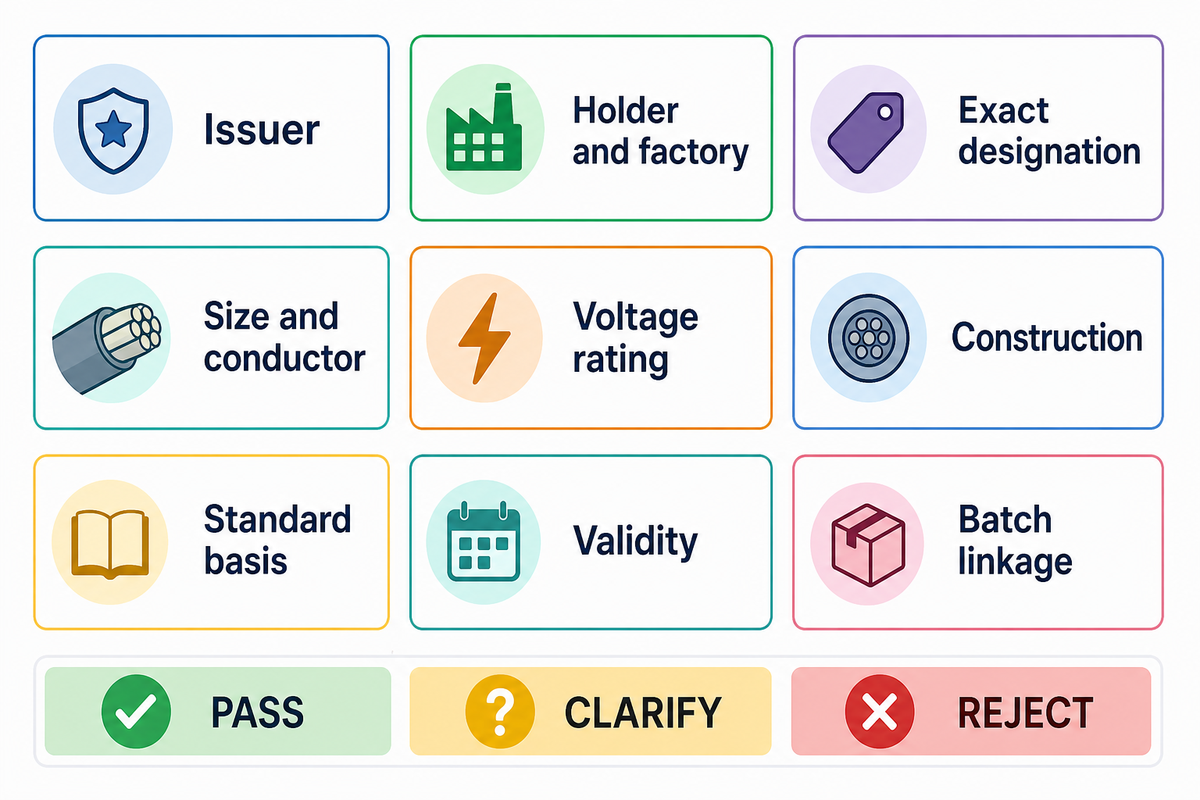
The nine-field comparator makes a release decision based on a stack of files. For each field you can make a decision of PASS, CLARIFY or REJECT. PASS indicates evidence matches the quoted product. CLARIFY indicates a gap that can be resolved. REJECT indicates a document belongs to a different route, model, size, factory or revision.
Evidence type
PASS evidence
CLARIFY
REJECT trigger
1. Designation and route
Exact term and governing source
Sales name only
Unproved equivalence
2. Issuer and ID
Issuer and record are traceable
Copy supplied, registry link absent
Identifier cannot be tied to issuer
3. Exact model
Quote, marking and scope match
Family named, model unclear
Evidence names another cable
4. Size
Ordered conductor is in scope
Range shown, class absent
Size falls outside scope
5. Voltage
Direct-current rating and context match
AC/DC notation unclear
Rating is below design need
6. Construction and tests
Drawing, materials, clauses and results align
Generic material names
Tested specimen differs
7. Factory scope
Manufacturing site is named
Legal entity only
Quote comes from another site
8. Validity and revision
Status and edition are current for the order
Expiry or transition unclear
Cancelled or superseded evidence
9. Batch and change control
Reel or lot links to approved files
Trace code method not shown
Unapproved construction change
In the case of the JINYOU offer, the page lists PV-CQ, JQ10896-1, DC 1,500 V, 2.0 to 8.0 mm², XLPE insulation and an XLPO sheath. Enter those values in the comparator as supplier claims pending document match. Marking them as PASS should await the record of the issuer, the exact model and construction, as well as the quoted size.
The quality reviewer owns Fields 1, 2, 3, 6, 7 and 8. Field 9 is procurement’s responsibility. The separation of these fields prevents a commercial quotation from becoming a technical approval.
Construction and Route Evidence for XLPE and XLPO Cable
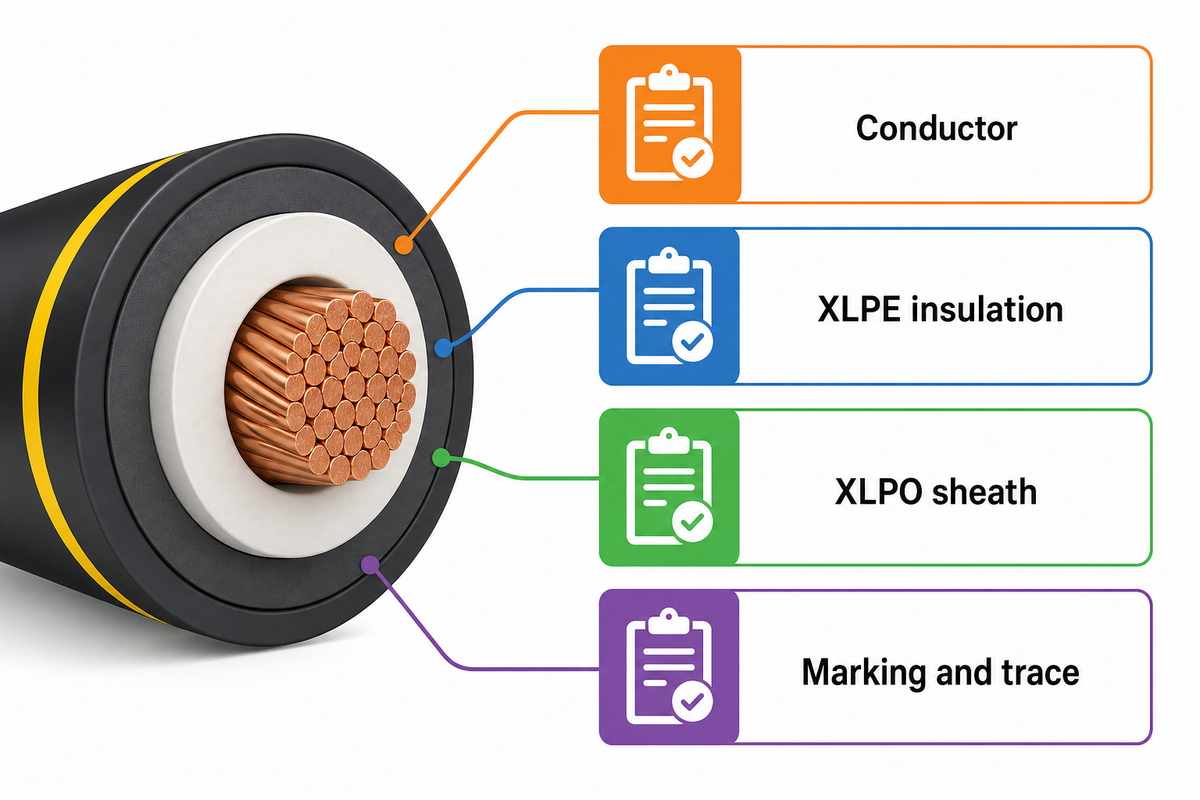
XLPE insulation and an XLPO sheath describe materials, not complete route fitness. The approval-pack fields therefore need route evidence, not material names alone. The installation can instead be framed as a set of testable questions: ultraviolet exposure, temperature, water, abrasion, bending, mechanical protection, flame or smoke requirements, chemical contact and connector termination. Each of these requirements must be matched to the exact model, construction and evidence.
Route condition
Ask the supplier for
Do not infer
Exposed roof or rack
Exact weathering method, specimen, exposure and result
A field lifetime from accelerated exposure hours
Wet or buried segment
Route permission, water-related evidence and protection detail
Underground fitness from sheath name
Tight bend or repeated handling
Minimum bend data, installation instructions and construction drawing
Flexibility from the word “cross-linked”
Connector termination
Conductor class, dimensions, strip length, crimp tool and pull-test basis
Compatibility from nominal mm² alone
UL Solutions notes that different global regulatory requirements specify which cable constructions are appropriate. For a Japanese project, this means that international test language can be relevant to reviews, but the project’s Japanese route and acceptance criteria will dictate the purchase.
Keep the route drawing with the test matrix. A cable may cross open air, conduit and termination zones in one circuit. Each zone has the potential to create a different evidence request even if the reel and conductor size are constant.
Japanese Solar Cable RFQ and Supplier Handoff
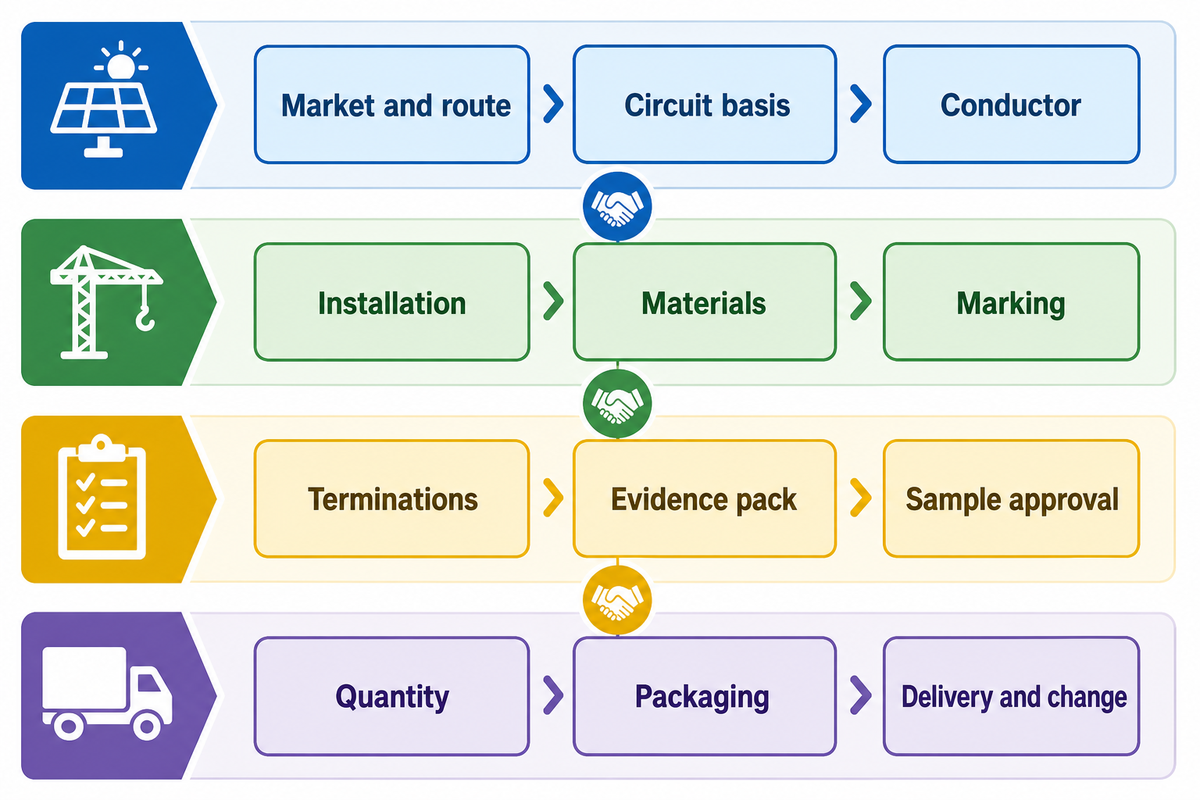
A good request for quote (RFQ) provides the supplier with enough controlled input to quote a single identified product and evidence pack. It does not permit the supplier to determine circuit current, cable size or statutory product classification; those are controlled buyer inputs. Complete the engineering and acceptance fields, then request a matched product, marking, documents, and agreed delivery.
12-Field Japanese PV Cable RFQ Checklist
Requirement
Buyer input
Supplier return
1. Market and approval route
Applicable specification and acceptance owner
Route statement and governing evidence
2. Circuit basis
Current, voltage and design reference
Rated product match
3. Route conditions
Length, method, ambient, grouping and exposure
Installation limits and test evidence
4. Conductor
Approved size and class
Construction and dimensional table
5. Insulation and sheath
Material and performance requirements
Drawing and claim-specific reports
6. Marking and colour
Required legend, language, colours and trace code
Artwork and sample image
7. Termination
Connector, terminal and tooling constraints
Compatibility data and preparation method
8. Approval pack
Nine-field comparator
Certificate, reports, issuer and factory scope
9. Sample approval
Sample length and acceptance checks
Tagged pre-production sample
10. Quantity
Total metres and cut plan
Manufacturing tolerance and allocation
11. Packaging and delivery
Drum, labels, destination and required date
Pack plan and shipment schedule
12. Change control
Notification and reapproval rule
Signed no-change or change-notice commitment
JINYOU Cable reports design, manufacturing and OEM support for renewable-energy cable from its Shanghai operation, established in 2006, with exports to more than 40 countries; these are company-page statements. The RFQ should still require offer-specific evidence and buyer approval before production release.
Please don’t just send “6 mm² Japanese solar cable.” Request a controlled package, where model, rating, marking, factory, reports and the shipping plan all agree.
What 2025 and 2026 Signals Mean for Japanese Solar Cable Buyers
Recent signals support tighter document control, not a cable-market growth claim. That control discipline continues after the RFQ handoff. Japan has a large photovoltaic fleet and continues to update standards, and newer conductors are appearing in trade publications. Buyers should use dated source checks, recorded revision fields and formal change control rather than assume approval status is permanent.
Signal
Buyer consequence
Action
IEA PVPS relays RTS Corporation estimates of more than 100 GW cumulative PV capacity and about 5.7 GW of 2025 additions
Large installed scale does not prove growing cable demand or product acceptance
Use the figures only as dated sector context
JISC posts continuing 2025 and 2026 standards notices
Undated report references can become ambiguous
Record exact part and edition on each order
Trade coverage reports aluminum PV cable activity in Japan
A material change reopens size, termination, route and approval review
Treat alternatives as new designs, not drop-in substitutions
This research found no verified 2025 or 2026 amendment specific to the JINYOU cable’s cited JIS references. The correct answer is a monitoring field in the approval pack, instead of a statement that the cable rules have recently changed.
The mixed, English-language keyword data are scant and can’t justify a market forecast. More procurement value comes from a quarterly issuer-status check and a pre-order report-revision check than from analyzing weak search-volume changes.
Japanese Standard Solar Cable FAQs
These answers resolve common pre-RFQ questions. They keep the legal route, product evidence and electrical design separate. A short web answer cannot approve a model or circuit for a real project.
What are the typical specifications for solar cable?
Typical fields include direct-current voltage rating, conductor material and cross-sectional area, insulation and sheath construction, temperature and exposure evidence, outer dimensions, marking, connector or terminal fit, and approval documents. Acceptable values depend on the circuit, route, market requirements and project specification. A supplier table should therefore be read as offered product scope, not as a ready-made design.
Can I use 1.5 mm² cable for solar panels?
There’s no one correct answer. The designer needs the maximum circuit current, system voltage, one-way length, installation method, ambient and grouping conditions, allowed voltage drop, and terminal compatibility. The selected cable must also satisfy the applicable product and project evidence route. Merely substituting a familiar size or a small array rating won’t suffice.
What type of cable is used for solar panels?
Purpose-built photovoltaic direct-current cable is commonly used between modules, combiners and inverters. For a Japanese project, the search phrase solar panel cable is only a starting point. Confirm the exact designation, voltage, construction, size, third-party evidence, statutory scope, route conditions and project acceptance requirements.
Which solar cable is considered the best?
The best choice is the cable whose verified scope matches the circuit, route, terminations, project documents and delivered batch. More labels don’t make a better evidence pack. A defensible choice also has a named approval owner and traceable records for the exact reel supplied.
What does PV-CQ mean on a solar cable?
Treat PV-CQ as an exact designation claim that needs its governing source, issuer evidence, model scope and marking checked. This run didn’t find a current public authority definition that makes PV-CQ equivalent to PV-CC, HCV, S-JET, S-JQA or PSE. Ask the supplier for the certificate record and technical basis, then compare holder, factory, model, size, voltage, construction, validity and batch linkage with the quotation. Do not release production until the returned record matches the exact item offered.
Does a JIS C 3665 reference prove the whole cable is accepted?
No. A report can cite a test method or part without proving every construction, rating, model, factory or installation requirement. Request the exact edition, clause, specimen, result and acceptance criterion.
What should a Japanese solar cable RFQ include?
Include the applicable market and approval route, circuit voltage and current, approved conductor, real installation conditions, materials, marking, colour, terminations, evidence pack, sample review, quantity, packaging, delivery and change control. Name the owner for engineering approval and the owner for document release. The supplier can then answer with one exact model and a matching set of records rather than a generic product family.
Shanghai Jinyou Jinhong Intelligent Electric Co., Ltd. has focused on new energy cable manufacturing since 2006, supporting solar/PV, energy storage, EV charging, and industrial or special-cable applications.
Use this guidance to prepare a clearer engineering or procurement discussion: operating environment, conductor and insulation expectations, route length, voltage, installation method, and project schedule.
Certificate evidence should be matched to the construction being specified. Public certificate evidence applies to H1Z2Z2-K solar cable constructions and should not be read as blanket certification for every JINYOU Cable product family.
PROJECT BRIEF
Move from article to specification
Share the application, required cable family, target standard, quantity range, and delivery window. The team can help structure the next engineering and procurement conversation.