Get in touch with JINYOU Cable Company

By Aurora · Updated September 2026
Record guide at a glance
Scope: solar cable purchasing, production records and delivery handoffs. Five record classes: material, production, testing, reel identity and delivery. The worked example is hypothetical; its quantities aren’t product specifications.
Solar cable reports may show passing results yet the receiving team won’t know WHICH delivered reel a report describes. Missing links are between existing complete records: a sample code in one, a batch number in another and a replacement label on a cut reel.
Quality Testing & Traceability is the process of connecting specific test results to identified materials, batches and reels. Traceability captures relationships required to connect test evidence with production, product and delivery information.
- Model reports, production batches and individual reels describe different scopes.
- Replacement reel labels should preserve the link to its parent record and original production batch.
- Digital records need controlled changes and a retrieval path that survives shipment.
What Quality Testing & Traceability Means for Solar Cable
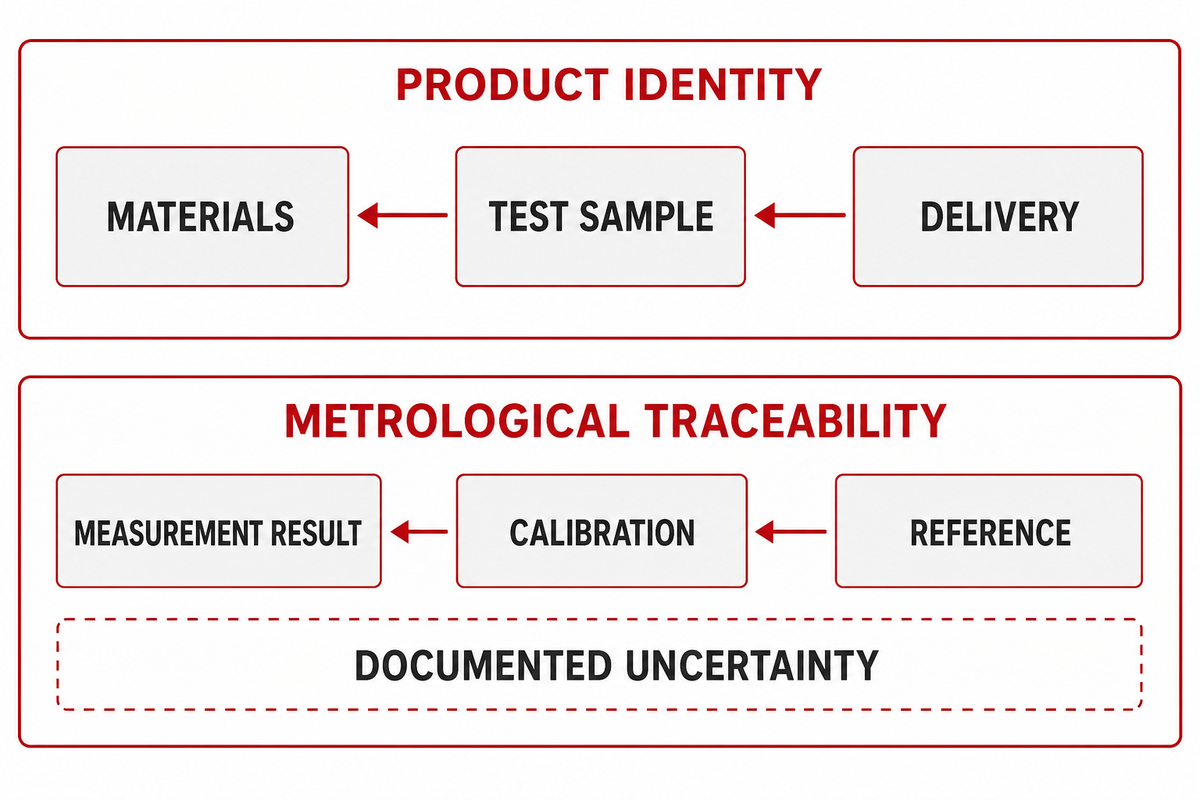
A test record captures what was measured. Traceability links product test evidence back and forth between identified inputs (materials, batches), product events (test, package) and outputs (deliveries, rejects). It thus answers “what was checked” AND “what material did we test”. One identifier doesn’t do so.
Quality assurance defines processes; quality control checks a defined set of outputs against requirements. (ASQ definitions) Product traceability links a record of such a test back to identifiable inputs, production and deliveries without asserting evidence that isn’t in the record itself.
NIST’s metrological traceability guidance describes a measurement result and its calibration chain to a reference, along with documented measurement uncertainty. One can’t guarantee the metrological traceability of a measurement result from an instrument record by itself.
Remember both sides of the chain belong to the test record. A link from a sample name to its material population identifies the result’s scope. The methodology and instrument linked in the record establish how the measurement occurred. When you ask for a test report related to a conductor sample that meets requirements, check that the report identifies the standard specification, pass criterion and method. Practical boundary: I want the information to link the result of that test to the specific sample and explain its relationship to the delivered batch in the order under review.
For an “everything is traceable” assertion from a supplier, ask for the documented anchor identifier at each end of each chain. Pick one delivered item, then request a complete, documented path back through its test, materials and production batch records.
Which Evidence Describes a Model, a Batch or a Reel?
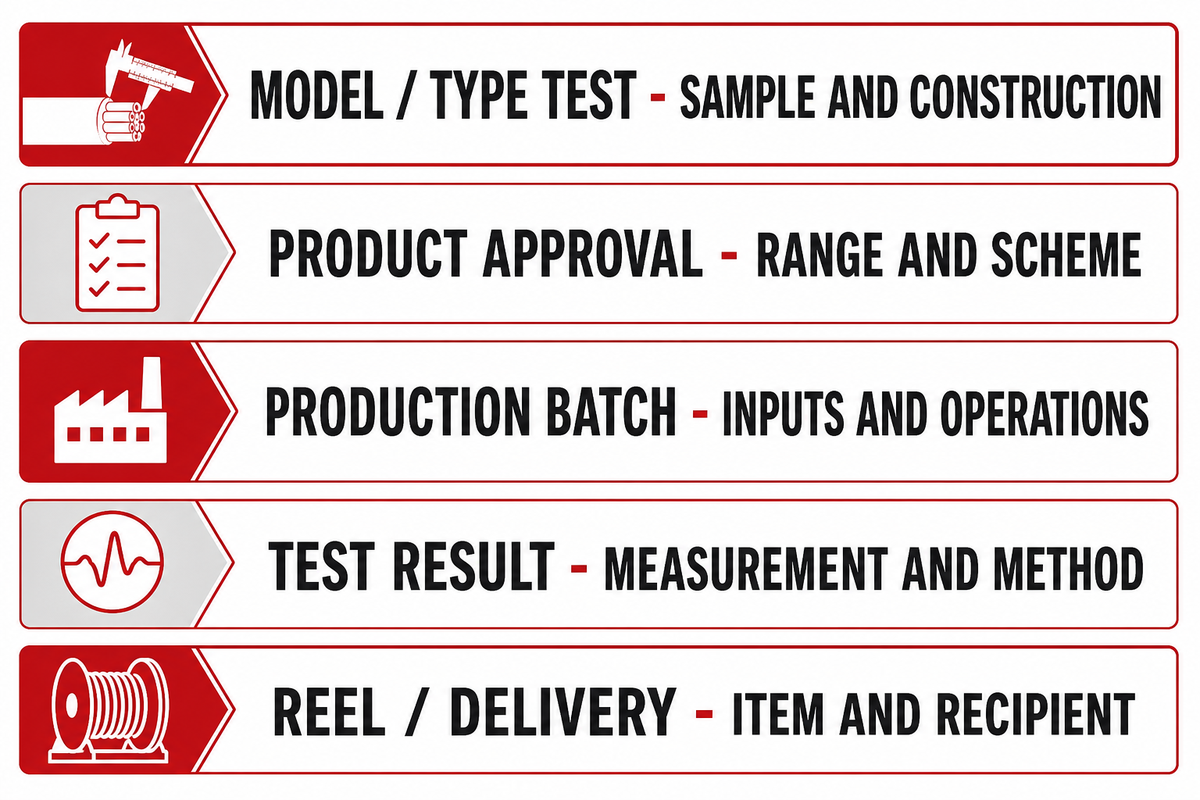
A test certificate or other document captures a level of identification: a product model, a physical part instance or a defined batch population. Ensure there’s an explicit link between these evidence scopes, not simply a repeat mention of the product name.
BASEC’s 2018 explanation of type testing and product approval describes a one-off type test as a snapshot. Product approval involves monitoring and periodic re-testing. Use this distinction in selecting relevant evidence: initial approval scope, current approval status, sample populations and the current scheme applicable to the order. Of course, identifying that the shipped product satisfies those conditions is essential to delivering accepted goods.
| Record | Useful question | Remaining link |
|---|---|---|
| Model or type-test report | What sample and construction were evaluated? | Offered construction and applicable report scope |
| Product approval document | What product range and approval scheme are covered? | Current scope, identity and shipment relationship |
| Production batch record | Which inputs and operations formed this batch? | Individual reels produced from it |
| Test result | What was measured, using which method? | Sample identity and represented population |
| Reel and delivery record | Which physical item went to which recipient? | Relevant batch, test and release records |
When multiple reels of a product come from the same batch of material supplied, that batch number can’t uniquely identify which specific reel reached its destination. We can achieve this identification, if required, through clearly defined serial numbering of the reels at creation, or tracking subsequent event histories, if such an identifier doesn’t arise inherently from materials handling and isn’t supplied in downstream records.
Correlate fields identified within the report against the PV cable test-report records for the order. Broad certificates should trigger a “scope” check. The assumption the batch shipped met all specified tests is flawed because there’s uncertainty that the samples used in testing matched the batch in transit.
Build the Record Chain from Incoming Material to Shipment
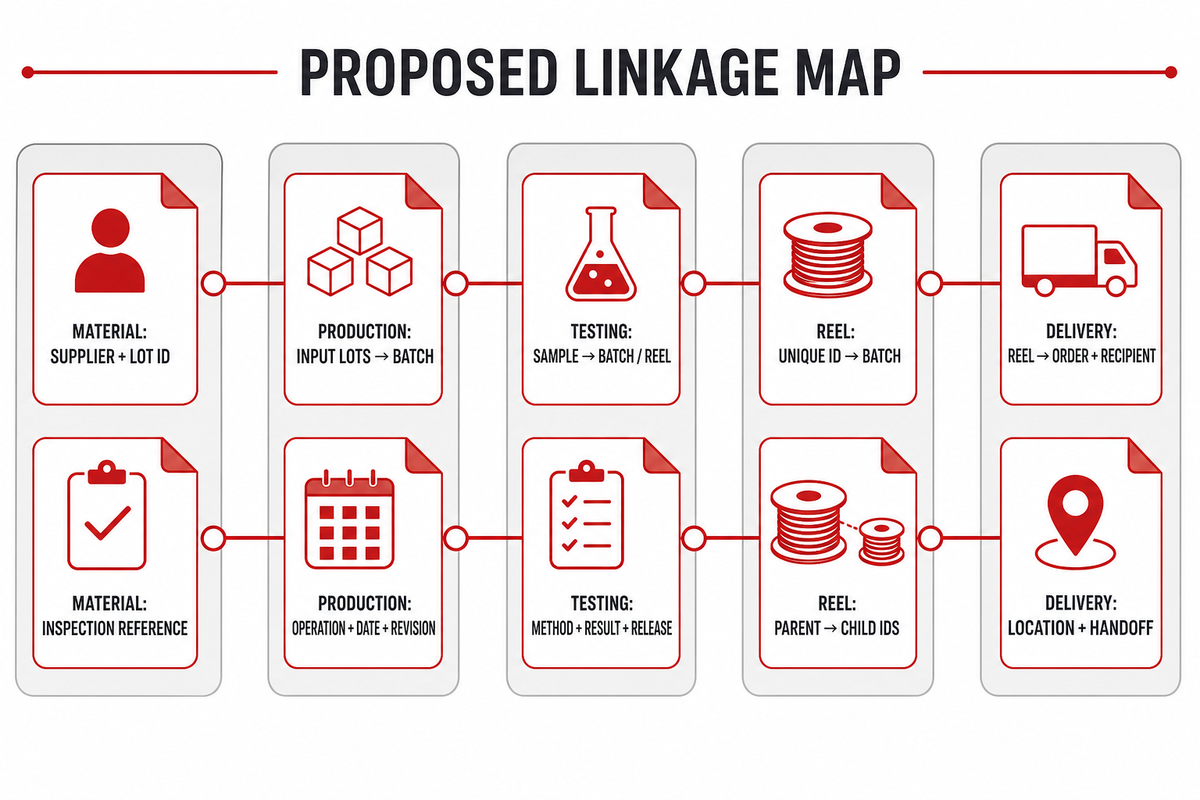
For this guide’s method, usable traceability needs explicit identifiers for incoming materials, production batches, test samples and physical deliverables, together with records of who did what and when. This example, by the way, is merely an illustrative table. It is not a certified reporting template.
Reel-to-Record Link Map
The Reel-to-Record Link Map explicitly identifies product reels back through production and the supply chain and forward through delivery.
| Record class | Field or relationship | Why retain it? |
|---|---|---|
| Material | Supplier and incoming lot ID | Find the origin of a material concern |
| Material | Incoming inspection reference | Locate the recorded acceptance decision |
| Production | Input lots → production batch | Trace consumed materials forward |
| Production | Operation, date and controlled revision | Distinguish production events |
| Testing | Sample ID → represented batch or reel | Keep result scope explicit |
| Testing | Method, result and release reference | Retrieve the basis of the decision |
| Reel identity | Unique reel ID → production batch | Distinguish physical reels within a batch |
| Reel identity | Parent reel → child reel IDs | Preserve the history after cutting |
| Delivery | Reel ID → order and recipient | Find affected deliveries |
| Delivery | Project/location and onward handoff | Support later installed-product retrieval |
GS1’s EPCIS overview describes exchanging events about product movement, status and custody between enterprises. This guide makes no assumption that EPCIS is mandatory for all cable orders.
Since common identifiers may not exist (or worse, are ambiguous!) from different sources – e.g. “Batch A” on your system vs an internal customer job number – map “other” identifiers back to “known” identifiers on the related systems/documents. Control these mappings in a spreadsheet or another record, and flag any connection that remains uncontrolled. Don’t just pile up documents when there’s a broken chain.
Link Requirements to Tests Without Losing Product Identity
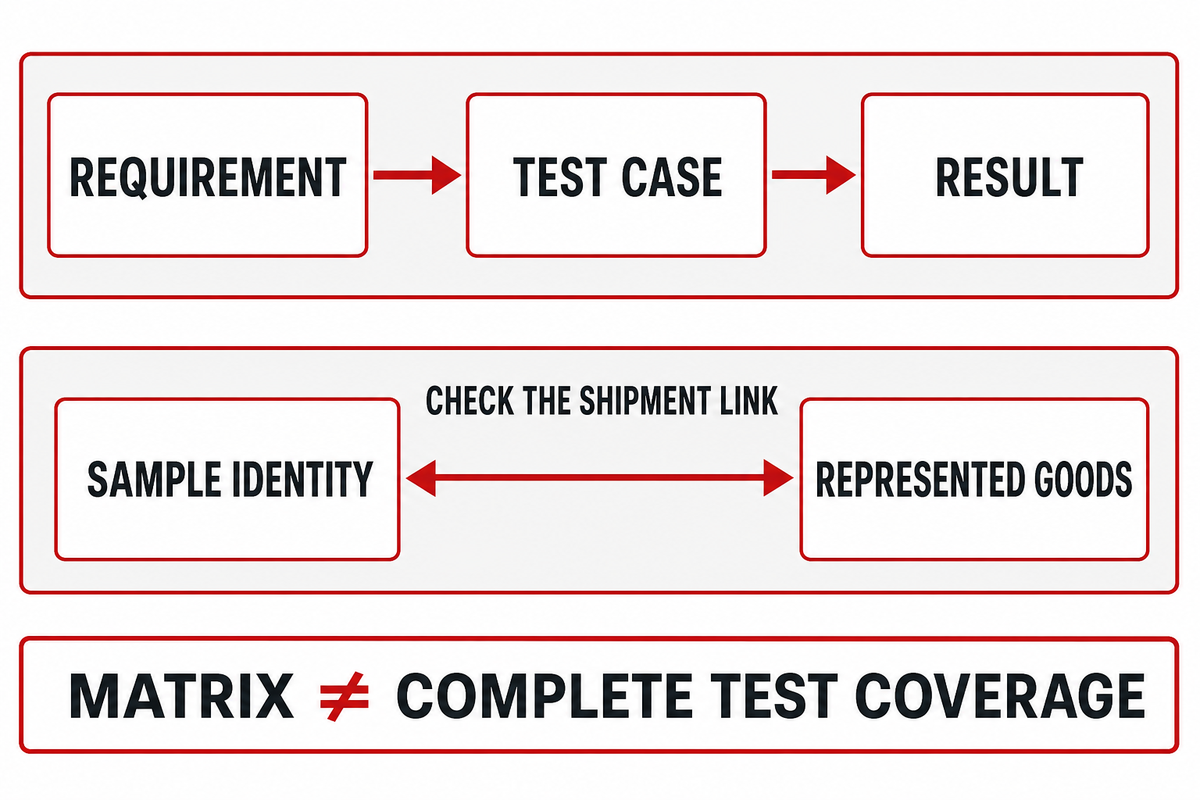
For this guide’s review method, requirements are directly mapped through defined test cases and controlled sample identifiers to defined sample populations, keeping requirement definition separate from product definition. A completed requirements traceability matrix for the requirements aspect only may demonstrate that the set of requirements is mapped but fails to establish traceability of shipped product that may lie outside the samples taken for the requirement demonstration.
We can use test management of requirements for creating a requirements-to-test case traceability matrix. In software testing, the practice of traceability uses a test case ID for tracing your test artifacts in both directions. Your cable team can borrow that discipline. (Software traceability context)
Connect requirements to test case records, keep links between requirements and results, and explain which goods the samples represent.
Useful test traceability includes: the tester, date, method revision, units, acceptance criteria and disposition. Test plans specify the tests planned; test runs record test execution. Traceability matrices support these testing activities by showing what each requirement addresses. In this context, traceability in software offers a useful analogy: a requirements traceability matrix maps requirements to test cases. Preserve links between requirements and results while keeping the physical sample identity explicit. Even a test suite of several requirements may depend on samples for which the link to a shipment must be checked separately.
Start with the requirement and follow the evidence for a forward traceability matrix. If producing a backward traceability matrix, start with a result and track back to the requirement it addresses. Forward traceability and backward traceability tell complementary stories; neither addresses physically missing traceability links. Treat this as a record review best practice, not proof of complete test coverage.
Keep connections between requirements visible when one change affects several tests. Requirements and tests may need review after a design or method revision. Your test management tool can list test coverage for that testing lifecycle, but its dashboard can’t supply a missing sample identity.
The IECEE listing for IEC 62930:2017 identifies the standard’s photovoltaic cable scope. Record the relevant edition and the requirement set agreed for your product. Updating a national-differences table does not automatically create a new edition of the underlying standard.
Engineering note: this guide doesn’t give test voltage, duration or acceptance tolerance. Those parameters belong to the relevant method and scope. Use the order’s solar cable standards documentation to clarify them before applying a “pass” result.
Follow a Split Reel in Both Directions
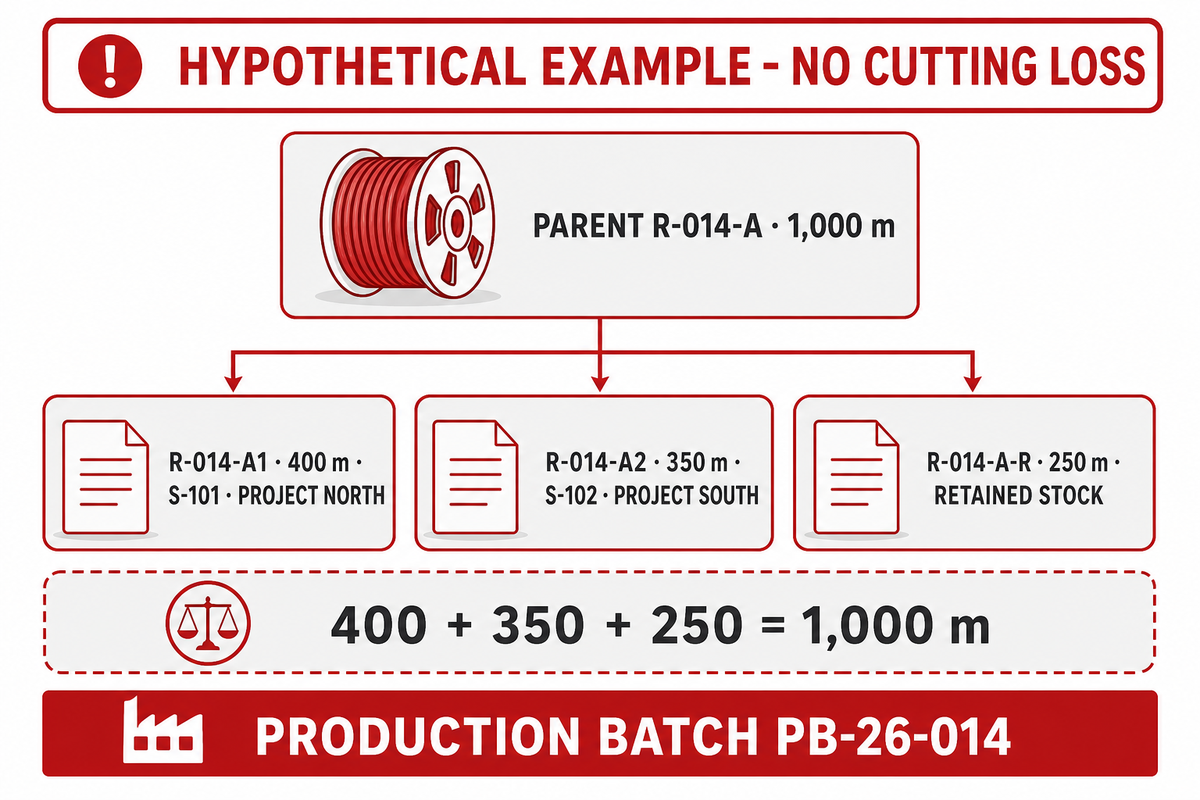
After a reel is cut, keep track of the relationship between the parent reel and each resulting physical reel. Unique child identifiers can keep the original production batch number. Record the amount and destination of each portion, including any scrap or retention. In the example below, one possible numbering approach, not a mandated one, is illustrated.
Split-Reel Record Check
The Split-Reel Record Check tests whether child reels maintain their parent relationship, reconcile quantities and lead back to evidence at its original scope.
Hypothetical example: production batch PB-26-014 produced reel R-014-A, recorded as 1,000 m. A distributor cuts two outgoing reels and keeps the excess. All identifiers and quantities below are fabricated for simplicity; the example assumes no cutting loss.
| Physical record | Parent | Quantity | Disposition |
|---|---|---|---|
| R-014-A1 | R-014-A | 400 m | Shipment S-101, Project North |
| R-014-A2 | R-014-A | 350 m | Shipment S-102, Project South |
| R-014-A-R | R-014-A | 250 m | Retained stock |
| Reconciliation | Original 1,000 m | 400 + 350 + 250 = 1,000 m | No unexplained difference in this example |
Backward traceability from R-014-A2 should lead to the parent and PB-26-014, then the relevant sample records, if those links exist. Forward traceability from a given input lot should show PB-26-014, the parent reel and both shipment records, plus retained stock, if those links are recorded. Forward and backward traceability depend on the same relationships being maintained. Record the actual cutting loss; it can’t be reconciled by changing the parent quantity.
ISO 22095’s official abstract explains that a chain-of-custody system alone does not establish product characteristics. Linking a child reel to its parent preserves identity; the relationship does not turn a parent sample result into a test performed on every child reel.
At the project handoff, connect the child reel to the installation record or controlled location ID. Keep that record available for later operator retrieval. One delivery address isn’t enough, when the cable from that address is dispersed across several sites.
Handle Missing Links, Retests and Rework
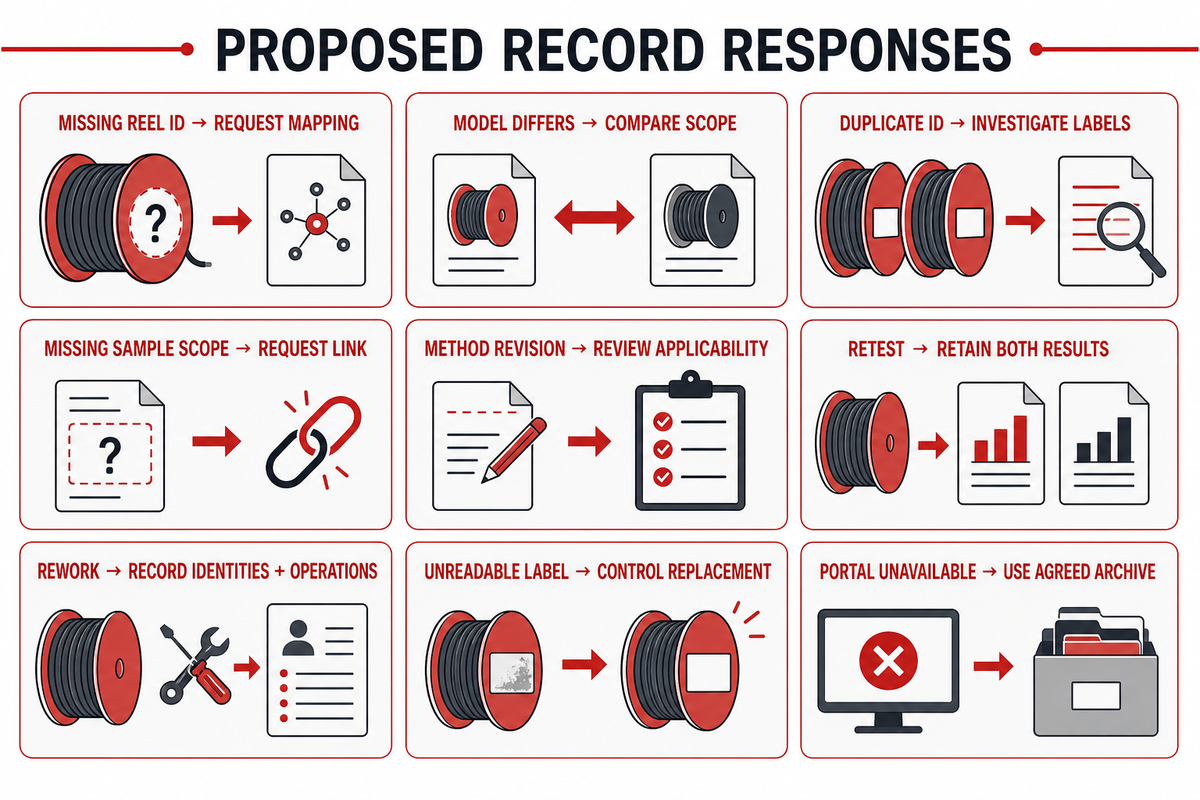
Treat a missing or contradictory link as an unresolved record issue with assigned responsibility. Keep the original records, document what you checked and record the final resolution. Retests and corrected labels should add an explained change into the record history; they shouldn’t covertly replace the evidence that caused the original question.
| Observed issue | Record response | Decision boundary |
|---|---|---|
| Reel ID absent from index | Request the documented identity mapping | Do not assume a nearby number is equivalent |
| Model differs from report | Compare construction and report scope | Refer unresolved scope to the responsible quality team |
| Two reels share one ID | Investigate duplicate or reused labels | Keep the two physical histories distinguishable |
| Sample population missing | Request its batch/reel relationship | A passing result has an unresolved scope |
| Method revision differs | Record the reason and applicability review | Do not assume revisions are interchangeable |
| Retest follows a failure | Retain both results and the retest rationale | Record who approved the final disposition |
| Material is reworked | Record affected identities and operations | Assess which evidence remains applicable |
| Label becomes unreadable | Use controlled replacement evidence | Do not reconstruct identity from appearance alone |
| Portal record is unavailable | Use the agreed archive and access owner | Flag missing evidence before relying on it |
The boundaries become obvious when tracing a historic cable recall. The ACCC’s 2021 Infinity cable FAQ report states initial samples had accredited testing, while subsequent regulator testing identified a safety issue. The recall, which began in 2013, included wholesalers. It concerned mains cable, not photovoltaic cable; it isn’t evidence about JINYOU products.
The record learning is to keep supplier and onward-delivery identity beyond the original shipment. Investigation of an in situ electric problem is for qualified professionals; records help find the evidence, they don’t prove handling or continued use is safe.
Preserve the decision history. Retain the original result, the reason for any correction and the authorized disposition. Deleting the earlier record makes later review harder.
Choose a Spreadsheet or Digital Record System
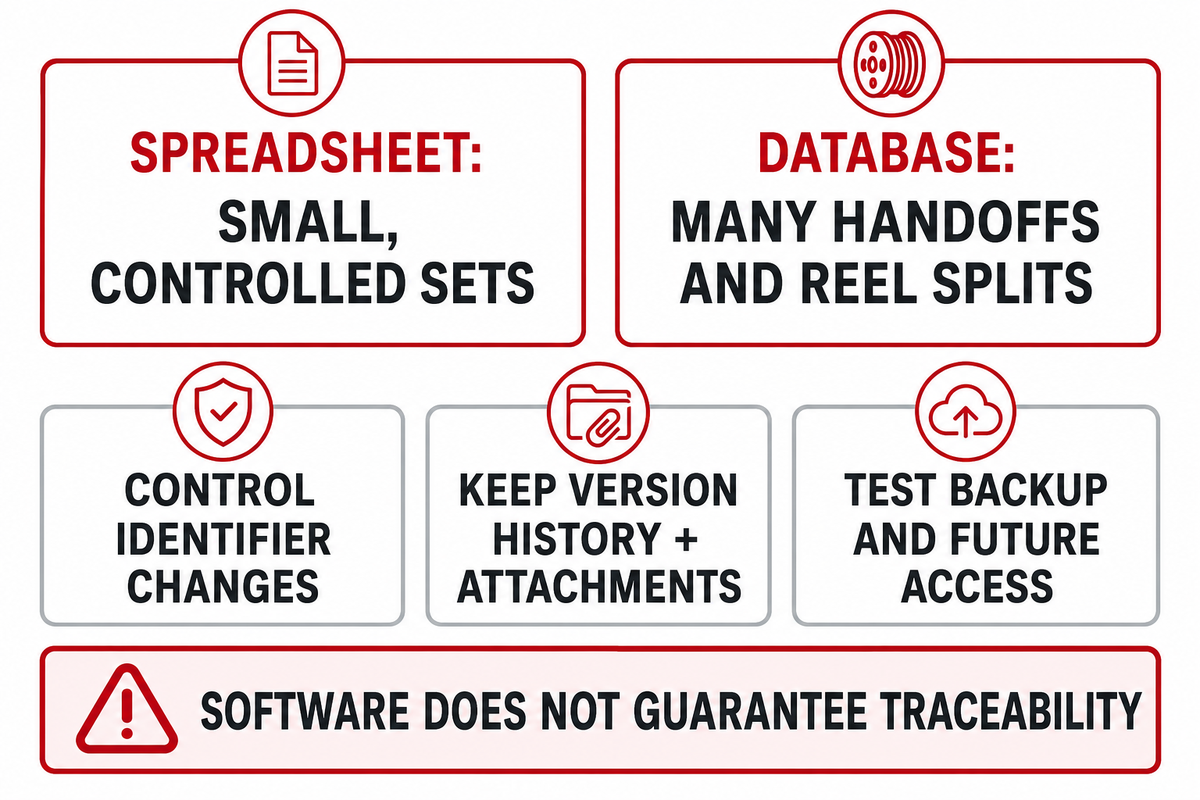
Select a record system based on the relationships, change controls and retrieval tasks it must support. Use spreadsheets for small, well-controlled record sets. Use database-backed management software if many handoffs, numerous reel splits or collaborative editing are needed. Test the actual workflow before deciding that a barcode, portal or electronic platform provides complete traceability.
Depending on its configuration, a laboratory information management system can link samples, test methods and results. Test management platforms can track requirements and test records. Neither system guarantees full traceability throughout the supply chain: the LIMS system needs the related production and reel relationships. Assess LIMS software on this point before acquiring extra modules. (Example LIMS capabilities)
For a controlled record system, specify which persons can create identifiers, modify relationships and authorize changes to address data integrity requirements. Maintain a version history, retain original attachments and separate editing permissions from authorisation for release. Data management should also address backup recovery and access after a staff departure. Such safeguards matter in regulated industries, but this guide isn’t certification of regulatory compliance in those fields.
Zhao and colleagues’ 2024 wire-and-cable study tried an industrial-internet and blockchain architecture. Its configured blockchain experiments averaged about 99.95% transaction success, a measure of those experiments, not cable compliance or the truth of original inputs. Automation and real-time visibility still depend on faithfully recorded events.
Risk-management approaches to quality records should accommodate the “incomplete-record” scenario. A basic example is whether the production traceability system will return a record of a sample even when the account where its record was originally created is disabled. A product traceability system that records raw material traceability but loses the test attachment leaves a gap in traceability and quality review.
Have each stakeholder retrieve the same example reel record using their customary access. Test the results against the master record list index. Good traceability means finding the required evidence and its correct links; elaborate interfaces don’t supply missing evidence. Better traceability needs accessible records; an interface alone doesn’t enhance the evidence. End-to-end traceability links the supplier’s records to onward delivery and project handoff. Review these links against applicable regulatory requirements without treating a complete screen as proof of regulatory compliance.
Digital Traceability Trends: Keep Records Portable
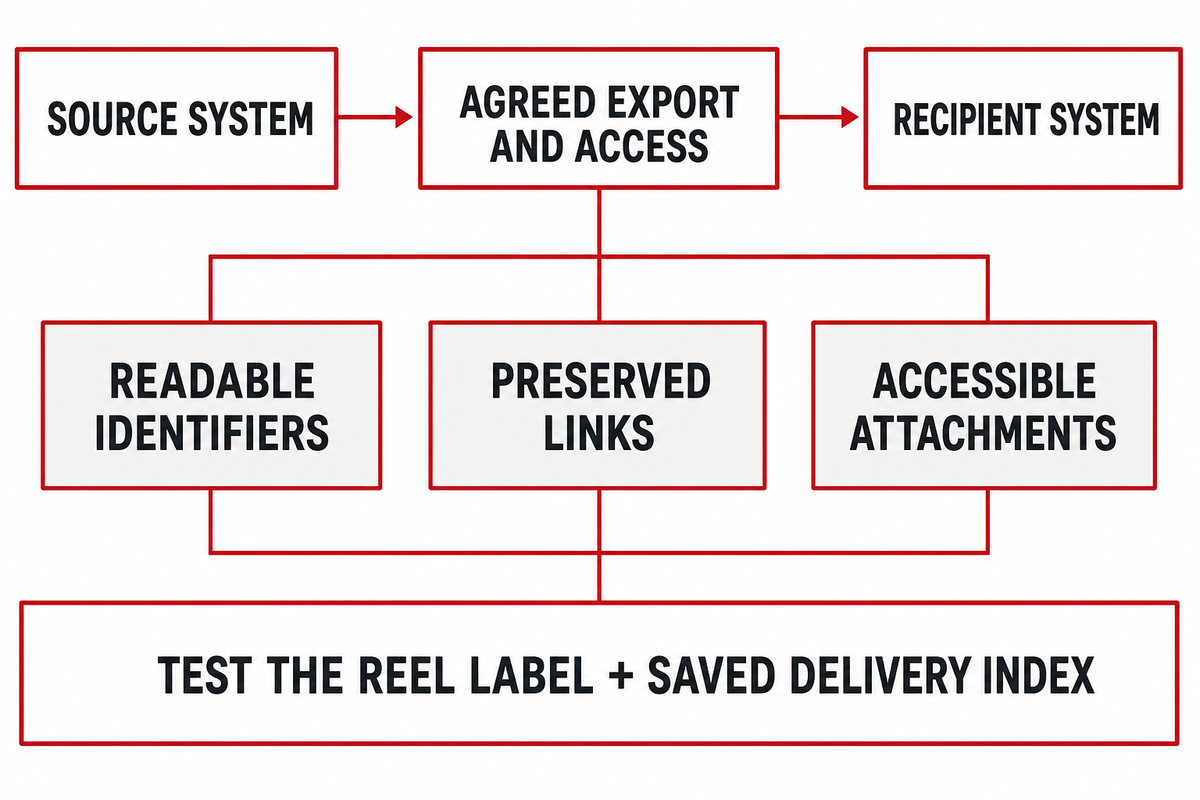
When transferring traceability data to another system, keep readable identifying attributes and links, plus any associated assets. Be sure the group agrees ahead on exporting methods, who can access what and how to handle attachments. Monitor portable traceability systems; see which data features are implemented in the workflows rather than just the software package itself.
GS1’s official overview lists JSON/JSON-LD and REST capabilities for EPCIS 2.0 and links its June 2022 launch announcement.
“Labels connect physical products to the data that supports manufacturing records, quality documentation and component history.”
An example of missing evidence is finding a properly referenced, readable physical label in a receiver’s test evidence pile, while the reel label URL links nowhere. An unavailable file would require an original record holder and an archived test attachment; otherwise, the reel’s identification could lead nowhere. Such a quality risk ought to be examined closely in vendor quality audits.
Ortiz’s article describes the risks of faded or detached labels; this guide separately recommends testing retrieval from both a physically attached reel label and a saved copy of the original delivery index. All exported data is useful only as long as its attachments stay accessible and recipients can resolve identifiers after the original portal closes.
A Receiving Checklist for Quality Records
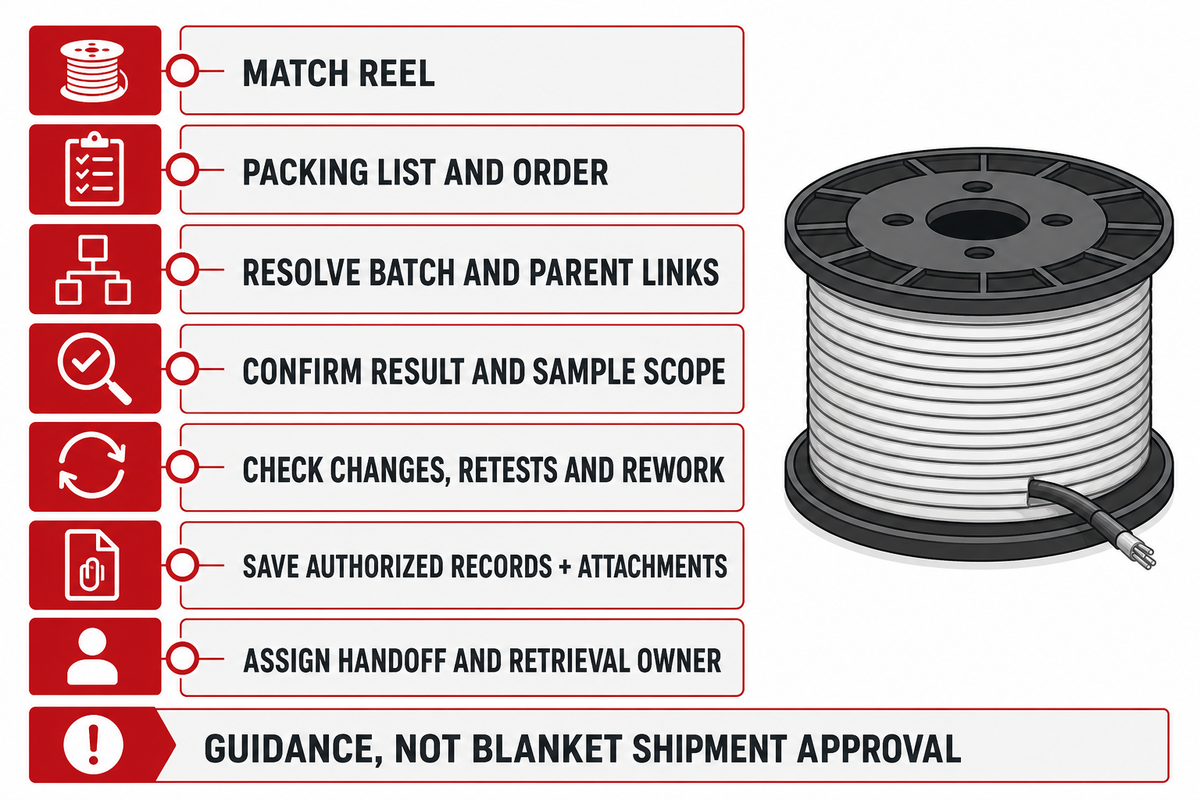
Have the receiver first correlate the delivered physical reel inventory to the evidence index; check any discrepancies or incompleteness before accepting the records as evidence. Check how a specific reel’s evidence matches its lot and what testing it describes; include the project handoff so this information supports inspection and cable installation.
- Match each delivered reel identifier to the packing list and order.
- Resolve the reel-to-batch relationship, including any parent reel.
- Locate the relevant result and confirm its sample scope.
- Identify unresolved changes, retests or rework dispositions.
- Save the authorized record version and its attachments.
- Assign the project/location handoff and future retrieval owner.
Use this checklist as guidance in assessing a shipment’s quality, with the regulatory and contractual provisions already approved by the responsible technical staff; it does not provide blanket approval of the shipment. Review cable certification documentation alongside the shipment-specific records.
Traceable handoffs preserve the relationship between the physical reel, its supporting evidence and its next destination. Missing relationships should remain visible until the responsible team resolves them.
Frequently Asked Questions
What are the two main types of traceability?
View answer
Forward traceability starts with an input, such as a conductor lot, and identifies the production batches, reels and deliveries that used it. Backward traceability starts with a finished reel or reported defect and follows the linked records toward its origin. Both directions depend on recorded relationships. Unique numbers can’t show those relationships unless the records explain how the items connect.
What is QA and QC testing?
View answer
Quality assurance concerns the processes intended to produce consistent work, while quality control checks outputs against defined requirements. For a solar cable order, these activities may include controlled test methods, inspection records and documented release decisions. Traceability connects the resulting evidence to the material or product it describes. It doesn’t replace testing, and a traceable reel can still contain a defect.
Does a certificate replace batch traceability records?
View answer
No. A certificate can describe a product, organization or approval scope, depending on what was certified. It doesn’t automatically identify every reel shipped against a purchase order. Buyers still need the relationships between the offered model, production batch, reel identifiers and relevant release records. Read the certificate scope and request the shipment-specific links before treating the paperwork as evidence for the delivered goods.
How long should solar cable traceability records be kept?
View answer
This guide establishes no universal retention period. Agree on retention and retrieval responsibilities under the contract, project obligations and applicable requirements. Keep the evidence accessible for the agreed period, including after a portal or service provider changes.
Does a barcode prove cable quality?
View answer
No. A barcode identifies or retrieves a record. It doesn’t establish that the cable passed an applicable test, or that the linked record describes the delivered reel.
Review JINYOU Cable’s Quality Testing & Traceability service page with the offered cable construction, reel list and needed delivery documentation, or contact JINYOU about the record pack.
Editorial scope: While we’ve compiled information from official standards-organization pages and a recent study, with an illustrative record example, this doesn’t confirm that operations at any JINYOU facility are approved; these examples aren’t replacements for applicable test procedures. These guidelines concerning evidence examination and reel separation reflect proposed practices, not confirmed standard clauses.
References & Sources
- Metrological Traceability National Institute of Standards and Technology.
- Product Approval vs Type Testing BASEC, 2018.
- EPCIS and CBV GS1.
- IEC 62930:2017 listing IECEE.
- ISO 22095:2020 catalogue and abstract International Organization for Standardization.
- Infinity cables frequently asked questions Australian Competition and Consumer Commission, 2021.
- Wire and Cable Quality Traceability System Based on Industrial Internet of Things and Blockchain Zhao et al., Applied Sciences, 2024.
- Durable Labels: The Overlooked Driver of Product Quality and Traceability Sonia Ortiz, Quality Magazine, 2026.
Related resources
Solar PV cable range · Understanding the test-report pack · Certification evidence · Applicable solar cable standards