Get in touch with JINYOU Cable Company

-
CALL US +86 181 1623 2461
-
EMAIL sales@jinyougroup.cn
1000V DC
ISO Certified
EV DC Charging Cable
1 kV EV DC Charging Cable for Custom OEM Projects
This EV DC charging cable page offers charger manufacturers, engineering teams and sourcing managers a controlled path from a published model to a project-ready cable specification. Jinyou Cable reviews the electrical interface, connector, thermal route, cable length, installation environment and target market before a configuration is deemed suitable.
- Charging station to electric vehicle
- DC fast charging application
- OEM input review
- Response to project enquiries within 24 hours
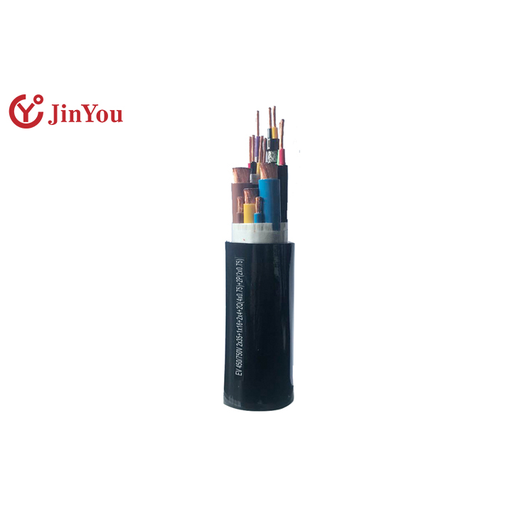
Project Contact at a Glance
Within 24 hours
We respond to project enquiries within 24 hours. This is an enquiry-response commitment, not a completed quotation or production schedule.
Technical review begins by fixing the destination and interface context; the Joint Office connector guidance is one current reference for North American projects.
EV DC Charging Cable Scope
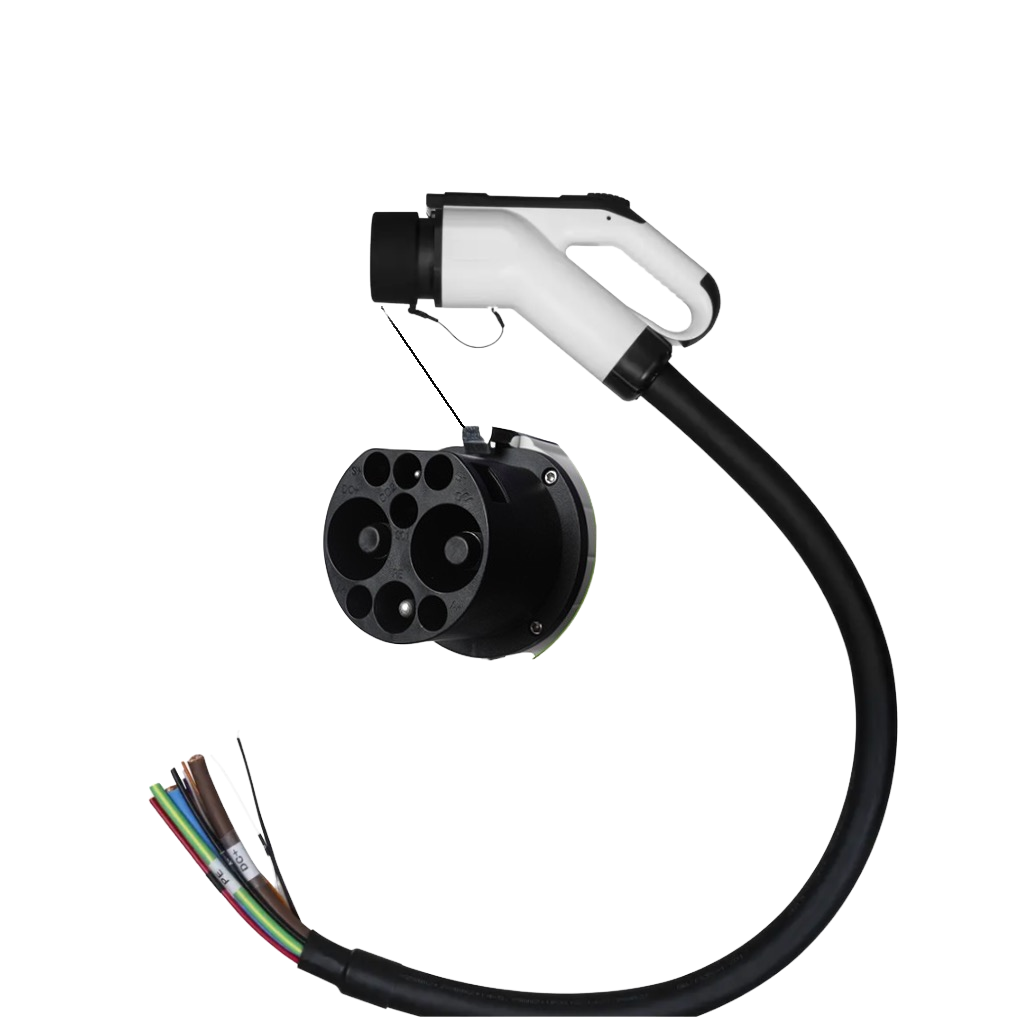
An EV DC charging cable transfers direct current from charging equipment to a vehicle charging inlet. It is not the same product scope as an EV high voltage cable, EV HV cable or automotive high voltage cable installed inside the vehicle between the battery, inverter, motor and other high-voltage components; the two scopes are not interchangeable and should not be conflated.
Charging-equipment side
The review covers how the cable connects to the charging station or charging point, including the free end, panel feed-through, routing, cable-management method and service access. The charger architecture determines which electrical connector and control conductors belong in the assembly.
Vehicle side
The specified vehicle connector, inlet family, target charging standard and market are reviewed together. Type 1, Type 2, CCS1, CCS2 and SAE J3400 refer to different interface contexts; none is assigned to EVDC-RS90S90 until the project record confirms it.
Manufacturing and OEM Capability
Jinyou Cable designs and manufactures cable products for renewable-energy and electric-vehicle applications.
Custom OEM work starts from the buyer’s specification and installation environment.
The published model becomes the basis from which all open electrical, mechanical and market fields are reviewed.
Charging-cable scope stays separate from in-vehicle high-voltage cable scope.
The model number starts the review
A 1 kV rating answers one electrical question. It does not answer charging current, charging power, connector compatibility, cooling, duty cycle, length, bend behavior, weather exposure or the evidence required by the approving body.
Engineering Review
A usable specification connects the electrical path, charging interface and physical installation. The following six groups are reviewed before a DC charging cable configuration is recommended.
Voltage and current
State maximum DC voltage, continuous current, any short-duration current request and the derating logic expected from the charger. A voltage rating is not converted into an amp or high power claim.
Connector and signals
Name the connector family, mating inlet, pin assignment, control pilot or communication requirement, sensor arrangement and any panel-side termination. Attach drawings or controlled part references where available.
Thermal system
State uncooled or thermally managed operation, duty cycle, ambient range, cooling-medium requirements and monitoring or shutdown logic. IEC 62893-4-1 and IEC TS 62893-4-2 are different selection paths.
Cable length and routing
Give the required cable length, exit direction, storage or retraction method, minimum routing space and vehicle-inlet positions to serve. Different charge-port locations make reach a station-layout constraint, while a longer cable adds conductor, thermal and handling demands.
Mechanical environment
Describe repeated flexing, pull, torsion, abrasion, drive-over risk, bend restrictions, connector support and low-temperature handling. Users describe CCS fast-charge cables as heavy and cumbersome, so a flexible handling target should be defined for the real installation and persistent side load on the vehicle inlet should be avoided.
Market and evidence
Name the destination, charging standard, approving party, required test plan and exact document list. A standard reference guides the review; it is not a model certificate by itself.
Reach and handling move together
The trade-off is practical reach versus conductor mass, thermal demand and cable management. The standard fix is to confirm against the furthest vehicle inlet and its real routing path instead of treating length as an isolated preference.
Evdc-Rs90s90
Customization Inputs and DC Cable Requirement-to-Evidence Matrix
This matrix separates published data from project decisions. It allows engineering, procurement and quality teams to identify fixed facts, open decisions and the evidence required to close each decision.
| Review field | Published fact or selection reference | What you send | Review output |
|---|---|---|---|
| Product identity | Evdc-Rs90s90 | Requested assembly and revision | Model-fit statement in the proposal |
| Voltage class | 1 kV DC published rating | Maximum system and charging voltage | Voltage-scope confirmation |
| Published lower bound | -40°C | Minimum storage and service conditions | Temperature-layer clarification |
| Published upper bound | +105°C | Maximum ambient, conductor and connector conditions required | Temperature-layer clarification |
| General EV cable context | IEC 62893-1:2017+A1:2020 | Target standard and edition | Applicable-clause review, not a conformity claim |
| Uncooled Mode 4 path | IEC 62893-4-1:2020 | Continuous current, duty and environment | Uncooled-scope review |
| Thermally managed Mode 4 path | IEC TS 62893-4-2:2021 | Cooling architecture, medium, monitoring and failure response | Thermal-system scope review |
| DC EVSE system context | IEC 61851-23:2023 | Charger architecture and control requirements | Cable-to-EVSE interface review |
| North American interface | CCS1 and SAE J3400 are project choices | Destination, funding rules and mating inlet | Connector path to confirm |
| CCS2 interface | IEC 62196-3:2026 is a selection context | Connector drawing, inlet and approval plan | CCS2 charging assembly review |
PARAMETERS
Quotation Inputs
Price is shaped by cable construction, connector or termination complexity, signal and sensing scope, thermal route, length, quantity, required verification, branding, packaging and destination. The commercial scope is issued against the reviewed configuration rather than a global price list.
| Driver | Why it changes the offer | How to reduce ambiguity |
|---|---|---|
| Electrical duty | Current, duty cycle and allowable temperature rise drive conductor and thermal decisions. | Send the charger output envelope and use profile. |
| Connector assembly | Interface, contacts, sensors, termination and branding change materials and validation. | Send controlled drawings and the mating inlet. |
| Length and management | Length affects conductor use, voltage drop, reach, mass and station routing. | Send a stall layout and vehicle-inlet coverage requirement. |
| Evidence scope | Tests, reports, witness points and market files change the review and production plan. | List required documents by model and approving party. |
| Commercial scope | Quantity, packaging, destination and delivery boundary affect the final quotation. | Include these fields in the RFQ cover sheet. |
Schedule is configuration-led
Availability and timing are confirmed after the technical scope, evidence plan and commercial boundary are clear. The written offer then records the approved configuration, evidence package and applicable commercial terms.
For public-sector procurement context, the GSA EVSE ordering guide illustrates why the equipment, site and support boundary should be defined before an order is released.
×
![Enlarged EV DC Charging Cable]()
Quality Verification
Jinyou’s Shanghai production facility uses automated machinery and testing systems for cable manufacturing. For an EV DC charging cable project, we convert the buyer’s specification into model-linked checkpoints so the drawing, assembly and requested evidence refer to the same configuration.
How the Project is Checked
- Input control records the model, voltage, current, connector, pinout, cable length, environment, thermal route and target market.
- Scope review compares the requested assembly with the published EVDC-RS90S90 record and identifies every open design field.
- Drawing alignment ties connector, termination, routing and identification details to the approved project record.
- Evidence planning defines the requested test, report or conformity object against the exact configuration before it is promised.
- Change control keeps model, drawing and revision references visible so repeat orders can be compared with the approved basis.
Company-Level Capability
The Shanghai operation covers cable design, manufacturing and sales for solar, energy-storage and electric-vehicle applications. Each enquiry receives a review and evidence package tied to the configuration under discussion.
Configuration-Level Proof
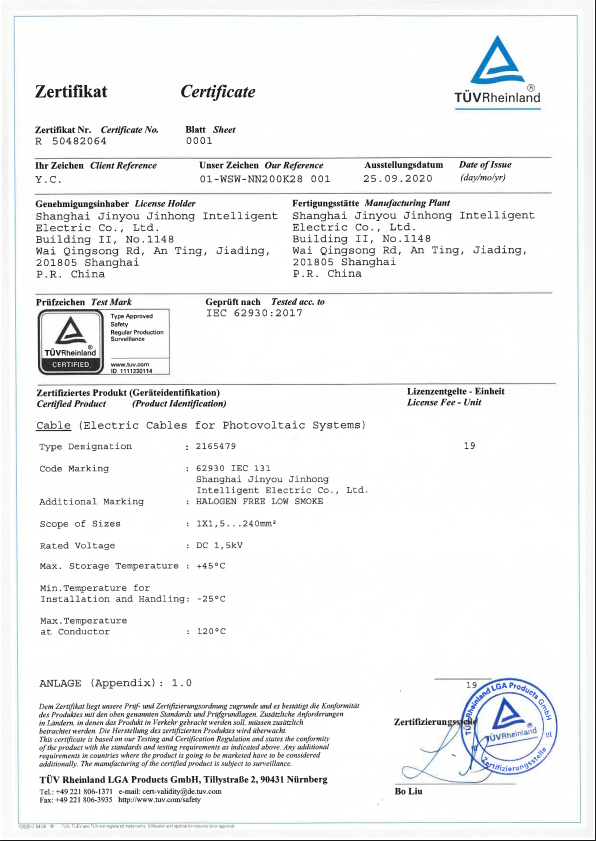
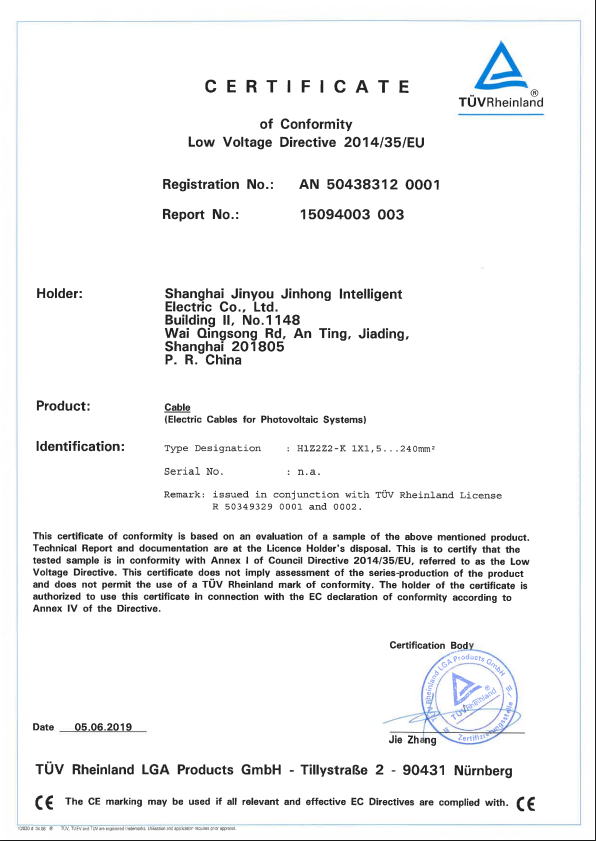
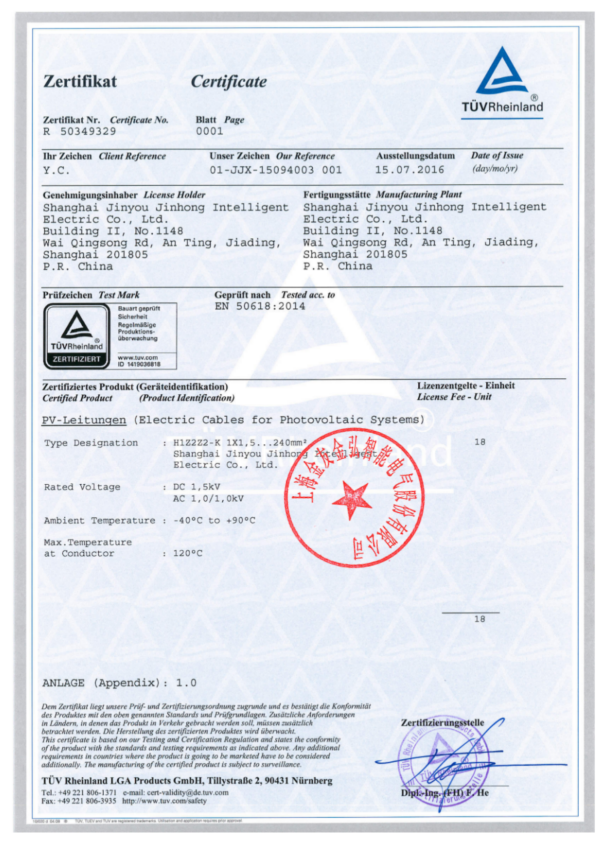
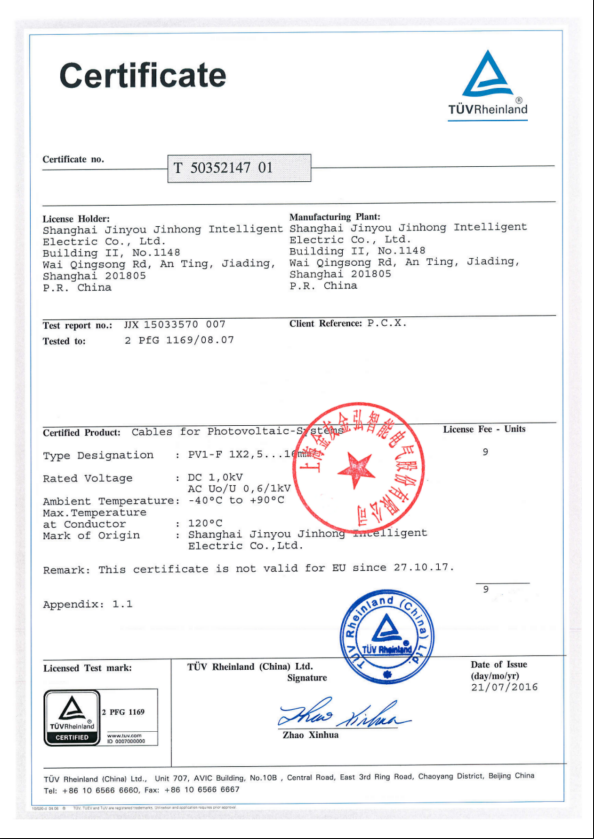
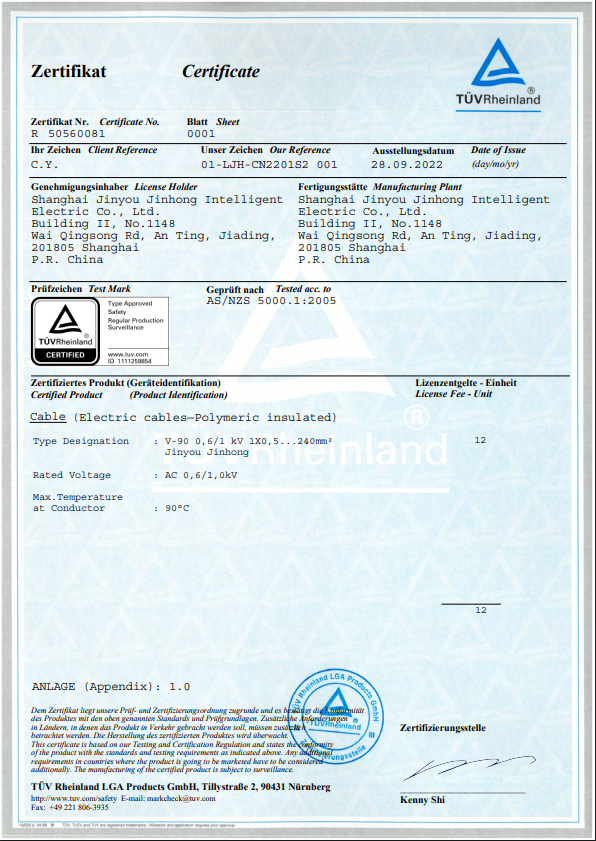
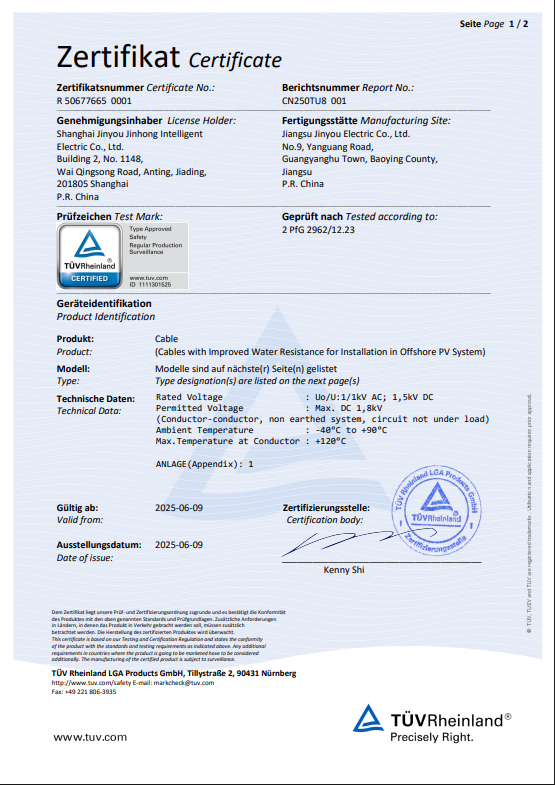
Ask for the exact evidence required for the offered assembly: drawing, specification, test plan, test result or conformity record. Those outputs are scoped in the quotation so a general badge is not mistaken for model proof.
General cable context from IEC 62893-1 is used as a review reference, not as a model-level conformity claim.
❮
Project Review Process
Send the use case. Share the charger, vehicle inlet, target market, maximum voltage, current profile, thermal route, length and quantity.
Close the interface. We review the charging connector, signals, sensors, panel termination and cable-management layout.
Separate fixed and open facts. We preserve the 1 kV published model data and return questions for every unsupported field.
Agree the evidence path. We map standards, tests, reports and approval responsibility to the proposed configuration.
Prepare the scoped offer. We set out included work, open assumptions and the commercial boundary in writing.
Release against the approved record. We use the agreed model, drawing and revision as the project reference.
Fast review starts with a complete brief
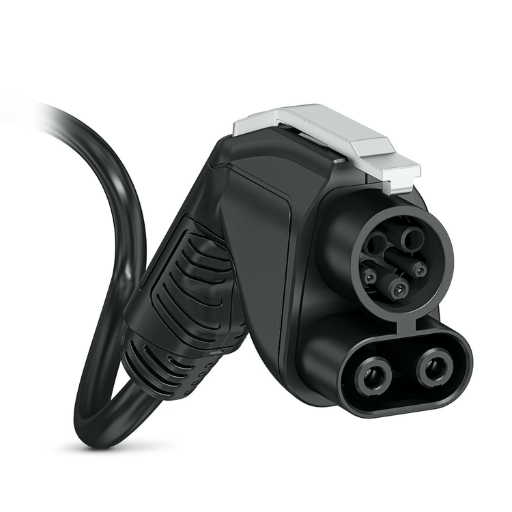
A photo of a plug or the words “DC fast charging” do not define a cable. The RFQ should connect electrical duty, connector, thermal design, physical layout, evidence and commercial inputs in one controlled record.
A public procurement example in the GSA EVSE ordering guide documents equipment, installation and support scope together.
First-Party Product Evidence
- Published EVDC-RS90S90 record
- 1 kV DC rated voltage
- -40°C to +105°C published temperature range
- Listed in the new-energy vehicle cable category
- Separated from the site’s automotive high-voltage shielded power cable listing
EV-focused company context
- Shanghai Jinyou Jinhong Intelligent Electric Co., Ltd was established in 2006.
- The automotive cable division was established in 2017.
- The company describes OEM/ODM EV charging-cable experience.
- The Shanghai facility uses automated machinery and testing systems.
- Jinyou Cable serves partners in more than 40 countries.
Connector, current, cooling, construction and market-specific evidence are tied to the configuration proposed during project review. General scope in IEC 62893-1 remains a selection reference rather than proof that this model holds a particular certification.
Where This Published Model Needs a Different Path
DC 1kV+ Config
| Situation | Why the 1 kV record is not enough | Next action |
|---|---|---|
| System duty above the published 1 kV DC rating | The requested voltage sits outside the stated model value. | Use a separately reviewed cable family and evidence set. |
| Thermal management is required | An uncooled cable path and a thermally managed path use different system assumptions. | Define cooling, sensing, fault response and IEC TS 62893-4-2 context. |
| Connector family is mandatory | A shared voltage is not necessarily a shared interface; CCS1, CCS2, Type 1, Type 2 and J3400 are not interchangeable labels. | Send the mating inlet and target-market requirements for confirmation. |
| The application is inside the vehicle | Battery-to-inverter or motor power wiring belongs to automotive high-voltage cable scope. | Route the enquiry to an EV high voltage cable sibling page. |
| Only a longer cable is requested | Extra reach changes mass, voltage drop, thermal behavior and station management. | Review length with current, layout, duty cycle and handling. |
EV DC Cable Engineering & Planning Tools
EV DC Cable RFQ Readiness Scorecard
Check whether your brief contains the inputs needed for a useful engineering review. The score measures input completeness only; it does not approve a cable configuration.
Access Tool →
EV DC Cable Thermal Scope Selector
Use declared cooling intent and duty timing to identify the review path. This selector is a scoping aid, not an ampacity calculation or a conformity decision.
Access Tool →
EV DC Cable Length Review
Build a planning length from your measured route and chosen service allowance. The result supports an RFQ discussion; it is not a final cable length, bend-radius or voltage-drop approval.
Access Tool →
EV DC Charging Cable FAQs
What is the difference between an EV DC charging cable and an EV high voltage cable?
The DC charging cable connects charging equipment to the vehicle inlet during charging. An EV high voltage cable or automotive high voltage cable is generally part of the in-vehicle power circuit between the battery and high-voltage components.
Does the 1 kV rating make EVDC-RS90S90 suitable for every fast charger?
No. The 1 kV DC rating does not define current, charging power, connector, duty cycle, thermal route, length, environmental exposure or market approval.
Is -40°C to +105°C an operating-temperature rating?
Jinyou publishes that temperature range but does not define its measurement layer on the source page. Treat it as a published range until the project document states whether it refers to storage, ambient, conductor, jacket, connector or another condition.
How is an uncooled cable separated from a liquid-cooled EV charging cable?
IEC 62893-4-1 addresses Mode 4 DC cable without thermal management, while IEC TS 62893-4-2 addresses cable intended for a thermal-management system. Cooling architecture, monitoring and failure response must be part of the charger-level review.
Is CCS2 the same as a Type 2 charging cable?
No. Type 2 is widely associated with an AC charging interface, while CCS2 adds DC contacts for Combined Charging System fast charging. The exact connector and inlet still need project confirmation.
Should a U.S. project specify CCS1 or SAE J3400?
Specify the destination, vehicle fleet, mating inlet and any funding rule. Joint Office guidance describes a transition in which federally funded DCFC can include J3400 while retaining the CCS1 minimum requirement.
Is a longer cable always better for a charging station?
No. A longer cable is not always the better cable: reach matters across varied charge-port locations, but extra length also changes conductor use, voltage drop, mass, thermal behavior and cable management.
Why can a fast-charge cable feel heavy or stiff in cold weather?
One winter account reports that cold conditions made alignment materially harder. High-current conductors, insulation, shielding, cooling content and connector hardware add mass, while material flexibility changes with temperature.
What should be included in an OEM RFQ?
Send maximum voltage, current profile, duty cycle, connector and pinout, thermal route, cable length, station layout, environment, quantity, target market, branding and required evidence. The scorecard checks these fields before submission.
Does “within 24 hours” mean a completed quotation?
No. Jinyou responds to project enquiries within 24 hours; a completed quotation depends on the specification and the open questions that must be closed.
Can Jinyou customise an EV charging cable?
Jinyou provides custom OEM services and reviews special installation requirements. The proposed connector, construction, branding and validation scope still need written project confirmation.
Which documents should a buyer request?
Request the exact drawing, specification, test plan, test result or conformity record needed by engineering and QA. The quotation should identify which objects apply to the offered model and revision.

