Get in touch with JINYOU Cable Company

-
CALL US +86 181 1623 2461
-
EMAIL sales@jinyougroup.cn
Photovoltaic Cable for 1000 V DC Solar Power Systems
DC 1000 V system fit
-40°C to 90°C operating range
1–2 m sample option
500 m custom minimum
We provide photovoltaic cable for solar DC paths where engineers require a known voltage route, environmental compatibility and a quotation-ready documentation set. This page begins with the old-specification values, then shows the checks we perform before a custom order is released.
Your drawing, marking and packing instructions remain with the quotation record; request a confidentiality agreement when your project warrants one.
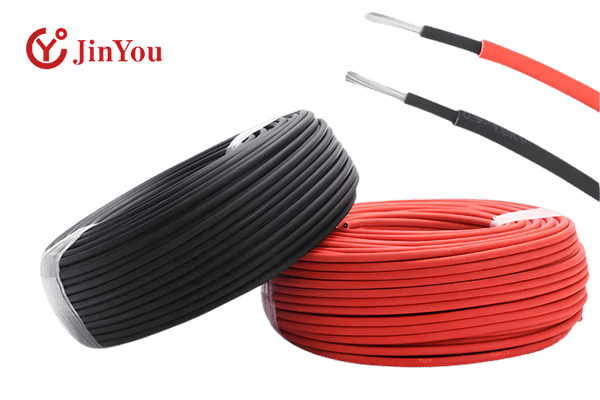
Specifications
System voltage
DC 1000 V
Between conductors
DC 1800 V maximum listed value
Operating range
-40°C to 90°C
Custom minimum
500 m per specification
Sample
1–2 m; shipping billed to buyer
Schedule
15 days after drawing approval
SYSTEM SPECIFICATION
Photovoltaic Cable for Solar DC Connections
Our engineers assemble cable configurations for the DC path between photovoltaic modules, string gear and inverters. Your route length, current, installation method and mating connector determine the terminated conductor and jacket choice.
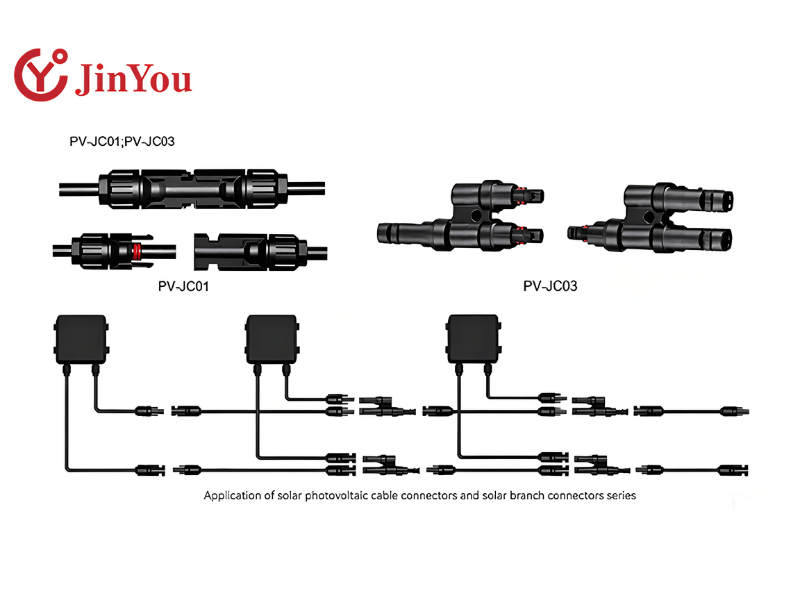
PV wire and photovoltaic wire connect a solar panel to the wider solar PV wiring path. For solar applications, the direct current route may call for copper, stranded copper or another copper conductor specified by the project; we confirm that choice rather than assume it.
01
Array and string routing
Polarity, route exposure, bend points and connector interfaces are reviewed for rooftop, ground-mount and carport layouts.
02
OEM project supply
The approved drawing and marking schedule become a controlled production and inspection record.
03
Installation-fit review
Before a quotation is confirmed, our engineers ask whether the cable is in conduit, direct-buried, exposed to salt air or paired with a specified connector.
04
Documentation handoff
The agreed product description, test references, packing instruction and shipment identification travel with the order record.
Reliability starts at the route
Sunlight, UV radiation, moisture, ozone, extreme temperature and high temperatures are exposure inputs, not marketing labels. A high-quality, sunlight-resistant solar cable selection keeps those inputs visible in PV systems, wiring and the inspection record.
“A photovoltaic cable is only a fit when its rating, environment and interface match the project route.”
PROCESS VERIFICATION
Cable Construction Inputs for OEM Projects
Conductor, insulation, finished diameter, marking and termination requirements are verified from your drawing or specification. When an RFQ names EN 50618 or another family, our team keeps that route explicit instead of re-selecting a material family because two product names are similar.
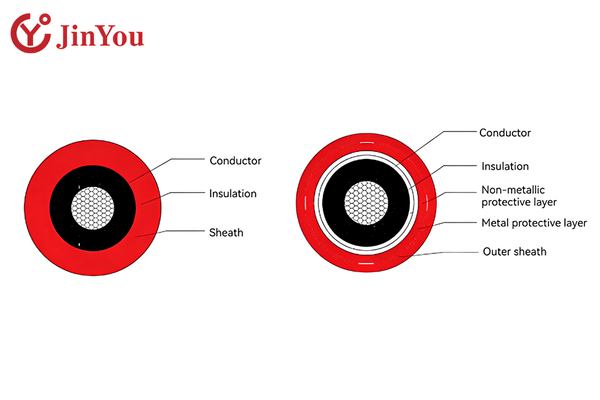
Seven-field RFQ input matrix
- 01 Target standard and certificate family
- 02 System voltage and polarity
- 03 Conductor size and route length
- 04 Installation environment and fastening method
- 05 Connector, lug or termination interface
- 06 Marking, colour and identification sequence
- 07 Packing, reel and shipment requirements
PROJECT SPECIFICATIONS
Identification, Packing and Project Requirements
The approved voltage sequence is printed and the packing instruction remains with the order. The marking record states whether EN 50618 or another family was requested; printed fields are not added without drawing approval.
Marking control
Printed text, spacing and length sequence are compared with the approved drawing before release.
Reel and length control
Our production record captures the requested reel or coil format and flags any change before shipment.
Document control
The specification, inspection record and packing list remain aligned to the quoted configuration.
Buyer checkpoint
Send the connector outer diameter, bend points and route method with the drawing. Those details prevent a technically correct cable from becoming a field-fit problem.
Electrical and Environmental Specifications
The values below are transcribed from the customer-hosted legacy product page. At quotation, our engineers verify the applicable family, duration and test scope; the table is not a blanket approval for all markets or installs.
| Parameter | Legacy product value or reference | Quotation check |
|---|---|---|
| Rated voltage | 0.6/1 kV AC; DC 1000 V | Match system and market requirement |
| Maximum between conductors | DC 1800 V | Confirm route and insulation family |
| Operating temperature | -40°C to 90°C | Confirm ambient and installation method |
| Maximum conductor temperature | 120°C | Confirm duration and calculation basis |
| Insulation resistance | ≥ 10^14 Ω·cm at 20°C | Confirm report format |
| Test voltage | AC 6500 V / 5 min, no breakdown | Confirm test record for quoted family |
| Minimum bending radius | 5D | Check connector and route bend points |
| Short-circuit temperature | 250°C for 5 seconds | Confirm fault-study assumptions |
| Flame reference | EN 60332-1-2 | Route to required standard family |
| Weathering reference | HD 605/A1 | Confirm environmental qualification |
| Expected service life | 25 years listed on legacy page | Confirm basis for the quoted configuration |
Why the standard family still matters
IEC 62930:2017 describes a family of single-core cross-linked DC photovoltaic cables up to and including 1.5 kV between conductors and earth. Its publication page also states a 90°C normal continuous conductor limit and a restricted 120°C use condition; those standard-scope values do not replace the product-specific quotation check.
Environmental qualification
NREL’s 2025 cable-jacket comparison found that durability varies with base material, formulation and jacket colour under combined accelerated stress. The quotation therefore asks for environmental exposure, colour and qualification records instead of assigning one universal service-life number.
Pricing, Samples and Lead Time
Cost follows the approved build, materials, cross-section, length, marking, packing and testing scope. A system-level DOE cost barometer can inform route and maintenance factors, but it is not a cable price or savings guarantee.
Custom minimum
Our custom-specification minimum is 500 m.
Sample policy
A 1–2 m free sample is provided; shipping is billed to the buyer.
Schedule
Small-batch orders ship in 15 days after drawing approval. Production runs are scheduled at 15 days, confirmed with your quotation.
Quote inputs that prevent rework
- 01 Target standard and certificate family
- 02 System voltage, current and route length
- 03 Installation environment and connector interface
- 04 Sample length, marking and packing sequence
Production and Test Controls
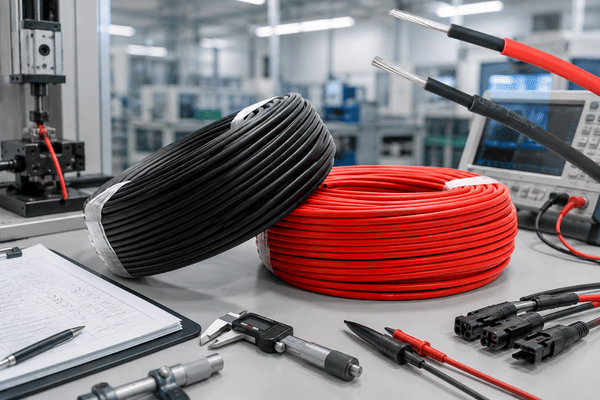
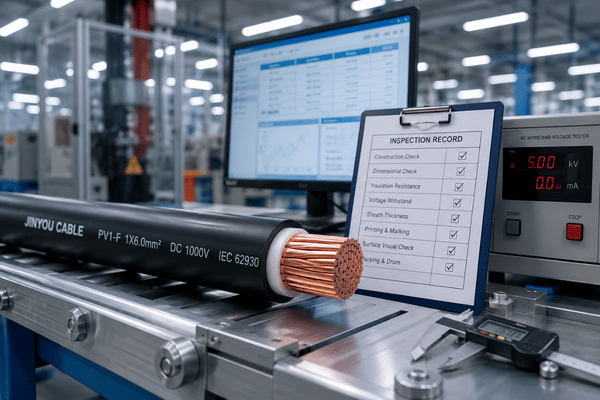
Production is released only when the drawing, product family and marking record are aligned. Inspection and documentation verify that the quoted cable is traceable; a process statement is not a product certificate.
01
Pre-production review
The approved construction, standard route, sample requirement and packing instruction are confirmed before scheduling.
02
In-process controls
Conductor, insulation and finished identification are compared against the approved order record during production.
03
Electrical checks
Our quality record aligns the requested insulation, withstand and short-circuit test references with the quoted family and report format.
04
Interface checks
Conductor cross-section, outer diameter and mating connector details are verified because “compatible” names do not prove an approved connection.
Because cable failure is route-specific, the test report is verified with IEC 62930:2017 scope and the approved drawing before release.
SolarPower Europe’s procurement guidance warns that product data alone is insufficient; supplier qualification, production review and cabling interface checks belong in the acceptance plan. EPC Best Practice Guidelines
Undersized cross-sections, inferior weathering/sheathing and mismatched connectors are preventable controls, not unavoidable on-site headaches. Proper cable management can avoid safety and performance issues like power loss, electric faults or inverter shutdown.
PROCESS ARCHITECTURE
OEM Project Workflow
The RFQ route is short enough that a project team can review and detailed enough to reveal route, interface and construction risk before production. EN 50618, IEC 62930, UL 4703 and project-specific routes remain separate entries in that review.
01
Requirements review
The engineering review covers system voltage, target standard, conductor size, environment and connector information.
02
Sample and specification confirmation
We return the product description, marking and sample plan for approval.
03
Controlled production
The agreed quantity is scheduled with inspection and packing instructions retained in the order record.
04
Inspection and document confirmation
We align the release record with requested test references and shipment identification.
Project handoff
For commercial, industrial or utility projects, include cable management and commissioning records with the wider IEC 62446 documentation set. Keep the wiring schedule with that handoff; the cable quotation should be one input, not a replacement for system commissioning.
CORPORATE IDENTITY
Jinyou Product and Manufacturing Proof
Jinyou Cable is the trademark of Shanghai Jinyou Jinhong Intelligent Electric Co., Ltd. The company-owned legacy pages show a Shanghai address, a firm working on renewable-energy-related cables and electrical systems, automated production machinery, testing systems and unique OEM cable services.
Our proof boundary is intentional: family-specific certificate files and product-page labels are verified against the quoted build. This page does not present a generic TUV, RoHS, IEC 62930, EN 50618, H1Z2Z2-K, PV1-F or UL 4703 proof for the generic product name.
Established base
Founded in 2006 in Shanghai, China.
Renewable-energy scope
Design, manufacture and sales of high-performance cables and integrated electrical systems for renewable-energy applications.
Export experience
Products are supplied to more than 40 countries, subject to the buyer’s destination requirements.
SYSTEM QUALIFICATION
Specification Boundaries and Product-Family Routing
Use this page when the project starts with the listed DC 1000 V photovoltaic cable values and needs a quotation review. Route the requirement to a separate family check when the specification names a different voltage, standard, certificate or installation qualification.
Project requirement
What this page establishes
Next action
DC system: 1000 V
The customer-owned product record gives DC 1000 V and DC 1800 V between conductors
Send voltage, current and route
H1Z2Z2-K, PV1-F, IEC 62930 or UL 4703
Family-specific matching is required
Request the matching family and scoped file
1500 V or 2 kV request
Not inferred from the 1000 V page
Request a separate product selection
Underground, coastal or floating route
Application qualification adds requirements
Provide soil, salt-air or water-exposure conditions
Routing rule
IEC 62930 scope, EN 50618 family language and UL 4703 terminology are not interchangeable labels. The buyer’s requested market standard is mapped to the product-family record before quoting.
When the route calls for a specialized family, compare the PV control cable selection or the offshore photovoltaic cable route before sending the final specification.
Some project schedules list 600V PV wire, 1kV or 2kV cable, AWG sizing, grounded and ungrounded photovoltaic power systems, or regular cables as comparison terms. Those labels describe a routing question; they do not change the evidence on this DC 1000 V page.
The wrong choice of product family is not always visible in the catalogue title, so the standard and interface check comes before a purchase order. A cable label is not a substitute for route evidence.
ENGINEERING UTILITIES
Photovoltaic Power System Cable Tools
PV Cable Bend Radius Check
Verify installation limits to prevent conductor strain and insulation damage during routing.
Access Tool
PV Cable Route Length Check
Calculate route feasibility and verify precise material requirements against site drawings.
Access Tool
PV Voltage Drop Check
Ensure system transmission efficiency remains within strictly accepted operational voltage limits.
Access Tool
FINAL SPECIFICATION CHECK
Send Your Cable Specification
Send the seven RFQ fields—standard, voltage, conductor size, route length, environment, termination and marking/packing. Our quotation team will return the product-family route, sample plan and quotation inputs.
Include your target delivery date and destination when they affect the project schedule.
KNOWLEDGE BASE
Photovoltaic Cable FAQs
How should buyers read the DC 1000 V and DC 1800 V values?
They are separate legacy product-page values. Send the system voltage and the project’s standard, including whether it names EN 50618 or another family, so we can confirm which value and test record apply.
Can this photovoltaic cable be used in conduit or direct burial?
Installation method changes the qualification question. Tell us whether the route is in conduit, direct-buried, rooftop, coastal or another exposure so the quoted family can be checked.
Does a connector with the same name prove compatibility?
No. The check covers conductor cross-section, outer diameter, contact area, seal fit and the approved mating combination.
What sample and minimum order should procurement plan?
Our custom-specification minimum is 500 m. A 1–2 m free sample is provided with shipping billed to the buyer.
How is the 15-day timing applied?
Small-batch orders ship in 15 days after drawing approval. Production runs are scheduled at 15 days and confirmed with your quotation.
What installation concerns should the RFQ include?
Installers discuss wire sizing and hidden installation cost in snippet-only threads. Include route length, environment and connector details so those concerns can be checked before release.
Is the 25-year service-life value a universal guarantee?
No. The 25-year value is listed on the legacy product page; the basis and applicable configuration must be confirmed for the quotation.

