Get in touch with JINYOU Cable Company

-
CALL US +86 181 1623 2461
-
EMAIL sales@jinyougroup.cn
JINYOU Cable, New Energy Cable Manufacturer in China
Shanghai Jinyou Jinhong Intelligent Electric manufactures cable for four energy currents: the direct current side of solar plants, the direct current bus in energy storage systems, the charging & vehicle internal circuits of electric mobility, and the power and signal runs of industrial cables. We principally sell to importers, distributors, engineering contractors and equipment builders.
They specify the cable before they choose the supplier. From the circuit, cross section, core configuration, and destination, our engineer sends a specification and a price.
Request a Quotation
Drawings and specifications you send are treated as confidential and are used only to prepare your quotation.
Specifications
- Quotation turnaround Within 24 hours
- Sample lead time 7 to 15 working days on the solar lines
- Production lead time 10 to 25 working days
- Minimum order None on stocked constructions; made-to-order from 100 to 200 m per type
- Trade terms FOB and CIF from a Chinese port
- With every shipment Certificate of origin, packing list, the factory test report for the shipped lot, and copies of the product certificates
These Energy Currents We Build Cable For
New energy is not one cable. Solar energy alone runs four different circuits between the generation of electricity and the grid, and storage, charging, and industrial equipment each add their own load. The construction of cables for renewable energy sources differs with the current the cable carries, not with the industry label on the project.
Solar & PV Cables
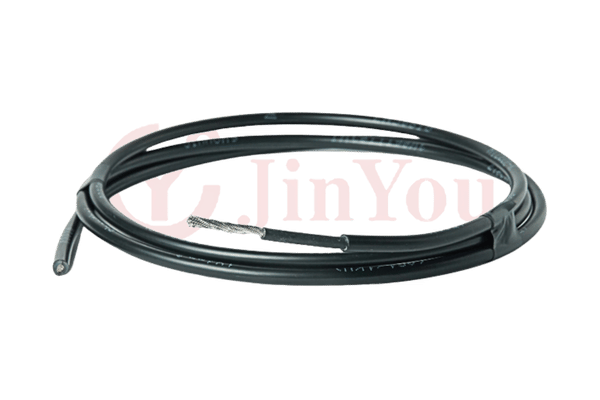
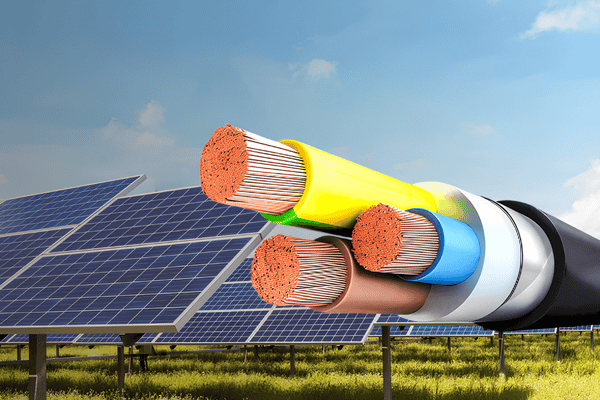
Ten photovoltaic lines covering the array direct current, earthing, control and the alternating-current side, from 0.5 to 240 mm². This is the line our three published certificates cover.
Energy Storage Cables
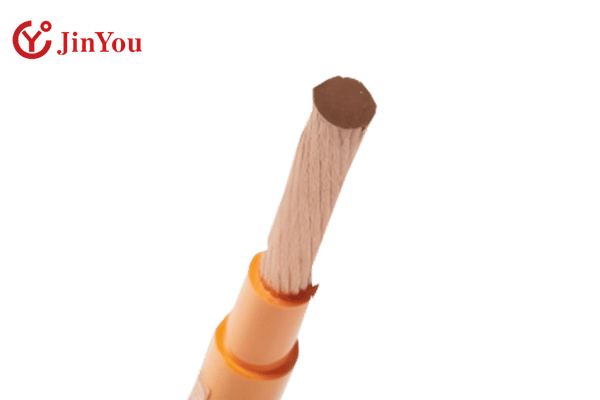
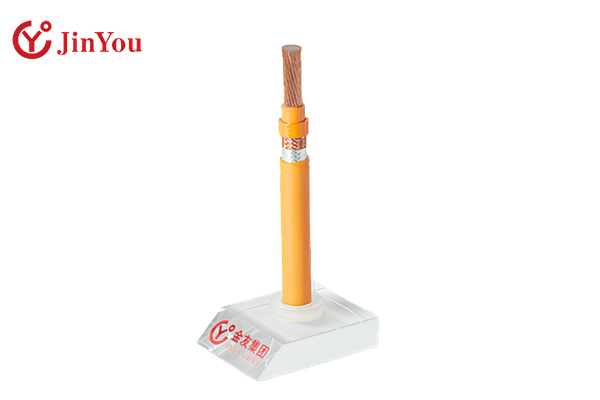
Flexible direct-current bus cable for battery enclosures and containerised systems, with Class 5 conductors to IEC 60228 and low smoke zero halogen sheathing. Send the bus voltage, continuous current, bend requirement and enclosure fire rating.
EV & Charging Cables
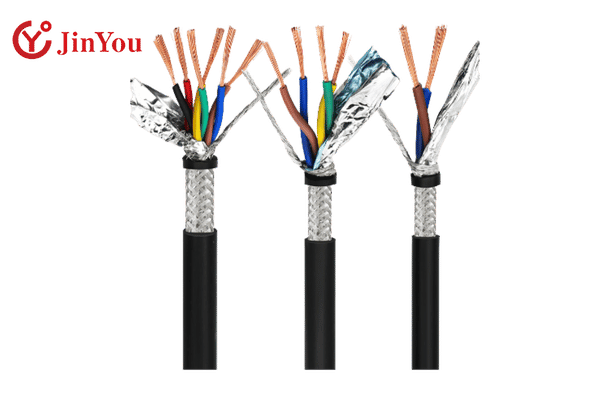
Alternating current (AC) and direct current (DC) charging assemblies for the charging equipment and the vehicle along with internal high-voltage and automotive cables. Four lines, quoted against your interface, voltage, current and length.
Industrial & Special Cables
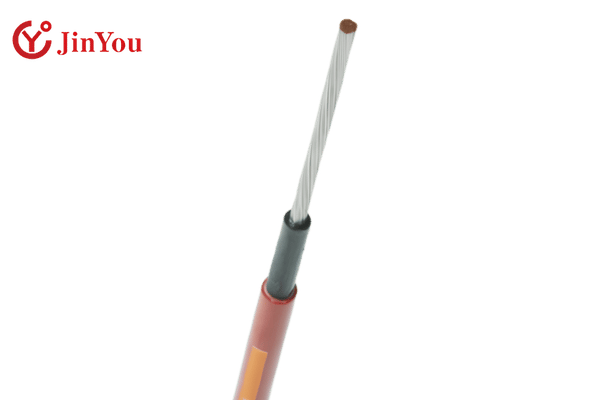
Six families built to the construction you specify: robot and energy-chain cable, screened instrumentation cable, variable frequency drive cable, motor lead wire, self-regulating heat tracing tape and building wire.
Quality, Testing & Compliance
The route from a standard named in your specification to an approval file your project owner will accept: document identity, production continuity, test reports and the certificate request path.
Applications & Solutions
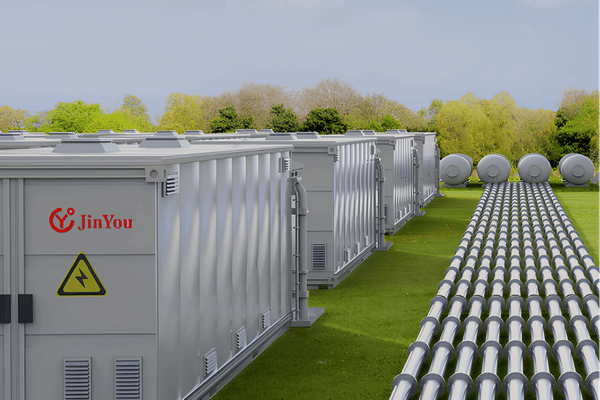
Selection by project type rather than by product code, covering utility-scale ground mount, rooftop, floating arrays and building-integrated photovoltaics.
| Current and circuit | What decides the construction | Standard family | Our line | Detail |
|---|---|---|---|---|
| Array direct current, module string to combiner | 1.5 kV DC, sunlight and heat exposure, single or twin core | EN 50618 and IEC 62930 | H1Z2Z2-K solar cable | Specification |
| Array direct current, superseded designation still written into tenders | Printed rating 600/1000 V AC, designation status matters more than construction | PV1-F | PV1-F solar cable | Specification |
| Direct current, combiner to inverter | Longer runs and larger cross-sections at 1000 V DC | IEC 62930 | Photovoltaic power system cable | Specification |
| Earthing and bonding | Below 450/750 V AC, insulated copper, frames and racking | Application bound | PV grounding cable | Specification |
| Monitoring, tracker and signal | 450/750 V, 2 to 61 cores, shielding decided per circuit | Application bound | PV control cable | Specification |
| Alternating current, inverter to grid | 0.6/1 kV and 1.8/3 kV, copper or aluminium alloy conductor, handing over to electric power distribution at the point of connection | Application bound | PV power cable | Specification |
| Storage direct-current bus | Flexible Class 5 conductor to IEC 60228, low smoke zero halogen sheath inside enclosures | Conductor class per IEC 60228 | Energy storage cable | Send your duty |
| Charging equipment to vehicle | Repeated flexing, interface and current defined by the charging standard | IEC 62893 family | EV charging cable | Specification |
| Vehicle-internal high voltage | Different buyer and different qualification route from external charging cable | Automotive qualification | EV high-voltage and automotive cable | Specification |
| Industrial power and signal | Motion, chemical exposure, drive noise or heat, all built to your drawing | Drawing bound | Robot, instrumentation, drive control, motor lead, heat tracing and building wire | Specification |
Destination market is the axis that costs projects money. A European certificate does not decide what an Australian, Japanese or North American project owner will accept, and in North America the same product is called PV wire and needs a listing we do not hold. The boundaries table further down sets out which routes we can answer and which we cannot.
Renewable Energy Applications
The same four currents reappear across every renewable energy application we supply, which is why the cable is specified by circuit rather than by project type. Rooftop arrays and utility-scale solar power plants differ in scale, not in the standards their direct-current runs answer to.
- Photovoltaic power stations on the ground, from the solar panel string through the combiner to the inverter
- Rooftop and building-integrated photovoltaic arrays
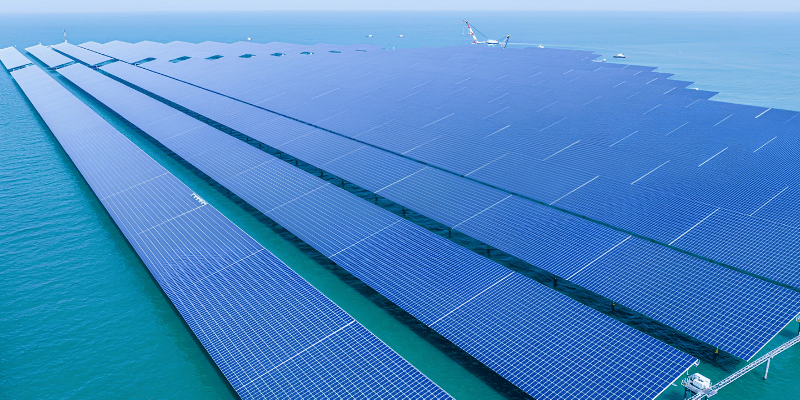
- Floating and near-shore arrays
- Battery energy storage systems installed alongside generation, and standalone grid-support storage
- Charging equipment at depots, forecourts and workplaces
- Industrial plant where the same cable families run motion, instrumentation and drive circuits
Where This Sits in the Wire and Cable Industry
Renewable Energy Cable is a new area in the wire and cable industry and has developed standards after most manufacturing plants already had Low Voltage Electrical Cable. Suppliers can therefore hold a long record in general electric power transmission and still be new to the direct-current side of an array, where a low-voltage habit becomes a 1.5 kV direct-current problem. Our cable solutions were built for the renewable side first rather than adapted from low-voltage practice, running from the string through to the point where the power joins the electrical grid and the wider power grid beyond it.
Circuits We Supply Most Often
- Module string and array direct-current for ground-mount and rooftop installations.
- Combiner-to-inverter direct-current feeders on utility-scale sites
- Earthing and bonding of frames, racking and enclosures
- 2 to 61 core tracker, monitoring and signalling cables.
- Inverter-to-grid alternating-current runs in copper or aluminium alloy
- Battery direct-current bus wiring inside storage enclosures
- Charging leads between charging equipment and the vehicle inlet
- Vehicle-internal high-voltage power paths
- Screened instrumentation and control circuits, energy chains, and axes
Conductor, Insulation and Sheath Systems
A cable’s construction defines and earns its rating. Construction quality is sometimes the first to be sacrificed when a supplier is trying to meet lower prices. The following measurements are all construction commitments we have made, and each is measurable when delivered.
Conductor
| Standard | Copper to IEC 60228, which fixes the nominal cross-section and the maximum conductor resistance for each class |
| Conductor class we build | Class 5 stranded copper at the modules, where the run has to flex; Class 2 where the installation is fixed |
| Coating | A continuous tin coating is mandatory under IEC 62930, so tinned copper is a requirement rather than an upgrade |
| Aluminium option | Aluminium alloy is available on the alternating-current line, where copper content dominates cost |
| Sizing language | Metric cross-section is the ordering basis; American wire gauge equivalents are given alongside it so a copper conductor can be compared across both systems |
| What it lets you check | Maximum electrical conductor resistance at 20 °C is the one field that exposes an understated cross-section |
Insulation and sheath
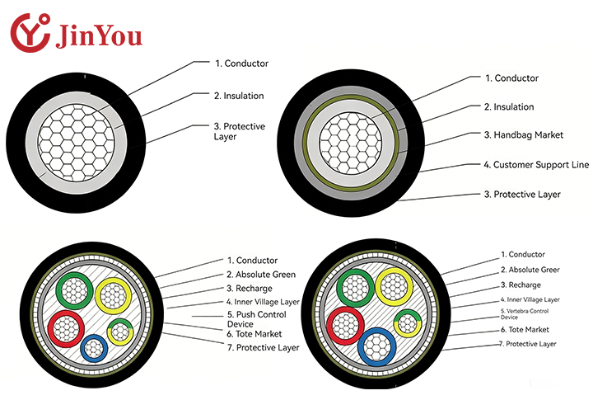
| Layers | Two cross-linked layers, insulation and sheath, which allows use with Class II equipment as defined in IEC 61140 |
| European route | Halogen-free low smoke only, under EN 50618 |
| International route | IEC 62930 admits halogen-free low smoke constructions and constructions that can contain halogens |
| Temperature | 90 °C normal continuous maximum conductor temperature; 120 °C permitted for a cumulative 20 000 h |
| Exposure | Resistant to sunlight, moisture, ozone and extreme temperature, outdoors for the design life of the plant |
Exposure the sheath has to survive
- Ultraviolet light and direct sun light, constantly, for the length of time the array is projected to be in service, are the first things to age an inadequate jacket.
- Abrasion from sand, vegetation management and installation handling
- Moisture, including direct burial, where the route trades UV exposure for permanent contact with wet ground.
- Ozone and extreme temperature swing
- Movement and flexing on floating arrays and on charging leads.
These are the primary design factors, and they decide the construction more than the nameplate voltage does. When such conditions are known, the design response tends to be a construction rather than a catalogue number.
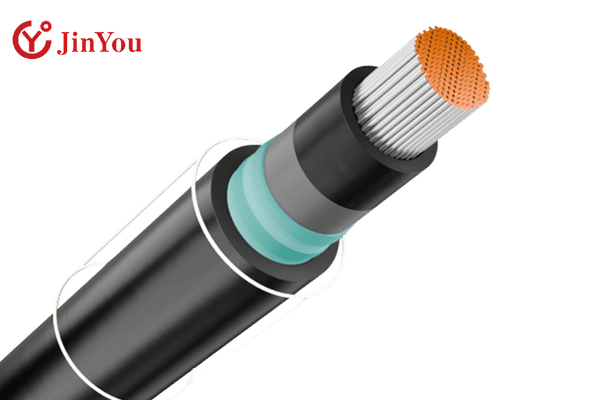
Why ordinary building wire cannot stand in
Building wire is rated differently from Renewable Energy Cable. It is polyvinyl chloride (PVC) insulated and rated at 450/750 V for alternating current.
It is not sunlight resistant and is not rated for a 1.5 kV direct-current array. Substituting this cable is the most expensive shortcut on a solar site, because the failure becomes evident after the project is commissioned.
Another construction
If none of the ten lines matches your circuit, send the cross-section, core configuration, voltage class and the destination market. We build to customer drawings and confirm feasibility and price in the quotation.
Marking, Packing and Drum Planning
Two factors affect whether a shipment installs cleanly: whether the printed marking on the cable is the one the inspector expects, and whether the drum lengths match the runs on your site. Both are settled in the quotation, not after loading.
Send length per colour instead of a single total. That one line in an enquiry eliminates the most frequent revision cycle in a cable order.
| Item | What we supply | Why it decides acceptance |
|---|---|---|
| Cable surface marking | Designation, standard reference and rating printed on the sheath | Site inspectors read the cable, not the datasheet; an Australian regulator states that compliant array cable carries the IEC 62930 reference printed on it |
| Rolls | 100 m and 200 m | Suits rooftop and distributed runs where a full drum is unusable |
| Plastic drums | 100 m, 500 m and 1000 m | Matches feeder and combiner runs without mid-run joints |
| Pallets | 1.12 × 1.12 × 1.12 m | Fixes the stacking arithmetic before booking |
| Container loading | 20 pallets to a 20-foot container | Lets you cost freight per metre before the order is placed |
| Drum plan | Split by colour and cross-section against your bill of materials | Ordering the right cable in the wrong drum lengths creates offcut waste and handling cost on site |
| Documents in the box | Certificate of origin, packing list, the factory test report for the shipped lot, and copies of the product certificates | Customs clearance and the project quality file are prepared from these, not from a later request |
Published Specifications Across the Four Currents
The following are the construction and testing figures. Where a figure belongs to one line rather than the entire range, the line is indicated in the row.
| Specification | What we hold |
|---|---|
| Array direct-current rating, H1Z2Z2-K line | DC 1500 V, single core and twin core |
| Cross-section range, H1Z2Z2-K line | 1.5 to 240 mm² (AWG 16 to 500 kcmil equivalent) |
| Conductor construction, H1Z2Z2-K line | Class 5 annealed tin-plated copper, meeting the IEC 60228 Class 5 requirements for the cross-section you order, including the maximum wire diameter and the maximum resistance that table sets |
| Maximum conductor resistance at 20 °C | The IEC 60228 limit for your cross-section and conductor class. We state the figure for the size you order in the quotation, and the factory test report for the shipped lot carries the measured value |
| Insulation and sheath | Two cross-linked layers; nominal and minimum thicknesses follow the product standard for the cross-section, EN 50618 or IEC 62930 as your route requires |
| Withstand voltage test, H1Z2Z2-K and Japanese Standard lines | 6.5 kV alternating current for 5 minutes |
| Withstand voltage test, Australian Standard line | 3.5 kV for 5 minutes under water immersion |
| Photovoltaic system cable rating | DC 1000 V |
| Control cable rating and core count | 450/750 V, 2 to 61 cores |
| Alternating-current power cable rating | 0.6/1 kV and 1.8/3 kV, copper or aluminium alloy conductor |
| Published cross-section range across all lines | 0.5 to 240 mm² |
| Conductor basis, all lines | IEC 60228 nominal cross-section and maximum conductor resistance |
Engineering tools on the solar hub
Four solar line calculators run in the browser, no enquiry required.
Pricing, Lead Times and Trade Terms
Construction and copper determine the price. A twin core costs more than a single core of the same size, a screened control cable costs more than an unscreened one, and there is no predefined price list for made-to-order cable. Your figure is included in the written quotation.
What Moves Your Price
| Driver | Effect on cost | How to reduce it |
|---|---|---|
| Conductor cross-section and metal | Dominates the unit price on every line | Size against the real run length and current rather than rounding up a size for comfort |
| Core count and construction | Twin core, screening and armour each add process steps | Confirm whether the circuit genuinely needs screening before specifying it |
| Number of cross-sections in one order | Each additional size is a separate production setup | Consolidate to fewer sizes where the design allows |
| Colour and drum split | Short drums of many colours cost more to wind and to ship | Send length per colour so the drum plan is built once |
How Your Quotation Is Produced
Send the circuit, cross-section, core configuration, length per colour and destination port, and we respond within 24 hours with a specification and a price. An engineer reviews the construction against your circuit before the price is written, which is why the answer arrives as a specification rather than as a number.
Lead Times by Order Stage
| Order stage | Lead time | What it covers |
|---|---|---|
| Samples | 7 to 15 working days on the solar lines | Ships after the specification is agreed; made-to-order industrial constructions run 2 to 3 weeks after drawing approval |
| Small batch | 10 to 25 working days | Covers the published lines and drawing-built constructions |
| Production order | 10 to 25 working days | Runs after the specification and drum plan are confirmed, and extends when the order covers several cross-sections at once |
Lead time starts when the specification and drum plan are confirmed, and it excludes transit. Minimum order is none on stocked constructions; made-to-order runs start from 100 to 200 m per type, and the minimum for the solar lines is set per cross-section and colour against your bill of materials.
Payment and Trade Terms
Payment is 30 percent telegraphic transfer deposit with the 70 percent balance before shipment, or an irrevocable letter of credit at sight. We quote FOB and CIF from a Chinese port as standard, with EXW, FCA, CFR and delivered terms quoted on request.
Sample Policy
Stock lengths are supplied as samples with freight paid by the buyer. Made-to-order samples are charged at production cost and credited against your first order.
SYSTEM / QUOTATION
Request a Quotation
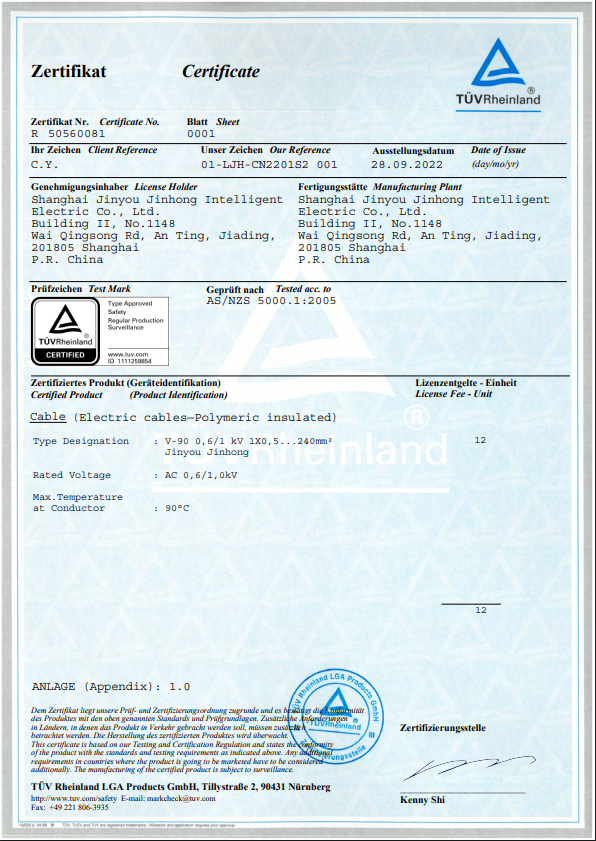
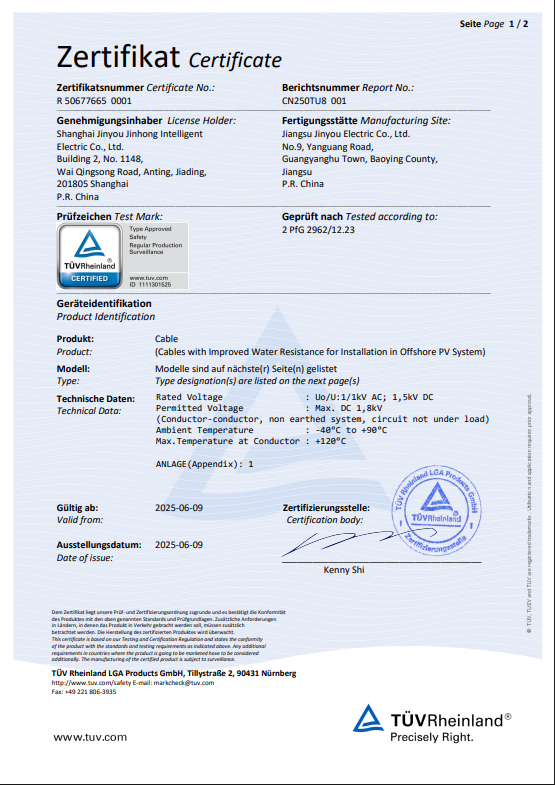
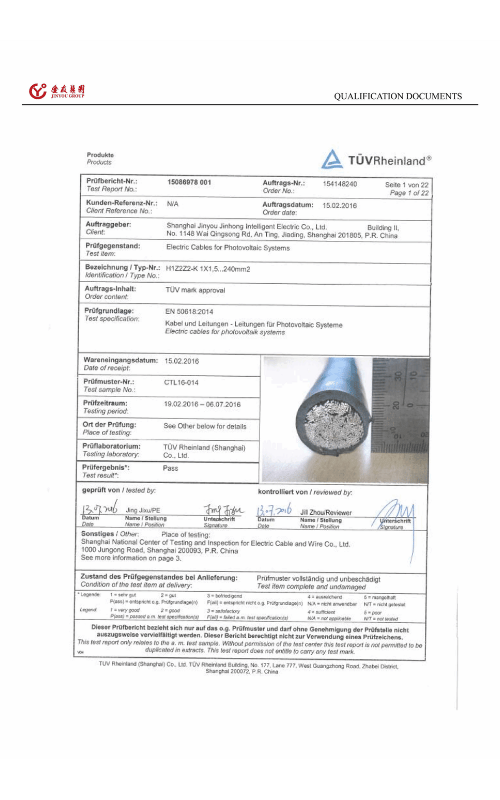
Certificates Published by Number
The Chinese cable manufacturers you are probably comparing us against name eight different certification bodies across their front pages, ten times between them. Not one of them provides evidence in the form of a certificate number. The giveaway is simple.
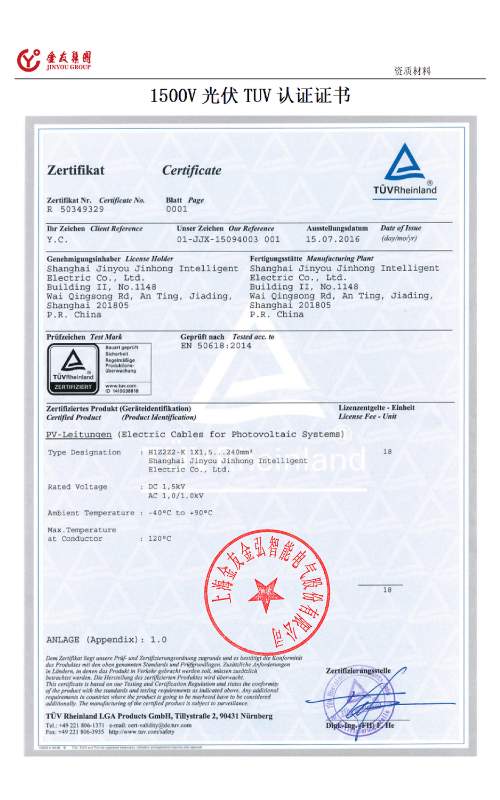
Evidence that cannot be researched is no evidence, and the most reported red flag for buyers is a certificate that turns out to belong to someone else. Here are ours with the evidence you need to research and check them yourself, without any request from us.
| Certificate number | Test mark ID | Holder | Model designation covered | Standard | Date of issue | Certificate type |
|---|---|---|---|---|---|---|
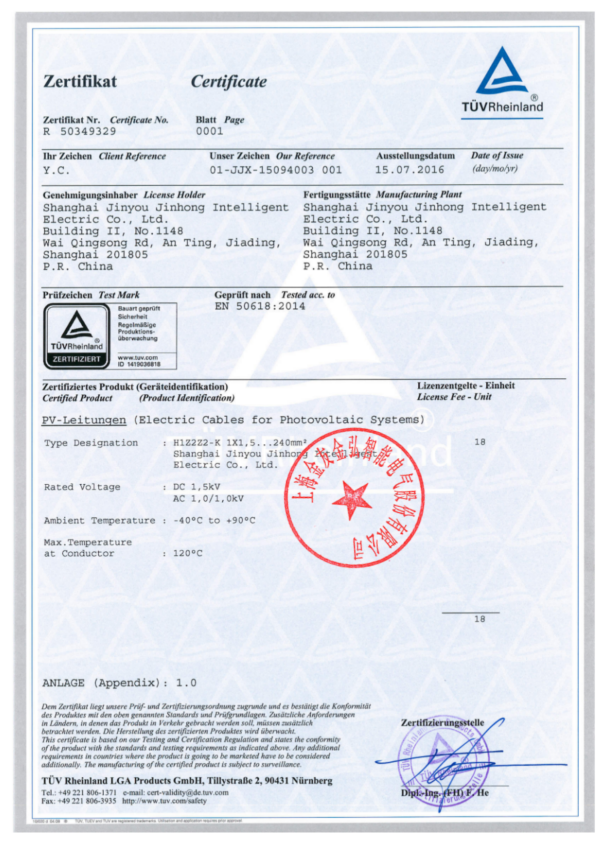
| R 50349329 | 1419036818 | Shanghai Jinyou Jinhong Intelligent Electric Co., Ltd | H1Z2Z2-K 1×1,5…240 mm² | EN 50618:2014 | 2016-07-15 | TUV-Mark Approval, Type Approval, order number 154048240 |
| J 50483940 | 1111231008 | Shanghai Jinyou Jinhong Intelligent Electric Co., Ltd | H1Z2Z2-K 2×2,5…16 mm² | EN 50618:2014 as listed by the issuer | 2020-12-17 | Certificate of Surveyed Conformity, J-Mark, order number 244266647 |
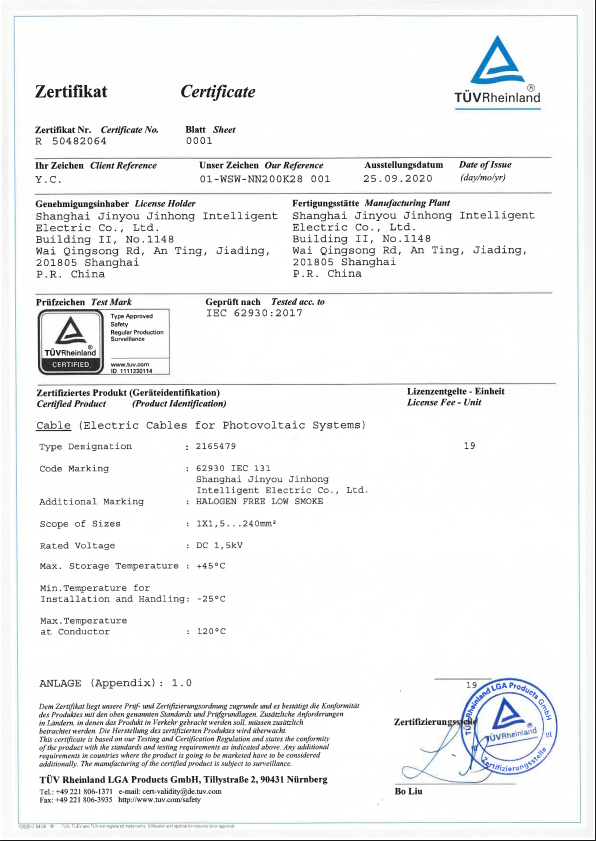
| R 50482064 | 1111230114 | Shanghai Jinyou Jinhong Intelligent Electric Co., Ltd | 2165479 / 62930 IEC 131 / HALOGEN FREE LOW SMOKE / 1×1,5…240 mm² | IEC 62930:2017 | 2020-09-25 | TUV-Mark Approval |
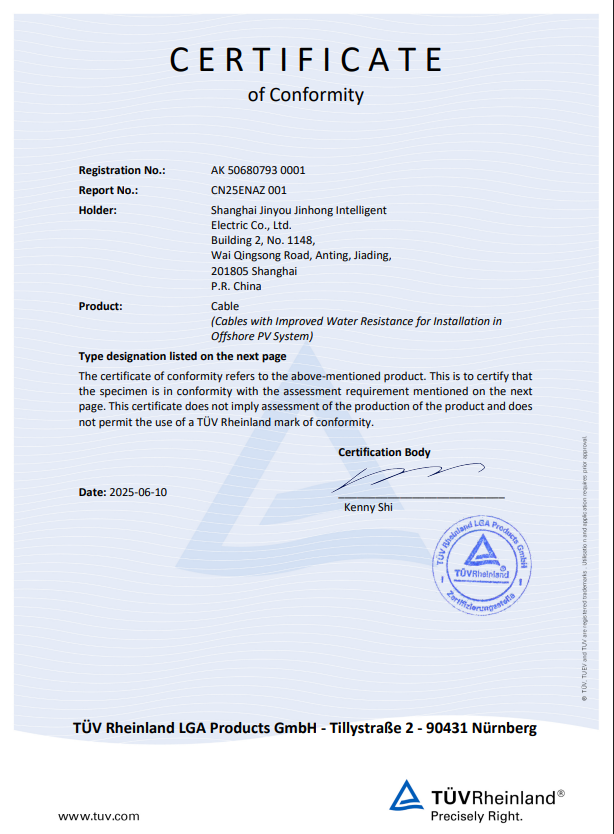
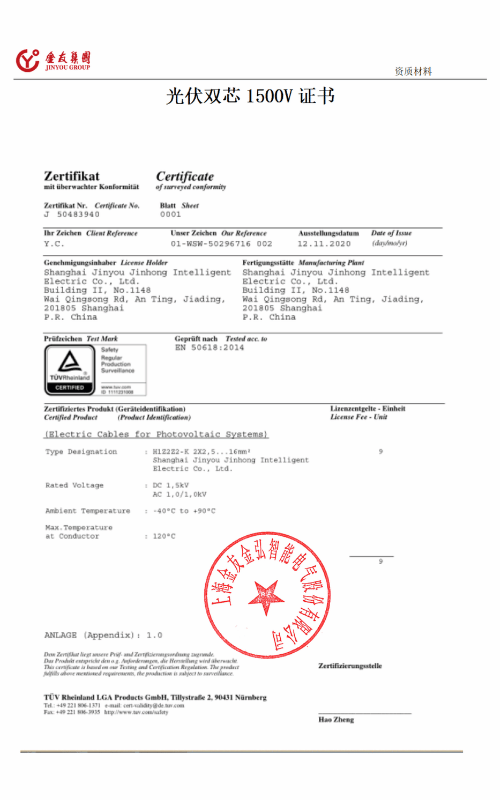
What These Three Certificates Cover, and What They Do Not
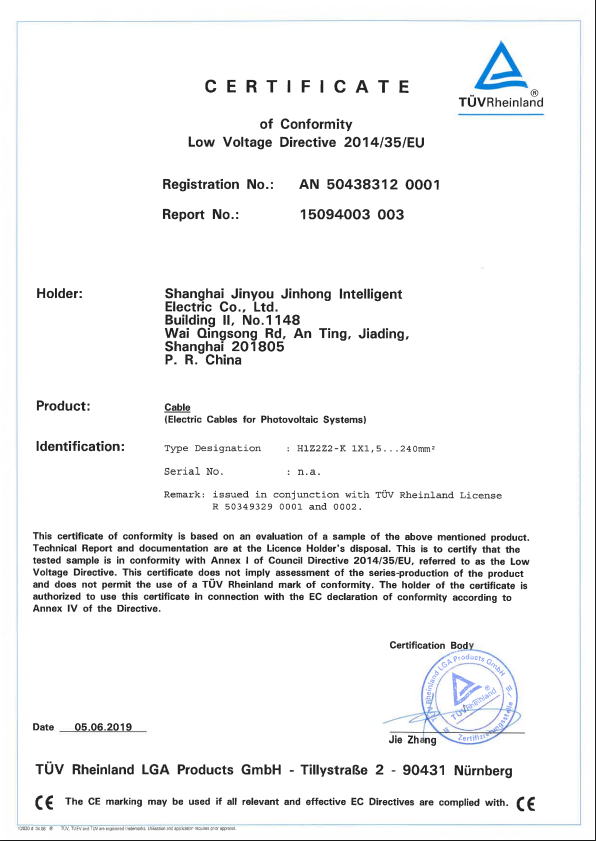
- All three are issued against the H1Z2Z2-K solar constructions listed in the table above, and against those constructions only.
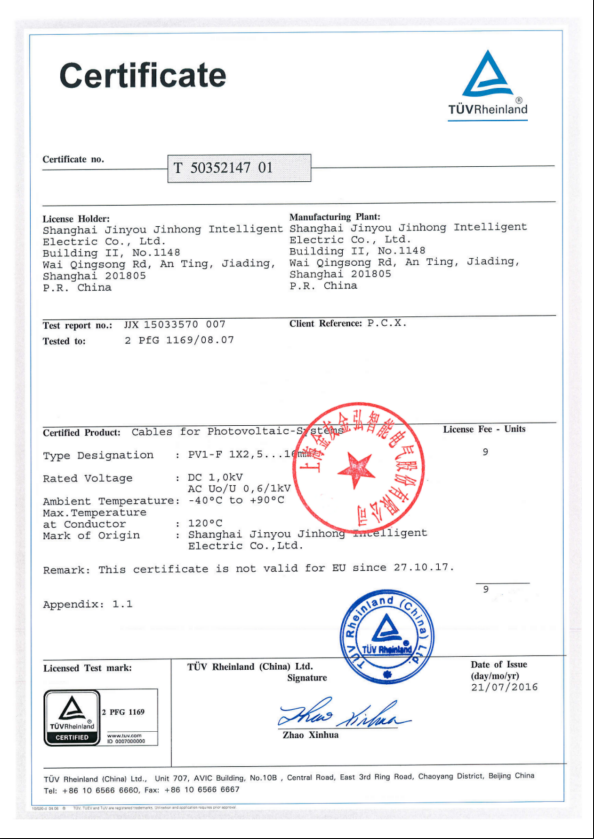
- They do not cover our energy storage, electric-vehicle, or industrial lines.
- None of them reaches 0.5 mm², so the published cross-section range of the company is wider than the certified range of these three documents.
Where a line is not covered by a certificate, this page says so rather than letting the certificate table imply otherwise.
The Disclosure Floor
This is the rule we hold ourselves to on every page of this site. A certification appears with its number, its holder name, the exact model designation it covers and the standard it was issued against, or it does not appear at all.
To verify the authenticity of the test mark, check its unique ID number at www.certipedia.com or scan the QR code. Authentic marks will display the product name and model as well as a certificate excerpt in their Certipedia entry.
TUV Rheinland, CertipediaHow to Check These Without Asking Us
- Reach the issuer’s register yourself rather than through a link a supplier sends you, ours included.
- Enter the test mark ID from the table above. An authentic mark also returns the product name and model along with a certificate extract.
- Match the holder name against the company you are about to buy from. The most expensive document in procurement is a genuine certificate held by a third-party holder.
- Read the scope on the certificate. The register shows the holder, model and test mark ID, but the standard and the covered range come from the certificate document.
All three entries were checked in the issuer’s register on 2 September 2026, where the holder name and the Shanghai address match this company. The standards are published by the International Electrotechnical Commission and the European standards bodies, and not by us.
Quality Control From Incoming Metal to Shipped Lot
- Conductor purity and resistivity are tested on incoming metal.
- Insulation and sheath compounds are checked by physical and chemical analysis for temperature resistance, ageing resistance and mechanical strength.
- Raw-material supplier qualification certificates and environmental compliance certificates are verified prior to acceptance of a batch.
- The factory test report for the shipped lot travels with the goods, so the batch you receive is the batch that was measured.
Quality control here is more like a chain of checks tied to a lot. Batch consistency, not a badge-on-page style of quality control, is the failure mode buyers describe most often.
Catching this at goods-in instead of on site is a result of tying the report to the lot instead of the product line.
What You Can Settle Before You Contact Us
Most supplier pages in this category provide no information until you send an enquiry. The table below is the opposite: everything you need to know is provided and the enquiry is only needed for the values that are truly dependent on your circuit.
The No-Enquiry Answer Set
| Question | Answer, on this page |
|---|---|
| How is the price built | From copper content and construction; there is no fixed price list for made-to-order cable |
| How fast is a quotation | Within 24 hours, written by an engineer as a specification and a price |
| How long are samples | 7 to 15 working days on the solar lines after the specification is agreed |
| How long is production | 10 to 25 working days after the specification and drum plan are confirmed |
| What is the minimum order | None on stocked constructions; made-to-order from 100 to 200 m per type |
| How is payment structured | 30 percent telegraphic transfer deposit with the 70 percent balance before shipment, or an irrevocable letter of credit at sight |
| Which trade terms | FOB and CIF from a Chinese port as standard; EXW, FCA, CFR and delivered terms on request |
| What ships with the goods | Certificate of origin, packing list, the factory test report for the shipped lot, and copies of the product certificates |
| Which certificates exist and what do they cover | Three, published by number above, covering the listed H1Z2Z2-K solar constructions only |
| What will we not do | No cable size, ampacity or voltage-drop result is published here, and we hold no UL 4703 listing |
From Enquiry to Shipment
-
You send the circuit: circuit position, cross-section, core configuration, length per colour and destination port.
-
The engineer reviews the construction: we check it against your circuit and confirm which line answers it, or whether none of the lines do.
-
We quote within 24 hours: a specification and a price, not a number on its own.
-
Samples ship: 7 to 15 working days on the solar lines once the specification is agreed.
-
We take the drum plan back: if the lengths we wind do not match the runs on your site, that is our error to correct, so we confirm the split by colour and cross-section in writing before production.
-
Production and shipment: 10 to 25 working days, then the goods leave with the certificate of origin, packing list, the factory test report for the shipped lot, and copies of the product certificates.
Enquiry Fields That Save a Round Trip
| Field | What to send | Why it removes a revision |
|---|---|---|
| Circuit position | String, combiner, earthing, control, alternating-current side, storage bus or charging lead | Decides the line before anything else is discussed |
| Destination market | European Union, international, Australia and New Zealand, Japan or elsewhere | Decides the designation your project owner will accept, which is not always the one you asked for |
| Length per colour | Metres against each colour in your bill of materials | The drum plan is built from this; a single total forces a second exchange |
| Route conditions | Exposure, ambient temperature, bundling, conduit or burial | Changes construction more than the nameplate voltage does |
Company Record
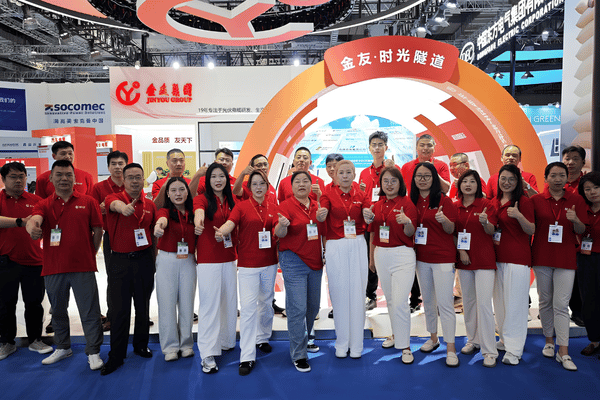
The entries below constitute the company’s own client recorded history and supply records. Export reach of more than 40 countries is stated on the same basis.
-
2006
Company established in Shanghai, focused on special cable for the new energy industry
-
2010
Obtained China’s first photovoltaic cable certification
-
2014
Listed on the National Equities Exchange and Quotations, stock code 830994
-
2023
High flame retardant B1 and B2 photovoltaic cables passed national appraisal
Supply Record
These are projects we state, not projects a third party has documented.
- State Power Investment Corporation’s multi-gigawatt renewable energy base in Qinghai Province, January 2020
- XPCC Northern Xinjiang Shihezi 1,000 MW and Tianfu 400 MW projects
- Huakang Anze New Energy 100 MW photovoltaic and energy storage project
- Guangxi Mona Lisa 85 MW building-integrated photovoltaic project
- Yangzhuang Village fishery-solar complementary project, Liyang
- Ningbo Dongmu Beverage Packaging 1249 Wp project
Industry Context
NB/T 42073-2016, the domestic industry standard for photovoltaic power generation system cables, is recorded by the international certification system as China’s registered national difference against IEC 62930:2017. That is context for buyers reading a Chinese datasheet; it is not a company achievement and we do not present it as one.
CASE APPLICATION
CABLE SOLUTIONS TO MEET YOUR NEEDS
Focused on the design, manufacture and sale of comprehensive electrical systems with high performance cables.
-
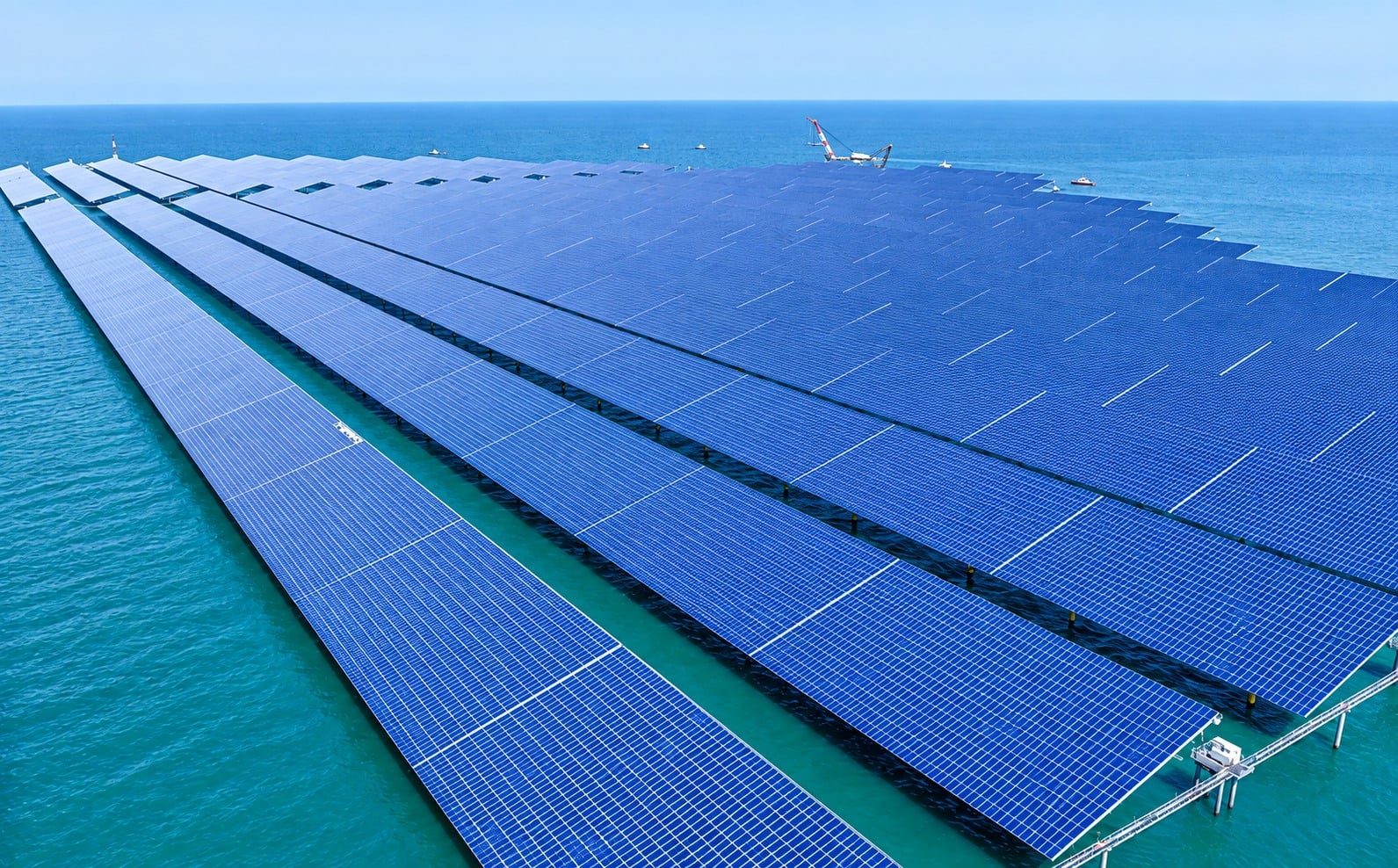 PROJECT 01
CGN Yantai Zhaoyuan 400MW Offshore Photovoltaic Project
-
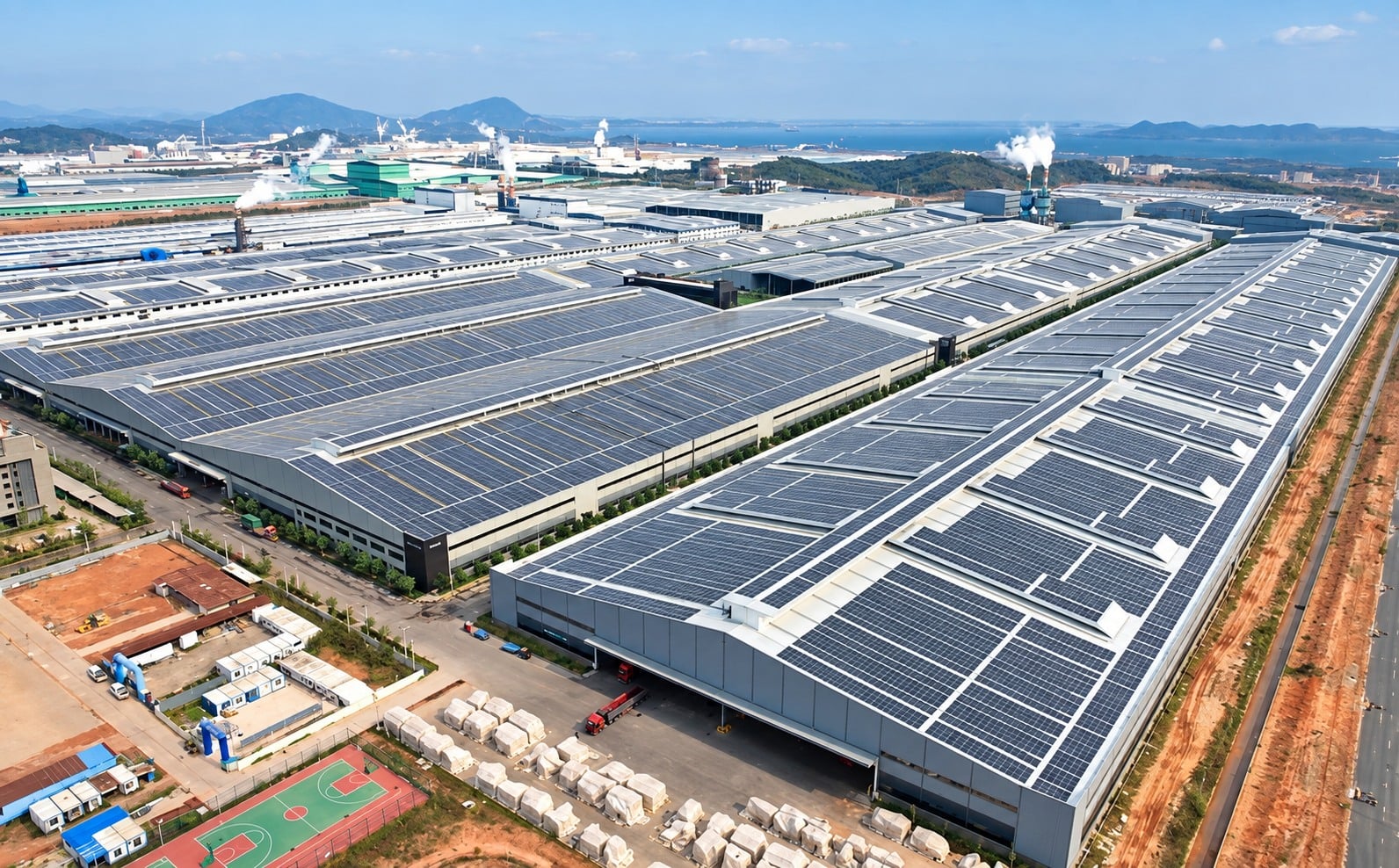 PROJECT 02
Guangxi Mona Lisa 85MW BIPV Photovoltaic Power Generation Project
-
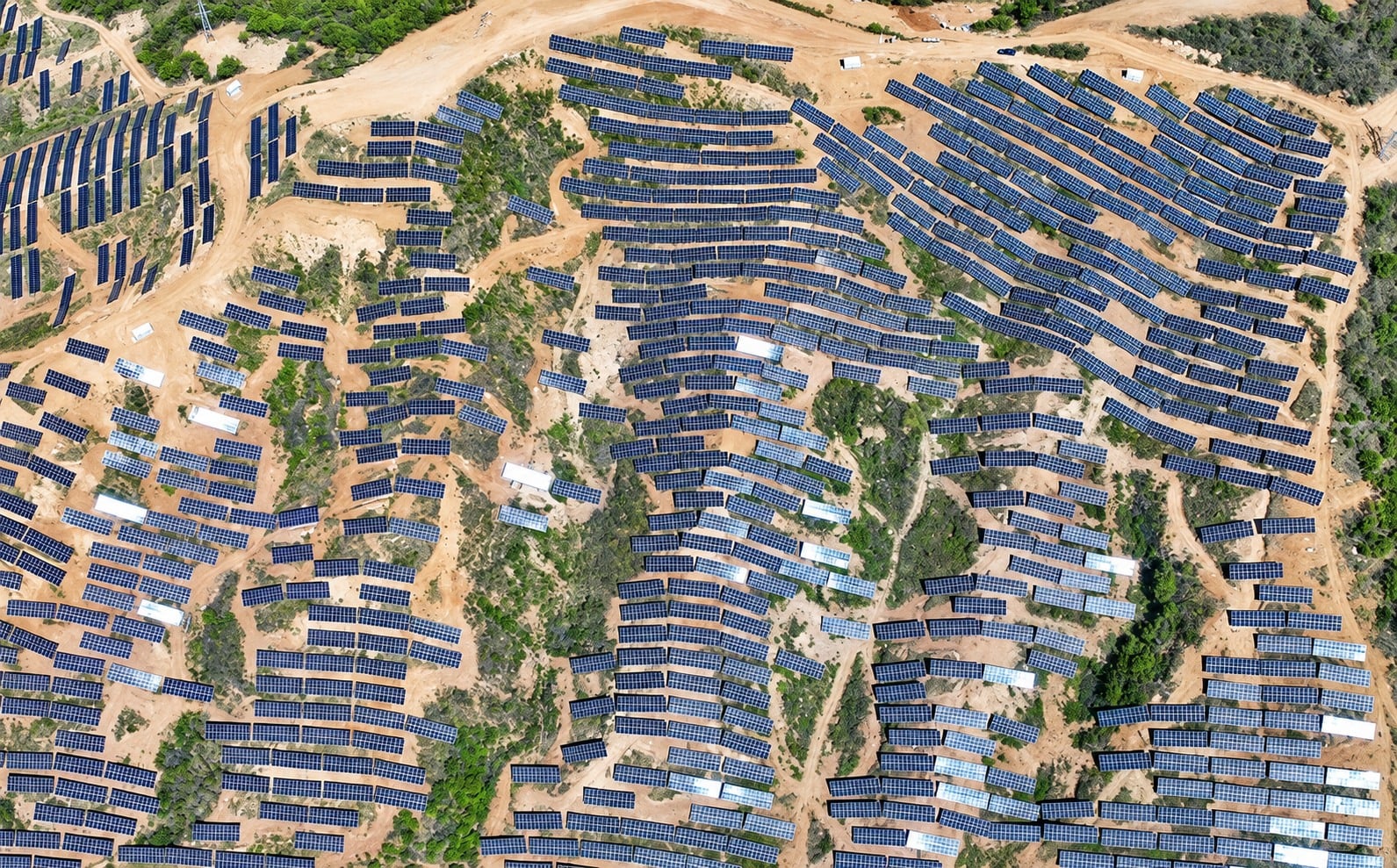 PROJECT 03
Huakang Anze New Energy Co., Ltd. Anze County 100MW Photovoltaic and Energy Storage Power Generation Project
-
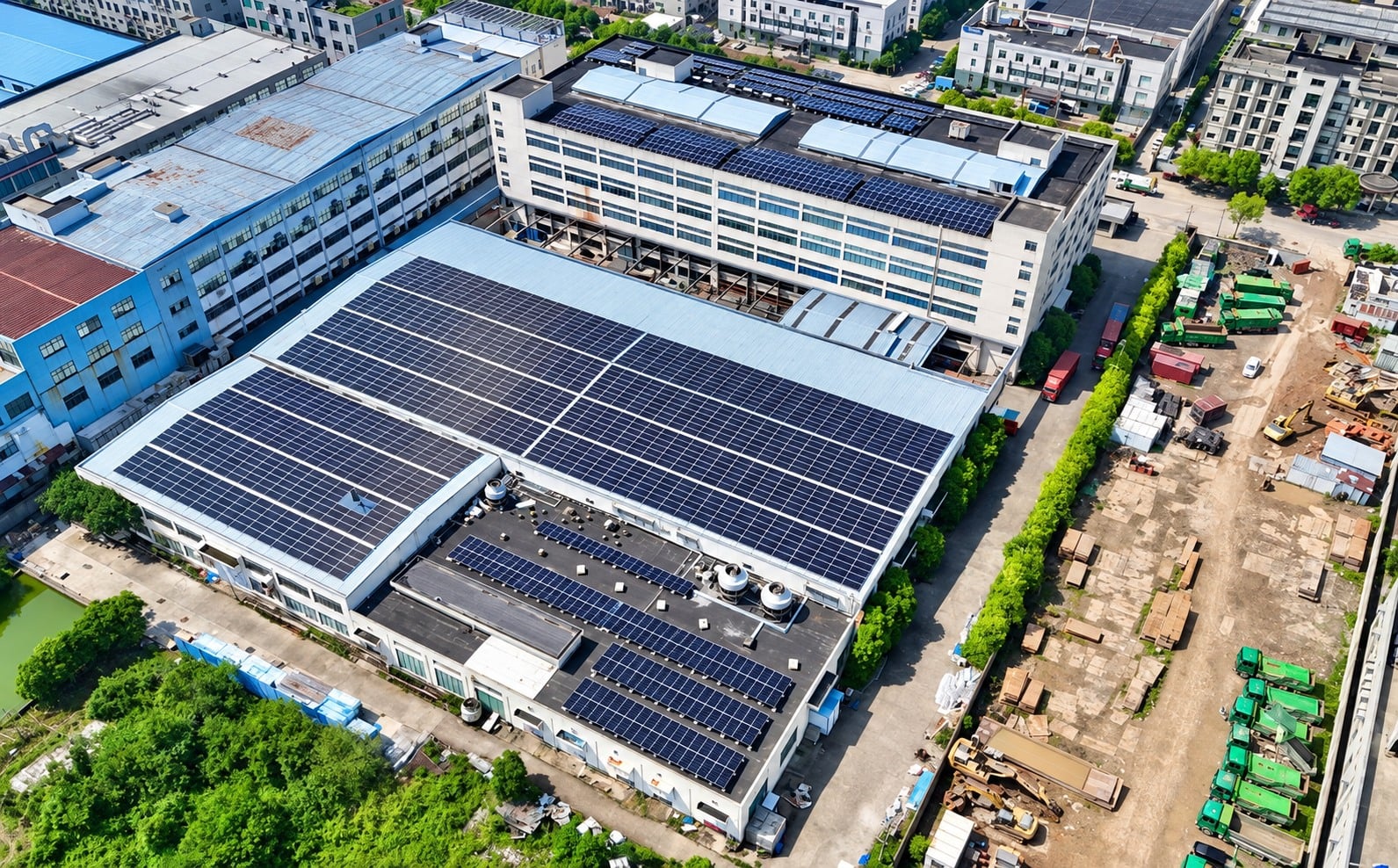 PROJECT 04
Ningbo Dongmu Beverage Packaging 1249Wp Project
-
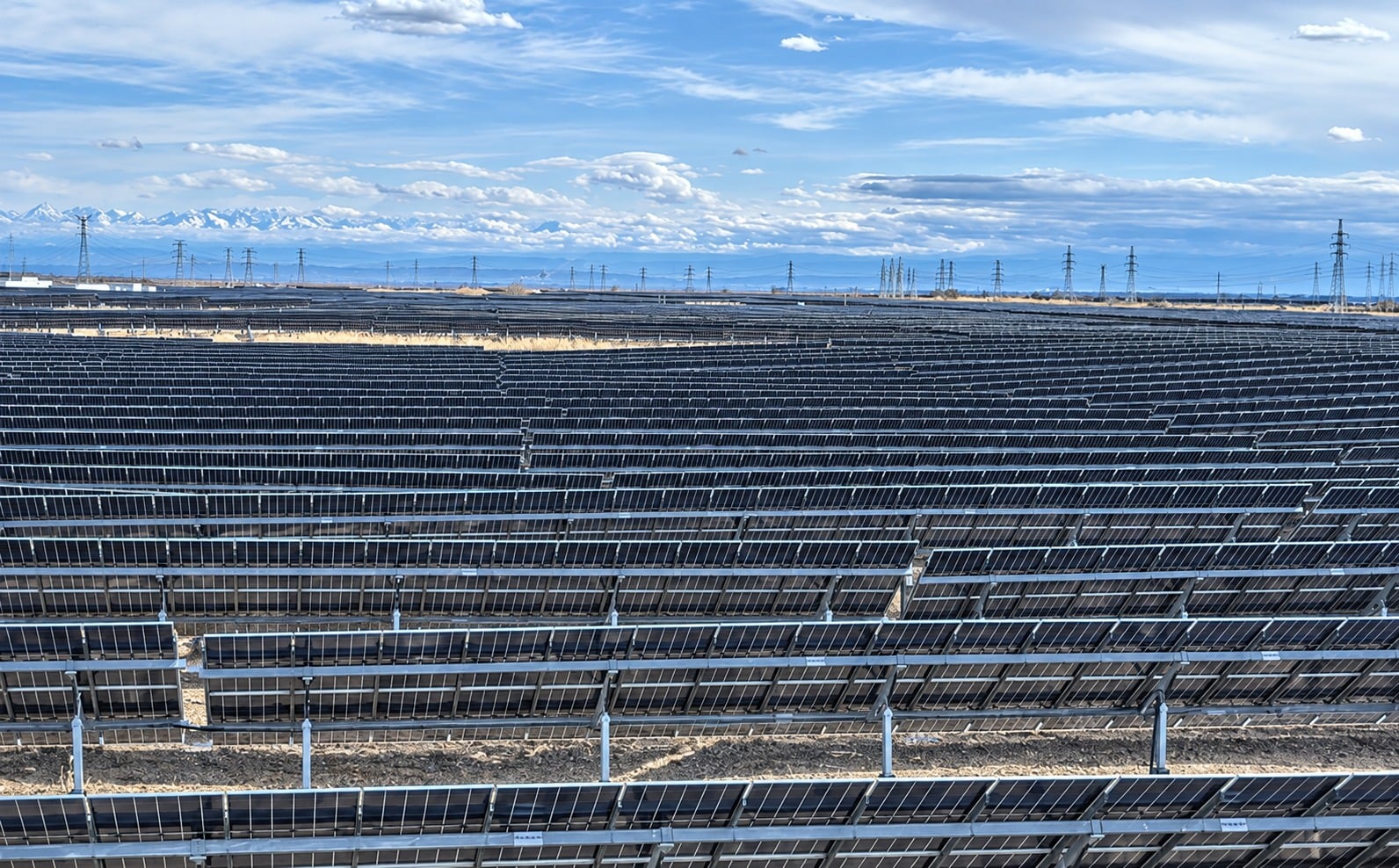 PROJECT 05
XPCC Northern Xinjiang Shihezi 1,000MW Project and Tianfu 400MW Project
-
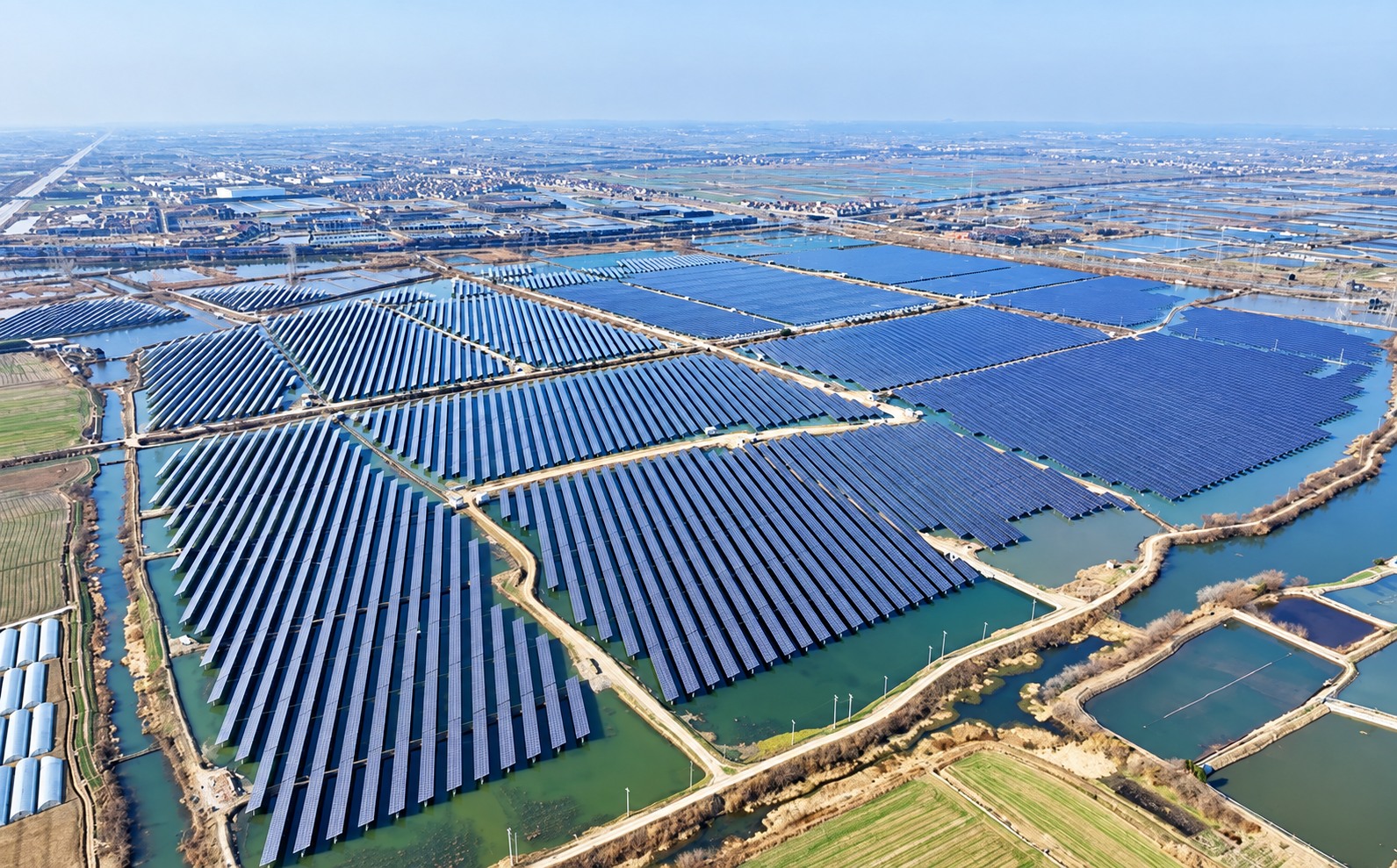 PROJECT 06
Yangzhuang Village Fishery-Solar Complementary Photovoltaic Power Generation Project, Liyang High-tech Zone

Where We Are Not the Right Supplier
Six situations where the honest answer is a boundary rather than a quotation, with each row stating the trade-off, what the wrong call costs you, and the right call to make instead. No supplier answers every route, and one that claims to does not always present an accurate assessment of its scope.
| Situation | Why it works against you | What to do instead |
|---|---|---|
| Your specification calls for listed photovoltaic wire under the North American code route | That route requires a listing we do not hold: we hold no UL 4703 listing and make no claim under it | Source that circuit from a listed supplier, and use us for the routes our certificates do cover |
| A federally funded United States electric-vehicle charging project | The Federal Highway Administration requires chargers manufactured on or after 1 July 2024 to have final assembly in the United States and more than 55 percent of component cost manufactured there; the criteria apply to the charger as a product, so imported cable counts against that fraction | Confirm the project’s funding source first; where the threshold applies, our cable is non-domestic content and its value will not count toward the domestic fraction |
| You want a service-life figure in years | The durability criterion in EN 50618:2014 is a temperature index tied to elongation at break after 20 000 hours, which is a material property rather than a promise of years | Specify the exposure conditions the route will actually see and let the construction answer them |
| You are comparing datasheet ampere figures across standards | The current-carrying capacities in EN 50618 are tabulated at a conductor temperature of 120 °C and an ambient of 60 °C, while those in IEC 62930 are tabulated at 90 °C and an ambient of 30 °C; both follow the same calculation method and land on the same figures once the same 60 K temperature rise is applied | Compare at the temperature rise your route actually sees, not at the headline number in each table |
| You need the connection qualified rather than the cable | We manufacture cable and do not certify a connector pairing, and field records place most direct-current failures at connections rather than in the cable run | Take the outer diameter we publish to your connector supplier and qualify the pairing there |
| You want us to size the cable for you | No cable size, ampacity or voltage-drop result can be right without your run length, current, electrical wiring method, grouping and ambient temperature | Use the sizing and derating calculators on the solar hub, then send the result with your enquiry |
Buyer Questions
Yes, and the difference is more about standards than marketing. Ordinary building wire is polyvinyl chloride rated up to 450/750 V for alternating current, while a solar cable carries two cross-linked layers, a 1.5 kV direct-current rating and sunlight resistance. In contrast, a solar cable is rated for 1.5 kV direct current, and its two cross-linked layers are what resist sunlight.
They have similarities, but there are also differences. EN 50618 admits only halogen-free low smoke single-core constructions, while IEC 62930 admits both halogen-free low smoke cables and cables that can contain halogens. Both design to 90 °C continuous conductor temperature with 120 °C limited to a cumulative 20 000 hours, and both treat the cable as suitable for Class II equipment as defined in IEC 61140.
No, this is the most commonly misread statement. Both standards set 90 °C as the normal continuous maximum conductor temperature, and 120 °C is a cumulative allowance limited to 20 000 hours. A common misconception is that the 120°C maximum cumulative rating is a second continuous rating, which results in an undersized circuit.
Because the two tables are stated at different reference conditions rather than because one cable carries more current. EN 50618 tabulates its current-carrying capacities at a 120 °C conductor temperature and a 60 °C ambient, IEC 62930 at 90 °C and 30 °C, and a published comparison of both against the general calculation method of IEC 60287-1-1 found that they agree once the same 60 K temperature rise is applied.
Measure the conductor resistance rather than the diameter. IEC 60228 fixes a maximum direct-current resistance at 20 °C for every cross-section and conductor class, so an understated cross-section shows up as resistance above the tabulated value for its size. Take the limit for the cross-section on your order, not a single figure quoted for a whole product range: one number cannot be correct from 1.5 mm² to 240 mm², and a supplier quoting it that way has told you something about how it reads its own standard.
To check a test mark ID in the certificate table above, enter the ID in the issuing body’s own register instead of following a link your supplier sends you to that register. An authentic mark provides the product name and model together with a certificate extract, and permits you to verify the holder name, the model designation and the scope against what you are about to buy. A certificate that opens under a different holder, or that names a construction you are not buying, is the answer.
Check the holder name against the company invoicing you. Buyers report being sold by intermediaries using certificate numbers that are genuine but belong to somebody else, and in these cases, the holder name check solves it in a single lookup. Our three certificates are held by Shanghai Jinyou Jinhong Intelligent Electric Co., Ltd., which is the company you will be buying from.
Only where your specification accepts the certificates we hold. The North American code route requires a listed photovoltaic wire and we hold no UL 4703 listing, and a federally funded charging project carries a separate domestic-content threshold described in the boundaries table above.
There is no minimum on stocked constructions, and made-to-order runs start from 100 to 200 m per type. We wind to 100 m and 200 m rolls and to 100 m, 500 m and 1000 m plastic drums, ship on 1.12 × 1.12 × 1.12 m pallets at 20 pallets to a 20-foot container, and split the drum plan by colour and cross-section, so send length per colour.
Samples ship in 7 to 15 working days on the solar lines once the specification is agreed, and production runs 10 to 25 working days after the specification and drum plan are confirmed. An order covering several cross-sections at once sits at the longer end because each size is a separate setup.
No. We manufacture cable and give you the outer diameter the gland must seal against, and qualifying the pairing lies with your connector supplier.
No. All three are issued against the H1Z2Z2-K solar constructions listed in the certificate table, so they cover neither the energy storage line nor the electric-vehicle line. Storage and charging cable is quoted against the construction and the standard family your project names, and any certification requirement for those lines is confirmed in writing before production rather than implied by the solar certificates.