Get in touch with JINYOU Cable Company

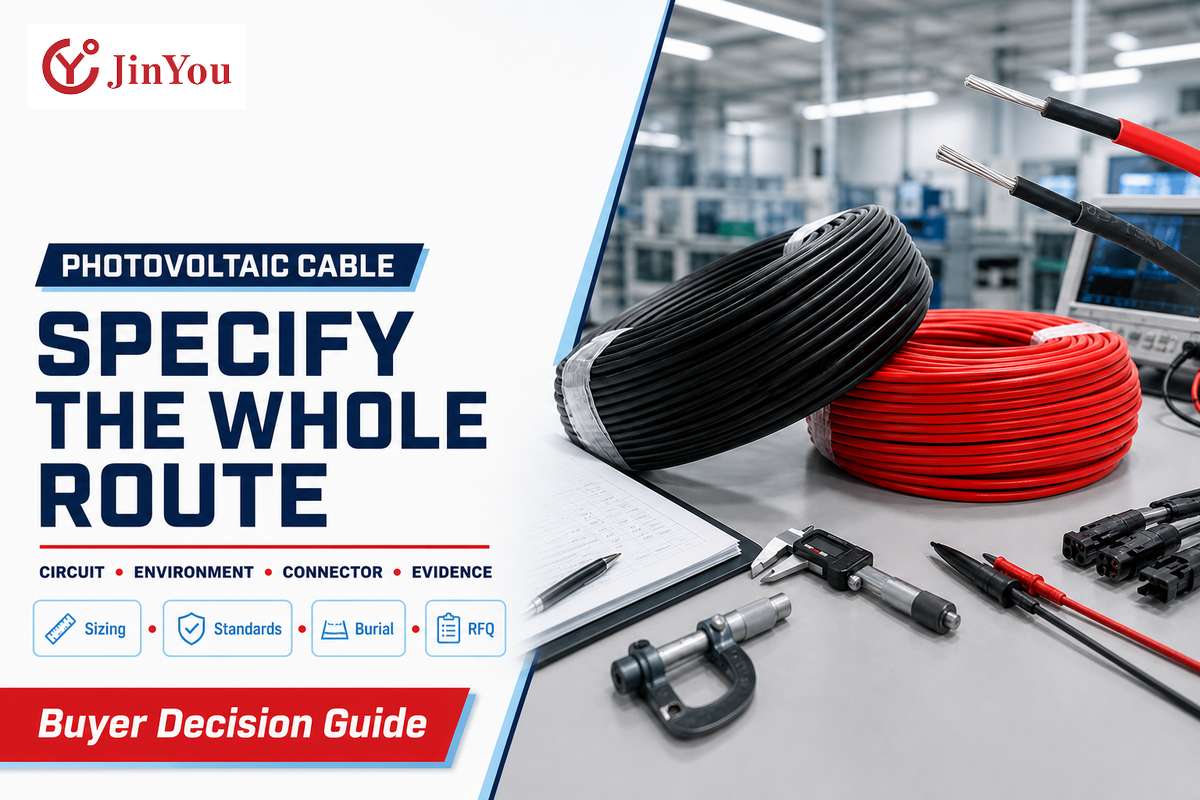
Technical buyer guide | Updated September 11, 2026
A photovoltaic cable can carry a familiar solar designation and still be wrong for the circuit, route, connector, certificate scope, or delivered lot. A photovoltaic cable is a purpose-built cable for defined direct-current connections in a solar power system. A detailed comparison is needed before pricing on a per meter basis. Comparison starts with the electric load, the installation environment, the detail of the interfaces, and the compliance evidence that must be provided with the cable.
This guide gives engineers, procurement teams, installers, and quality reviewers ten checks to close those gaps. This guide also separates the product-standard claims from the project approvals, as these are usually compressed into one term that is often misleading: ‘compliant.’
Short answer: select photovoltaic cable based on circuit voltage and current, design temperature along with operating conditions, route, target voltage drop, protection, connector system, and evidence required by the destination market. Cable shouldn’t be selected based on project kilowatts, a jacket legend, or a general ‘solar cable’ label.
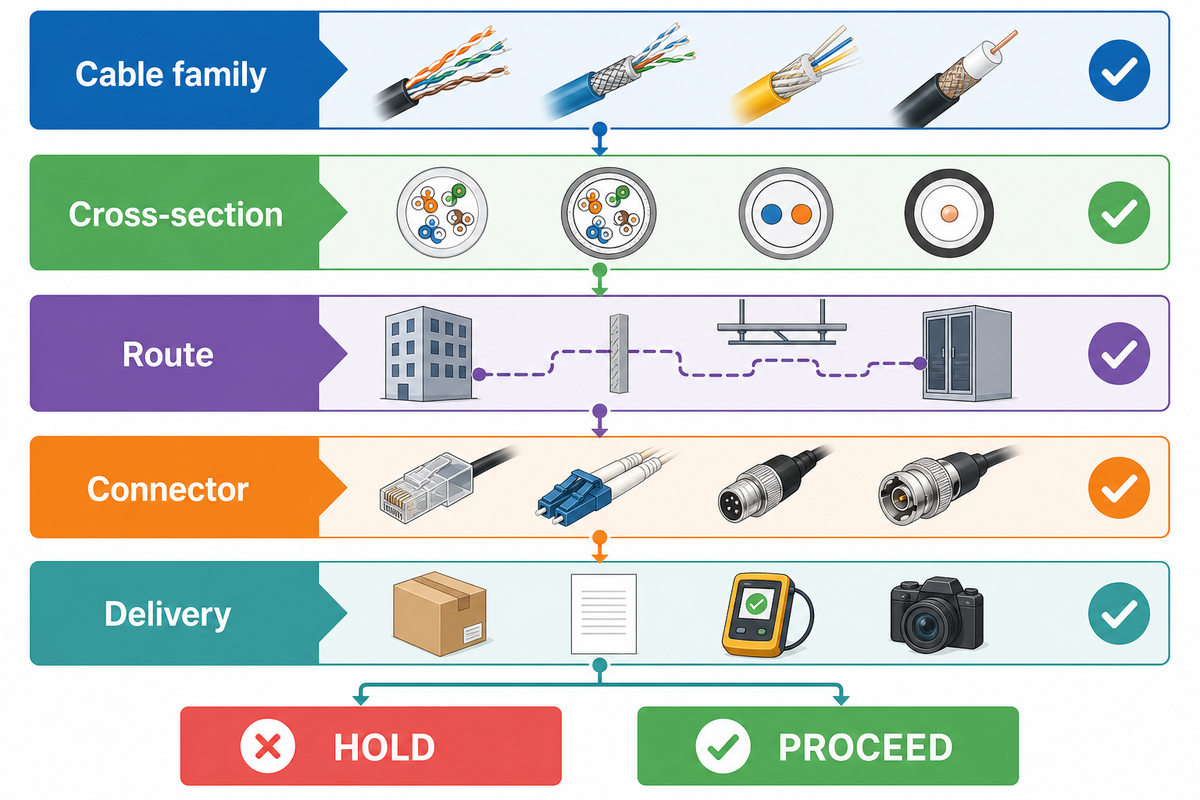
Fast Specification Screen
| Decision | Minimum input | Evidence to keep |
|---|---|---|
| Cable family | Destination market, circuit position, applicable code | Standard edition and product certificate or listing |
| Cross-section | Design current, length, drop limit, installation and derating | Calculation, table basis and protection check |
| Route | Sun, water, soil, conduit, tray, edges, support and movement | Exact product marking plus installation approval |
| Connector | Manufacturer, part number, contact range and mating pair | Assembly instruction, tool record and inspection result |
| Delivery | Quantity, drum, marking, sample, documents and date | Approved drawing, lot test and traceability record |
What Is a Photovoltaic Cable?
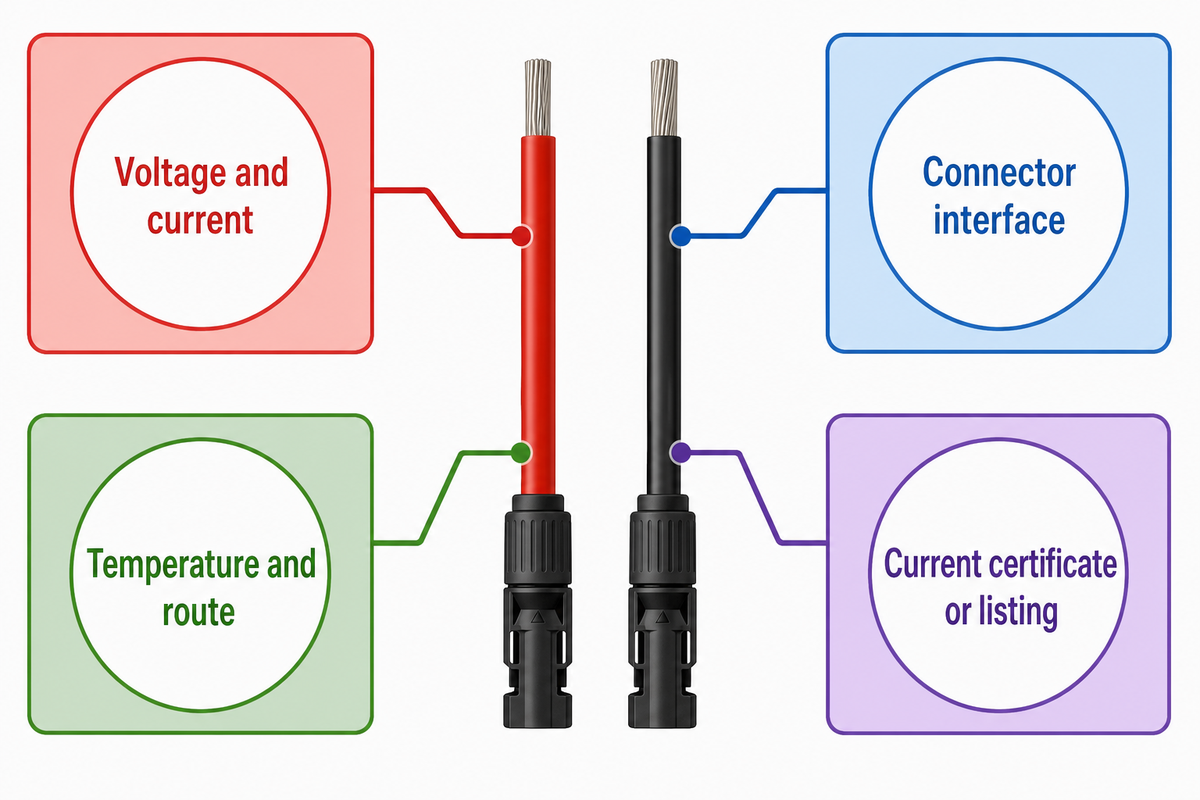
A photovoltaic cable is a cable designed for defined direct-current connections in a solar array, such as module-to-module, string, combiner, and inverter-side connections. This product definition doesn’t approve all installation scenarios. Voltage, current, temperature, route, connector interface, fire and environmental requirements along with the evidence provided by the project define cable suitability.
The official IECEE record for IEC 62930:2017 describes a single-core cross-linked insulated power cable with a cross-linked sheath for the DC side of photovoltaic systems. Its scope defines a limit of 1.5 kV DC between conductors and between conductor and earth. It also indicates a maximum conductor temperature rating of 90°C and operation at 120°C with a limit of 20,000 hours.
In sourcing terminology, that classification is solar panel wire. Determine the voltage limit and other bounds of the product for the given construction.
Those numbers define a standard’s product scope. They don’t imply that each wire should be run at the maximum voltage. In practical sourcing language, the same category may be called solar panel wire. The installed circuit may have lower terminal ratings, different ambient conditions, additional derating, or a local rule that controls the final choice.
Evidence boundary
“Photovoltaic,” “PV wire,” “H1Z2Z2-K,” and “PV1-F” aren’t project-acceptance decisions. Each term has to resolve to an exact construction, governing standard, current certificate or listing, and approved route.
Photovoltaic Cable vs Normal Cable: Which Differences Matter?
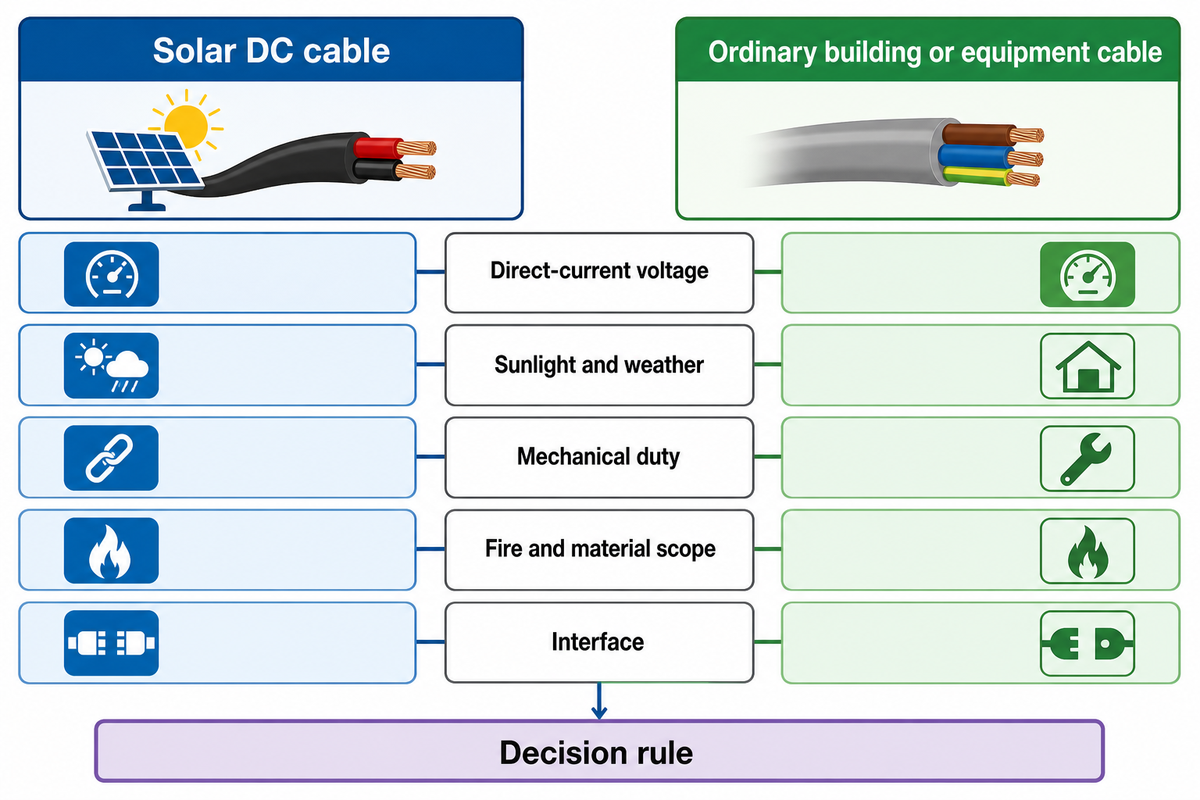
Ordinary building or equipment cable isn’t an automatic substitute for a solar DC cable, but “solar cable is better” is also too vague to be useful. Consider the conditions the installed conductor must survive and the supporting tests or listings.
| Condition | Why it matters in a PV route | What to verify on the exact product |
|---|---|---|
| Direct-current voltage | Array voltage changes with string design and temperature | Rated voltage basis, corrected maximum voltage, terminals and connector ratings |
| Sunlight and weather | Rooftop and field routes face ultraviolet light, heat, water and cycling | Applicable weathering, wet-location and temperature evidence |
| Mechanical duty | Slack, sharp edges, failed ties and tight bends damage insulation | Bend radius, support method, abrasion protection and pulling limits |
| Fire and material scope | Outdoor, indoor and building-entry routes may have different requirements | Halogen, smoke, flame, reaction-to-fire and national documentation |
| Interface | Cable diameter, conductor class and contact range affect the termination | Approved connector, contact, seal, crimp die and assembly instruction |
What is the difference between solar cable and normal cable?
Solar DC cable is designed for specific photovoltaic DC applications. This may include specified voltage, cross-linked insulation and sheath, exposure to sunlight and moisture, and temperature compatibility with solar arrays. Normal cable is acceptable for many applications, but it may not replace that function or use without evidence. The safe comparison isn’t the name of the product. It’s the specific voltage, conductor, insulation, sheath, temperature, environmental tests, permission for installation, connector range, and destination approval for the product quoted.
How Do You Choose Photovoltaic Cable Size?
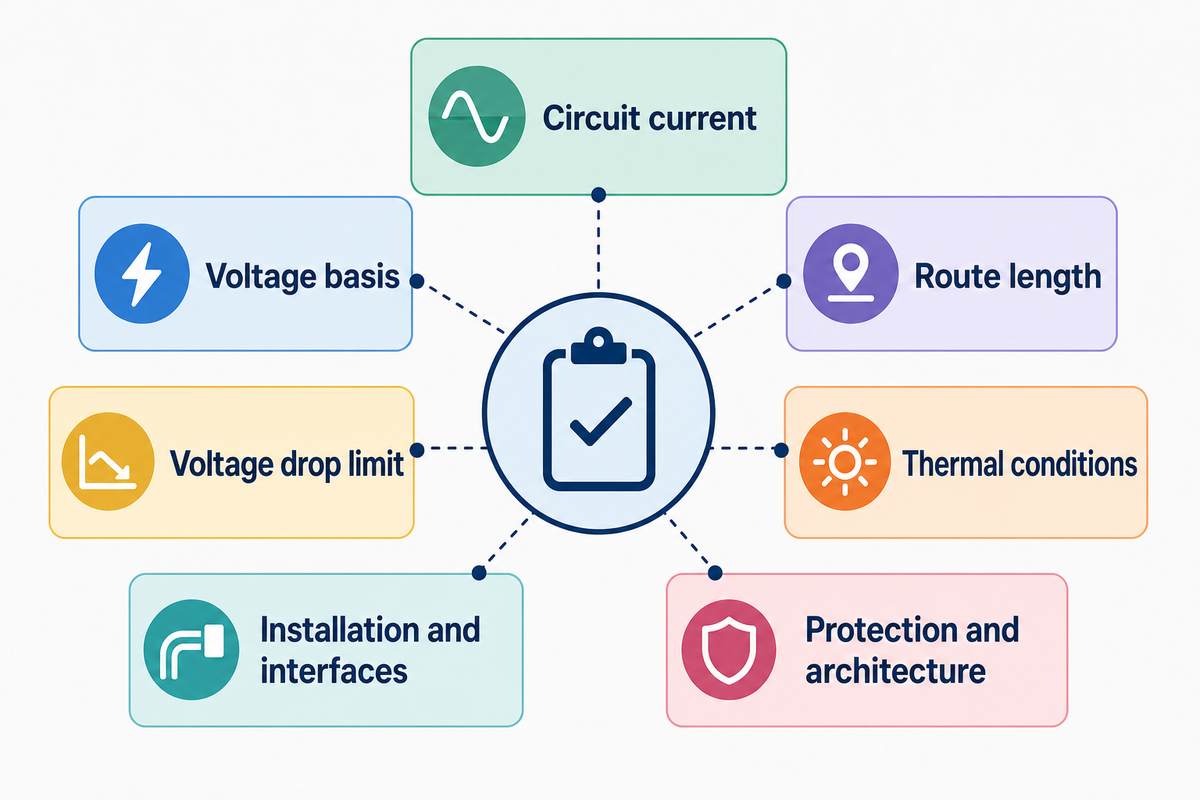
A project power figure can’t select a photovoltaic cable size. Kilowatts don’t indicate string current, corrected voltage, route length, grouping, conductor temperature, termination limit, or protective device. Record conductor area in mm², route length in m, calculated drop in V and relative drop in % before checking a cross-section. At least freeze these seven input groups prior to checking a cross-section:
- > Circuit current: use the design current including source-circuit and code factors.
- > Voltage basis: record the operating voltage and the corrected maximum open-circuit voltage for the lowest design temperature.
- > Route length: distinguish the one-way physical length from the positive-and-negative loop used in the voltage-drop calculation.
- > Voltage drop limit: specify the project criterion, don’t take a universal percentage from the internet.
- > Thermal conditions: state the ambient air or soil temperature, solar heating, grouping, soil thermal resistivity, ducts and drying risk.
- > Installation and interfaces: include free air, surface, tray, conduit or burial, and connector and terminal conductor ranges.
- > Protection and architecture: assess fault withstand, protective coordination, bifacial-module current factors, non-optimal orientation, DC-to-DC units and direct battery connection where applicable.
The current IEC 62548-1:2023 plus Amendment 1:2025 catalogue record explicitly notes revised cable requirements and provisions for bifacial modules, non-optimal orientations, DC-to-DC conditioning and arrays directly connected with batteries. So, a seven-line intake is a first step, not a replacement of the applicable design standard.
Illustrative voltage-drop screen
Suppose a copper DC loop is 80 m long, and has a design current of 14 A. Consider a first pass of a 6 mm² conductor. Using a simplified resistive check and the value of copper resistivity at 20°C of 0.0175 Ω·mm²/m yields:
Voltage drop = 14 A × 80 m × 0.0175 Ω·mm²/m ÷ 6 mm² = 3.27 V. The screening result records a 14 A design current, a 6 mm² conductor, an 80 m loop, a 3.27 V drop and a 0.54% ratio.
At 600 V operating voltage, this is approximately 0.54%. This does not approve 6 mm². Operating temperature raises resistance, and ampacity, protection, terminal range, grouping, route, fault duty and local rules still have to pass.
For an early comparison, JINYOU’s DC string voltage-drop and cross-section sizer can help organize inputs. Treat its result as a screening value that returns to the governing tables and project engineer.
Match Voltage and Temperature Ratings to the Real Circuit
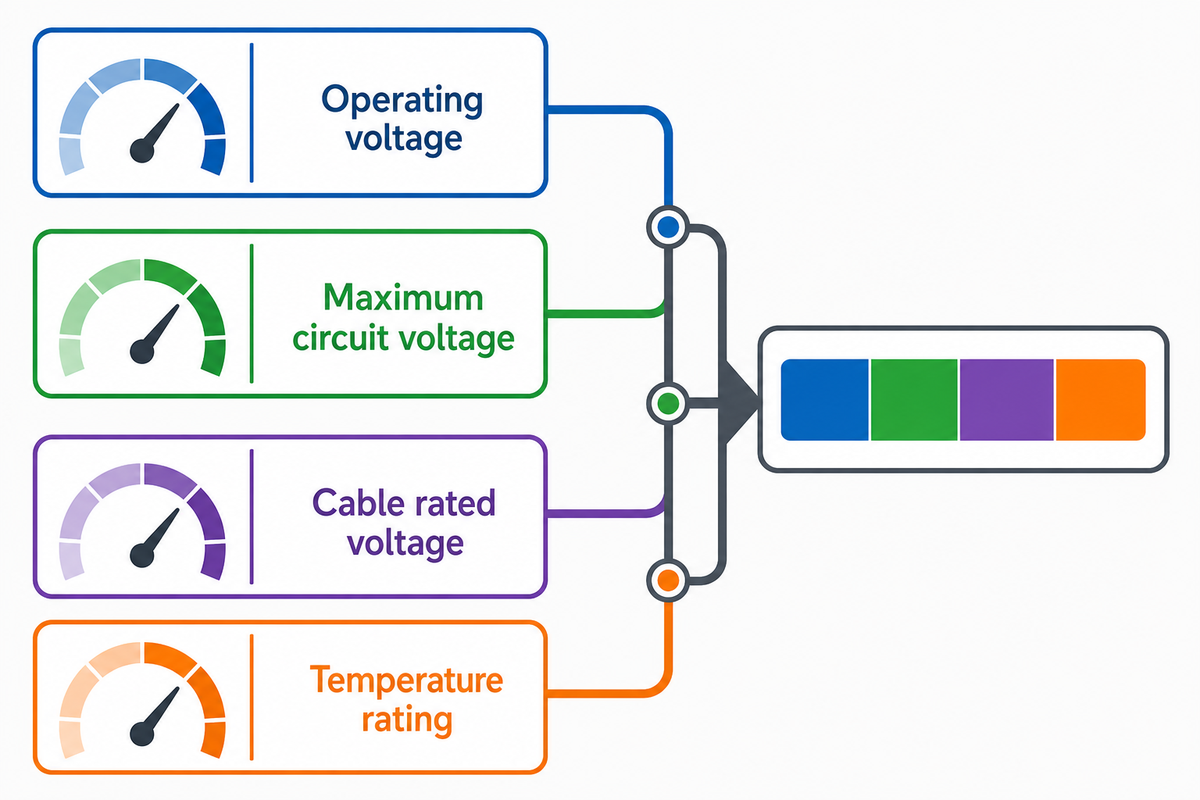
Voltage labels have different meanings. For example, the module string has an operating voltage, and a cold-corrected maximum open-circuit voltage. A cable standard has a rated voltage. Limits exist for connectors, terminals, disconnects and inverters. The lowest of the above limits defines the assembled path.
| Value | Question it answers | Common error |
|---|---|---|
| Operating voltage | What the array normally delivers at a given condition | Using it instead of cold-corrected maximum voltage |
| Maximum circuit voltage | What insulation and interfaces must withstand in the design | Checking cable but not connectors or terminals |
| Cable rated voltage | The product’s declared voltage basis under its standard | Relabelling a test or page value as system rating |
| Temperature rating | A product or standard conductor/environment boundary | Ignoring reduced ampacity at higher ambient temperature |
JINYOU’s current photovoltaic power system cable has a system fit of 1,000 V DC, an operating range of -40°C to 90°C, and a 1,800 V maximum between conductors for a non-grounded, no-load circuit; the page says that value is halved in a single-phase grounded DC system. These are manufacturer-published values, and 1,800 V isn’t stated as an IEC 62930 rated operating voltage; the project drawing and evidence pack must define its basis.
Which Photovoltaic Cable Standards and Designations Matter?
The right standard depends upon the destination, circuit and procurement contract. IEC 62930, EN 50618 and UL 4703 are not decorative equivalents, and a cable name does not replace the current certificate or listing or prove acceptance in the project’s destination market.
| Reference | Useful meaning | What it does not prove alone |
|---|---|---|
| IEC 62930:2017 | International PV cable product-standard scope up to 1.5 kV DC | Halogen-free construction, burial, connector compatibility, or project acceptance |
| EN 50618 / H1Z2Z2-K | European flexible, single-core, halogen-free PV cable route | Building reaction-to-fire class, national installation approval, or exact certificate scope |
| UL 4703 / PV Wire | North American photovoltaic wire product route | That jacket printing alone proves certification or every intended use |
| PV1-F | A legacy designation still found in drawings and searches | Current conformity without EN 50618 or IEC 62930 evidence |
One distinction that is not insignificant matters. IEC 62930’s official abstract includes both halogen-free low-smoke cables and cables that can include halogens. The current DIN record for EN 50618 describes flexible, single-core, halogen-free cable. Do not extend the broader IEC material scope to EN 50618 or to a specific H1Z2Z2-K product.
TÜV Rheinland’s transition notice says older 2PfG certification bases were withdrawn and moved toward EN 50618 or IEC 62930. Accordingly, PV1-F may remain useful as legacy drawing language, but it should not be the only current conformity evidence. Buyers can compare JINYOU’s H1Z2Z2-K cable and PV1-F cable pages, then verify the current certificate and project route rather than assuming equivalence.
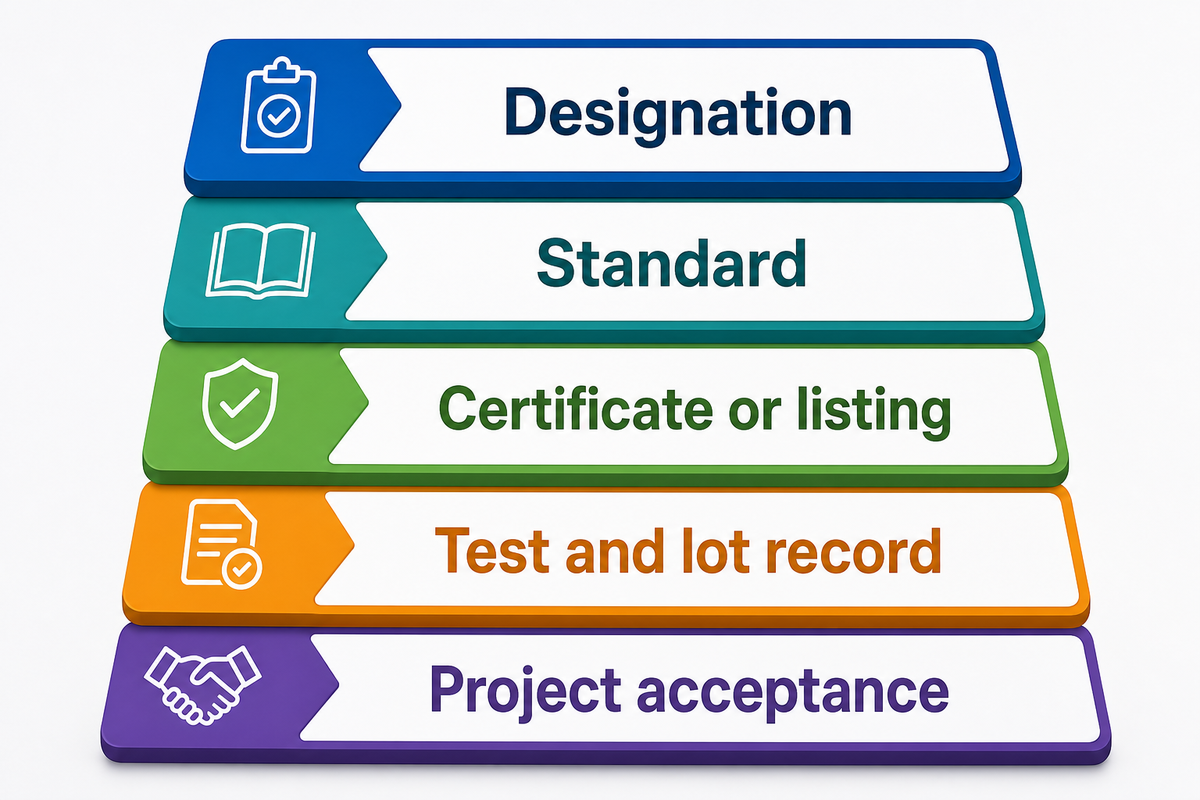
Five evidence layers that should not be collapsed
- Designation: what family or construction the marking identifies.
- Standard: what requirements and scope the document defines.
- Certificate or listing: what exact product, size, factory and validity are covered.
- Test and lot record: what was tested and whether the delivered cable can be traced to it.
- Project acceptance: whether the designer, authority and contract accept that product in the actual route.
UL’s application guide provides a useful North American check: the UL Mark on the coil, reel, flange or box is the controlling tag for certified wire and cable. Surface printing is supplemental. Submitter’s package-label photos and the product-category record.
For a North American submittal, record each construction field separately: wire gauge in AWG or mm², 600 V or 2 kV voltage marking where applicable, stranded copper or aluminum conductor, cross-linked polyethylene (XLPE) insulation, jacket properties, and the exact UL listing. None of those fields proves another one. Match each requested use to the product listing, data sheet, installation rules, and project documents.
Can You Bury Solar PV Cable? Check the Whole Route
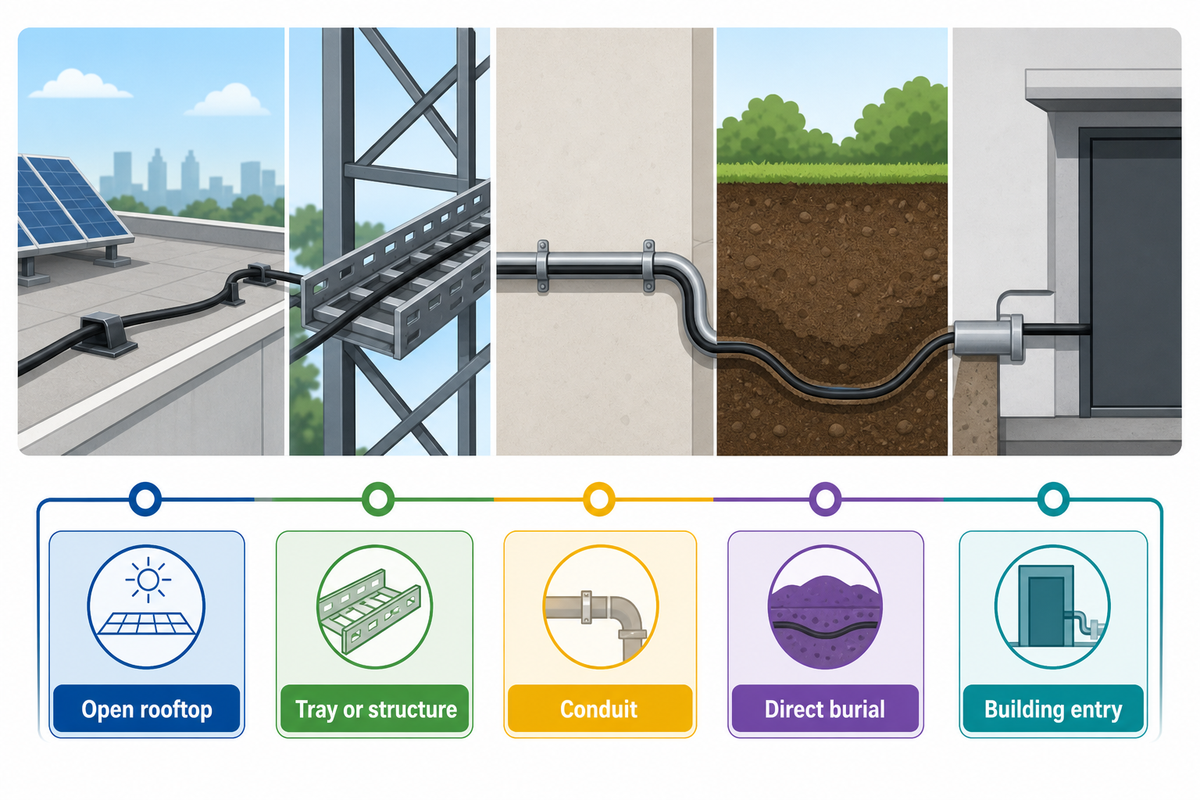
Some photovoltaic wire is approved for direct burial, but photovoltaic labelling in isolation doesn’t grant direct burial clearance. Verify the marking and certificate, listing, and instruction manual pertaining to the cable, rules relevant to the installation, cover depth, mechanical protection, environmental constraints, etc.
Decisions pertaining to direct burial and ampacity of buried cables are independent. Even a cable listed for burial may need correction for soil temperature, thermal resistivity, partial drying, ducts, grouping and installation geometry. Water exposure, chemicals, rodents, rocks, pulling damage and transitions into conduit also affect the route.
| Route condition | Cable proof | Installation proof |
|---|---|---|
| Open rooftop | Sunlight, wet and temperature rating | Support spacing, edge clearance, bend and connector position |
| Tray or structure | Permitted use and mechanical properties | Tray fill, grouping, clips, movement and abrasion control |
| Conduit | Wet-location and pulling suitability | Fill, derating, drainage, seals and pulling plan |
| Direct burial | Explicit product-specific burial approval | Soil, depth, thermal model, protection, transitions and local acceptance |
| Building entry | Required fire and smoke classification | National documentation, route length and transition method |
The U.S. Department of Energy warns that standard plastic ties can fail early under heat, ultraviolet exposure and chemical interaction. Slack cable can then abrade against surfaces, contributing to faults, power loss and module damage. Hence, cable support is part of reliability of power systems, not a cosmetic installation.
Verify Connector Compatibility Before Crimping
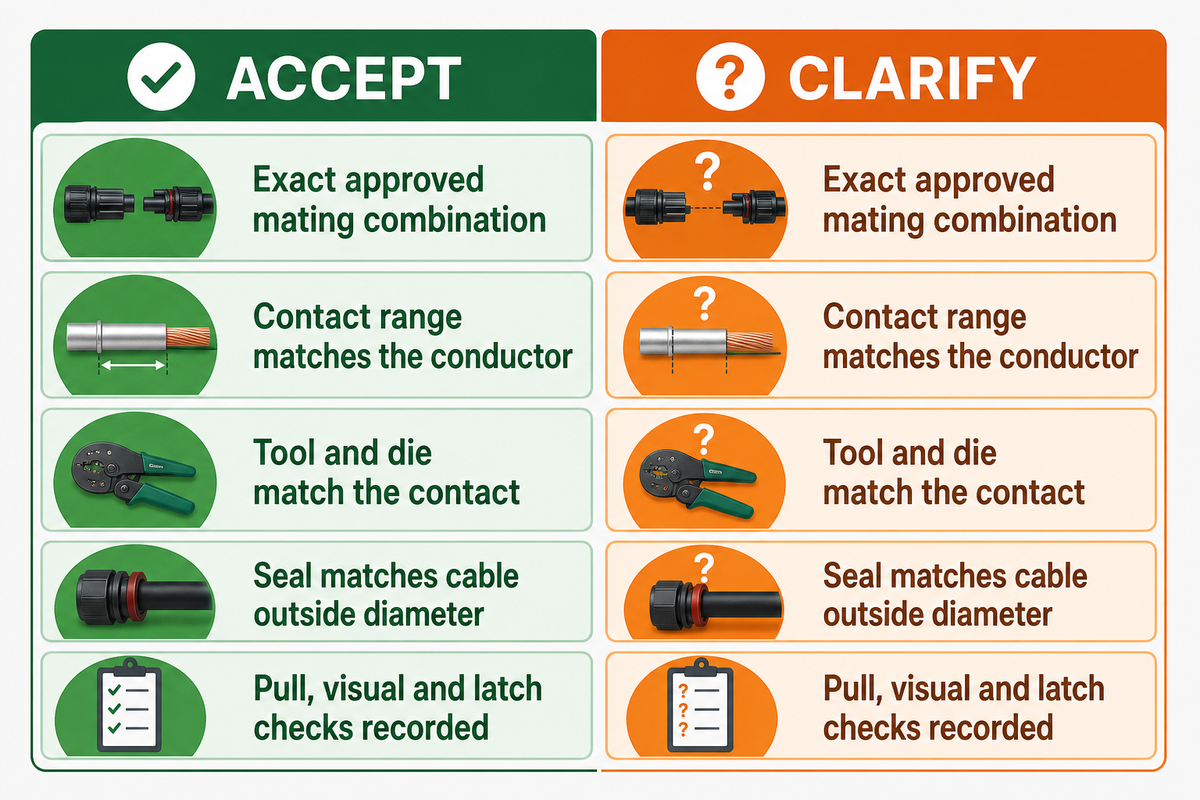
Not all click together connectors form an approved mating pair. Poor installation, mismatch, and poor design or manufacture are risks Sandia National Laboratories describes. In its United States field samples, normal observations were around 25–27°C while hot connectors reached 95°C; Sandia cited a hot condition as a high resistance and a significant safety concern.
The cable specification should therefore name more than “MC4 compatible.” Record the connector manufacturer and part number, contact, housing, seal, approved cable outside-diameter range, conductor cross-section and class, mating approval, strip length, crimp tool, die, locator, calibration and assembly instruction.
Accept
- Exact approved mating combination
- Contact range matches the conductor
- Tool and die match the contact
- Seal matches cable outside diameter
- Pull, visual and latch checks recorded
Reject or clarify
- “Compatible” without part numbers
- Mixed connector families without approval
- Generic crimper with no die record
- Solder added against the assembly instruction
- Open connectors left exposed to dirt or water
From the discussions in forums, it’s clear why buyers ask if it’s necessary to crimp, solder, or both. The answer isn’t based on which is more popular. Assembly must strictly follow the connector manufacturer’s approved method and use the approved tooling. Other modifications (e.g. adding solder) or substituting a contact can affect stress, sealing, and thermal behavior.
Installation and Commissioning Checks That Product Certificates Do Not Replace
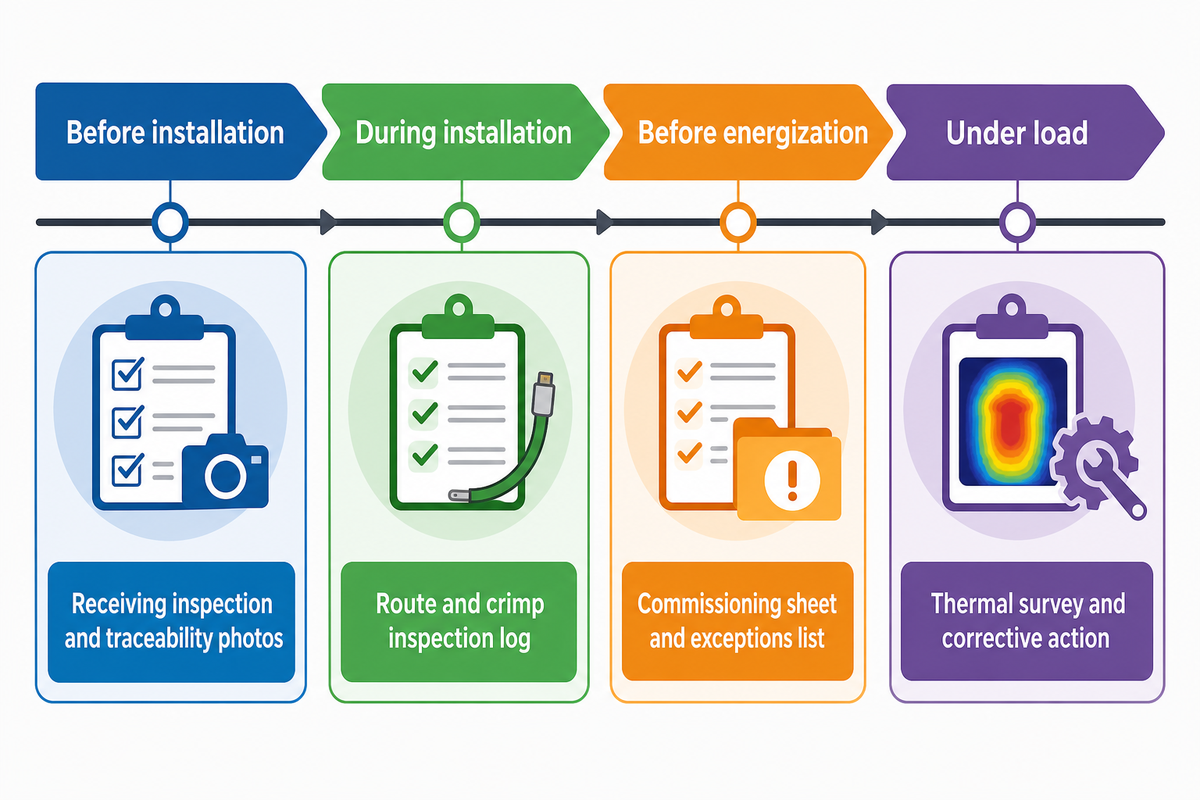
A certificate doesn’t check the cable drum that was delivered, the line built, or the crimp made in the field. Build a handover record at three times.
| Moment | Checks | Record |
|---|---|---|
| Before installation | Drawing revision, drum identity, cable legend, dimensions, packaging damage, certificate scope and lot test | Receiving inspection and traceability photos |
| During installation | Pulling tension, bend radius, sharp edges, support, bundling, polarity, connector exposure and termination method | Route and crimp inspection log |
| Before energization | Continuity, polarity, insulation test as specified, connector latch, labelling, torque where applicable and open-circuit conditions | Commissioning sheet and exceptions list |
| Under load | Thermal anomalies, strain, movement, unsupported cable and water traps | Thermal survey and corrective action |
Consider the test method, limits, and safety controls outlined by the project and the pertinent standards. The checklist doesn’t invent universal field-test values. JINYOU’s PV cable test report guidance and quality and traceability page can assist with the supplier-document side of the handover.
Use the 12-Line Photovoltaic Cable RFQ Lock Before Comparing Price
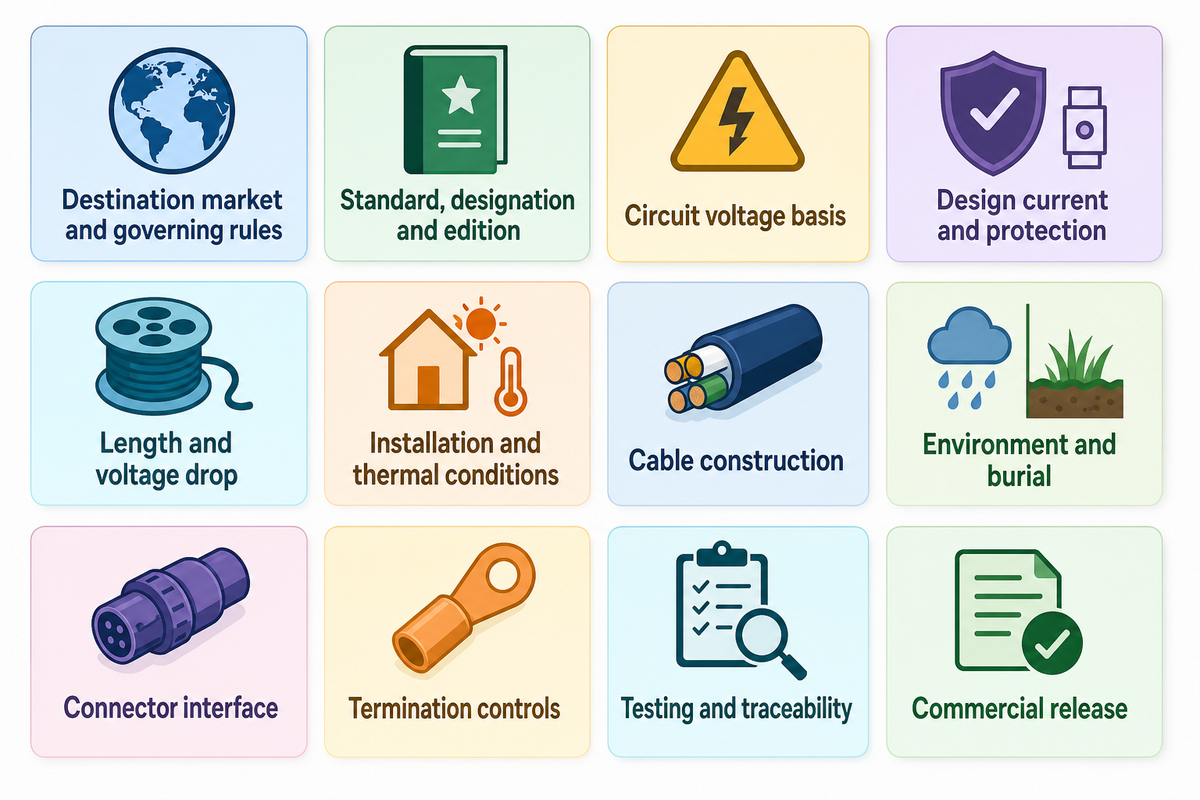
The 12-Line Photovoltaic Cable RFQ Lock is a procurement hold point. Leaving a line blank should show the buyer and supplier are considering different assumptions when conducting their pricing. Prior to price per metre comparison, sample approval, or substitution acceptance, fill out the RFQ Lock.
| # | Input category | Buyer entry | Supplier evidence or response | Owner |
|---|---|---|---|---|
| 1 | Destination market and governing rules | Country, authority, project code | Applicable standard and national adoption | Compliance |
| 2 | Standard, designation and edition | IEC, EN, UL route | Certificate/listing number, scope and validity | Quality |
| 3 | Circuit voltage basis | Operating and corrected maximum | Rated-voltage statement and terminals | Electrical design |
| 4 | Design current and protection | Current factors and protective device | Ampacity and fault-withstand basis | Electrical design |
| 5 | Length and voltage drop | One-way, loop and drop limit | Calculation with temperature basis | Project engineer |
| 6 | Installation and thermal conditions | Air, tray, conduit, soil, ambient, grouping | Derating and installation table basis | Project engineer |
| 7 | Cable construction | Material, class, mm², OD, colour | Drawing and data sheet | Engineering |
| 8 | Environment and burial | UV, water, salt, chemical, rodent, fire | Explicit ratings, tests and route limits | Civil/electrical |
| 9 | Connector interface | OEM, part number, mating pair, cable range | Approved combination and assembly file | System integrator |
| 10 | Termination controls | Strip, tool, die, calibration, inspection | Work instruction and acceptance record | Installation |
| 11 | Testing and traceability | Type, routine, lot, marking and drum | Reports tied to exact size and lot | Supplier quality |
| 12 | Commercial release | Quantity, sample, packing, drawing and date | Minimum, sample terms, schedule and change control | Procurement/logistics |
Apply a simple disposition. If electrical inputs are incomplete, return the request to design. If route or connector evidence is lacking, hold the price comparison. If construction, documentation, lot traceability and delivery terms are acceptable, proceed to sample or quotation review.
The variables that comprise a quotation, minimum order quantity, sample availability, freight responsibility, and lead time, aren’t fixed cable specifications. Request that JINYOU clarify each term in writing against the approved drawing and the required delivery date. Since 2006, JINYOU Cable has focused on cable and integrated electrical solutions for solar, energy storage, and electric vehicle applications, providing original equipment manufacturing support for project specific constructions.
Send your 12-line cable specification
Hidden Bottlenecks After the Cable Drum Arrives
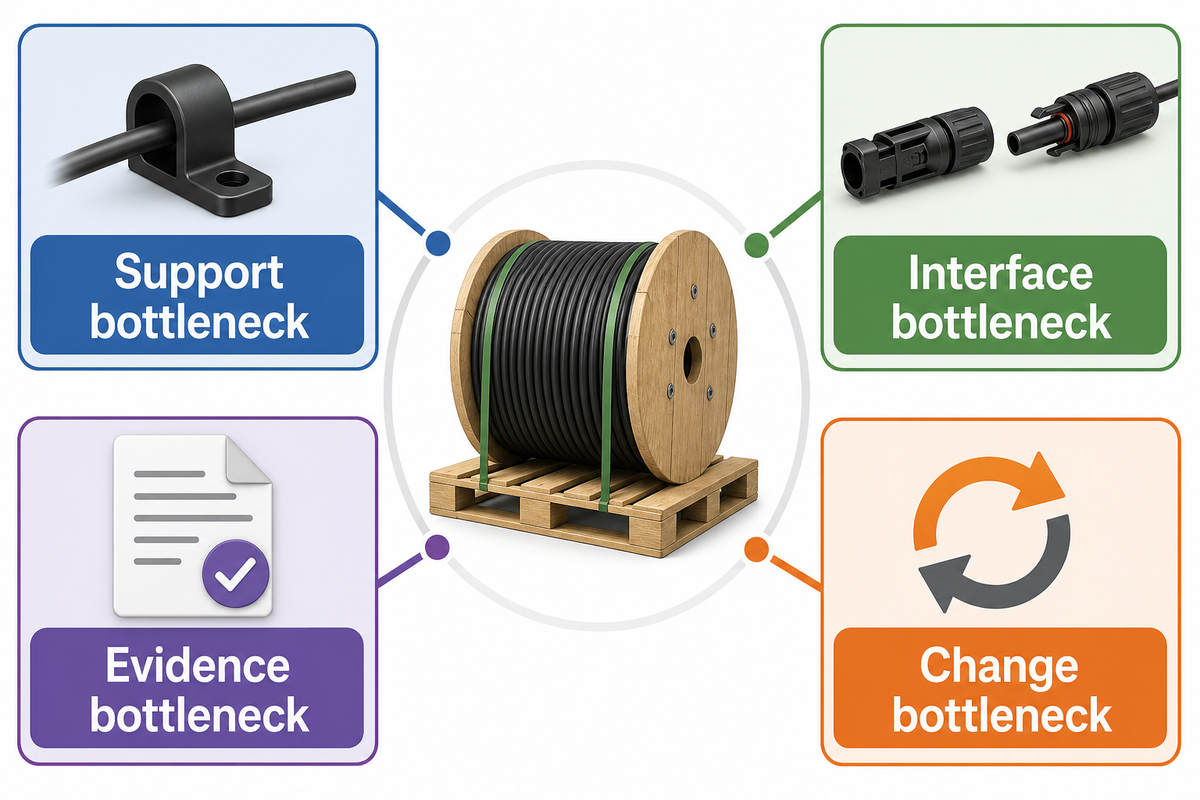
Four groups of people see different aspects of the same risk. The installation manager sees risks that are pulling, bending and supporting. The commissioning engineer sees risks of polarity, insulation and thermal anomalies. Operations sees risks of movement, water and access for maintenance. Safety reviewers see risks due to a mismatch between the approved file and the constructed route.
- Support bottleneck: the cable is correctly rated but the tie, clip or edge protection fails first.
- Interface bottleneck: the conductor is correct but the contact, seal or mating pair isn’t.
- Evidence bottleneck: the cable looks correct but the certificate or lot report can’t be tied to the delivered drum.
- Change bottleneck: a field substitution breaks the approved cable, connector, tool or route combination.
These constraints explain why a product certificate is necessary but insufficient. They can be addressed by a controlled bill of materials, an approved drawing, receiving record and installation inspection with a documented exception process.
What Current Demand Signals Mean for Cable Buyers
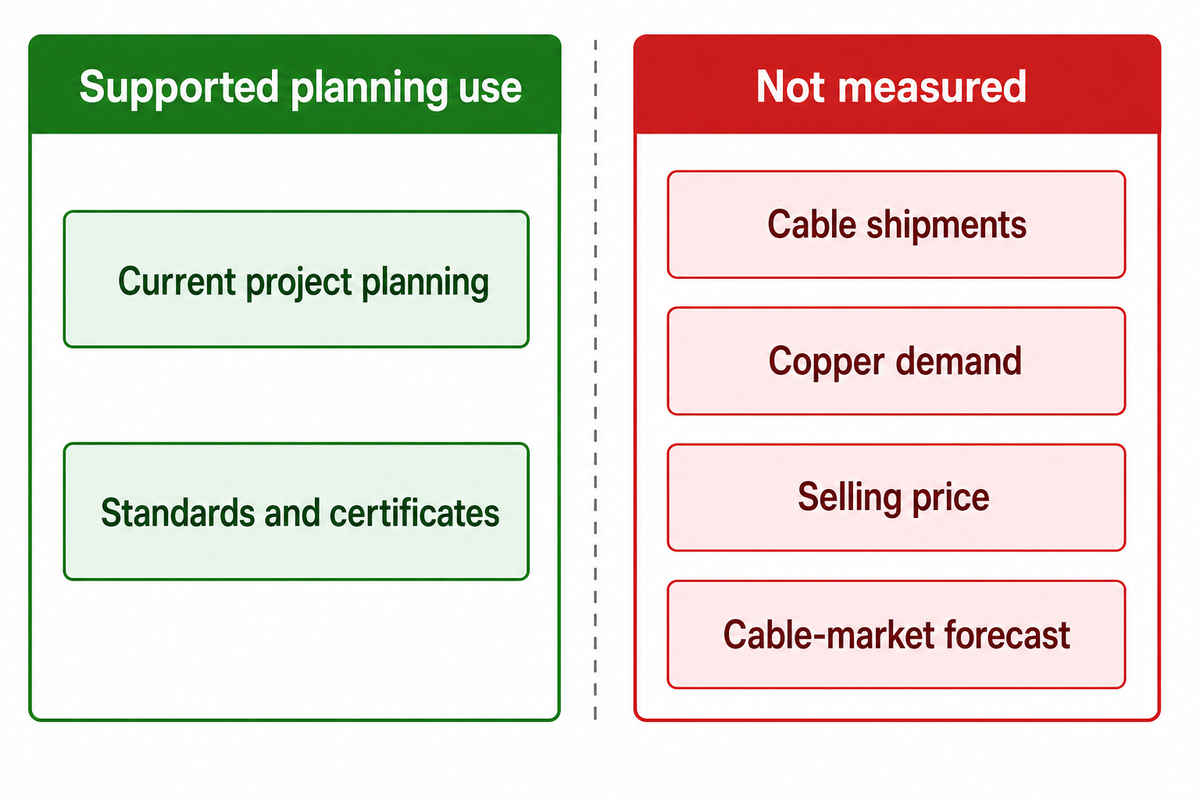
Search demand for photovoltaic cable and broad growth in installed solar capacity show that buyers continue to need wiring decisions. They don’t measure cable shipments, copper demand, selling price, or year over year sales of photovoltaic cable. These signals support current project planning, not a cable-market forecast.
Combining external capacity data with transparent material-intensity assumptions can create a planning scenario, but that’s still not a market measurement. Utility-scale wiring intensity also has substantial uncertainty because layout, voltage, architecture and route differ. For sourcing, the actionable current signal is narrower: standards, certificates, connector evidence and route assumptions need a date-stamped check before each project release.
Data limitation
No transparent, cable-specific year-over-year series was verified in this research run. This article therefore makes no photovoltaic-cable market-growth forecast.
Frequently Asked Questions
What is a photovoltaic cable?
Answer
A photovoltaic cable is a cable made for defined DC connections in a solar power system, including module strings, combiner paths and inverter-side circuits. An exact product may be evaluated for sunlight, water, temperature and voltage duties under a named standard. The category name alone doesn’t approve its size, connector, burial route or use in a particular jurisdiction.
What is the difference between solar cable and normal cable?
Answer
Solar cable is designed and evaluated for specified photovoltaic duties such as DC voltage, outdoor weather, wet conditions, thermal cycling and array wiring. Normal cable may not carry the same construction, ratings or approvals. Compare the exact voltage, insulation, sheath, temperature, sunlight, wet-location, fire, burial and connector evidence rather than assuming every solar cable is superior in every application. A normal cable can still be correct for a protected alternating-current or equipment route when its ratings and local rules match; the decision belongs to the circuit, not the marketing category.
Can you bury solar PV cable?
Answer
Yes, when the exact cable is approved for direct burial and the installation follows the applicable rules. The words PV cable, sunlight resistant or IEC 62930 do not establish that permission by themselves. Check the product marking, listing or certificate, soil and water exposure, cover depth, mechanical protection, transitions and local approval. Then calculate buried-route ampacity using the actual soil and grouping conditions.
Is photovoltaic cable used for AC or DC?
Answer
This photovoltaic cable is primarily for the array’s DC side. After the inverter, select the AC conductors separately.
What information should I send a photovoltaic cable supplier?
Answer
Send the destination market, governing standard and edition, operating and maximum DC voltage, design current, protection, route length, voltage-drop limit, installation method, ambient and grouping, conductor and construction, environmental and burial duty, exact connector interface, crimp controls, testing and traceability requirements, quantity, sample, marking, packing and delivery date. Attach the drawing and identify which assumptions still need the supplier’s engineering response. For connectors, include both mating part numbers and the cable outside-diameter range. For buried routes, state soil, duct, depth and mechanical protection. For North American certification, ask for label evidence from the coil, reel, flange or box plus the product-category record. Finally, identify the person who can approve design clarifications so an incomplete field doesn’t quietly become a supplier assumption.
Make Price the Last Comparison
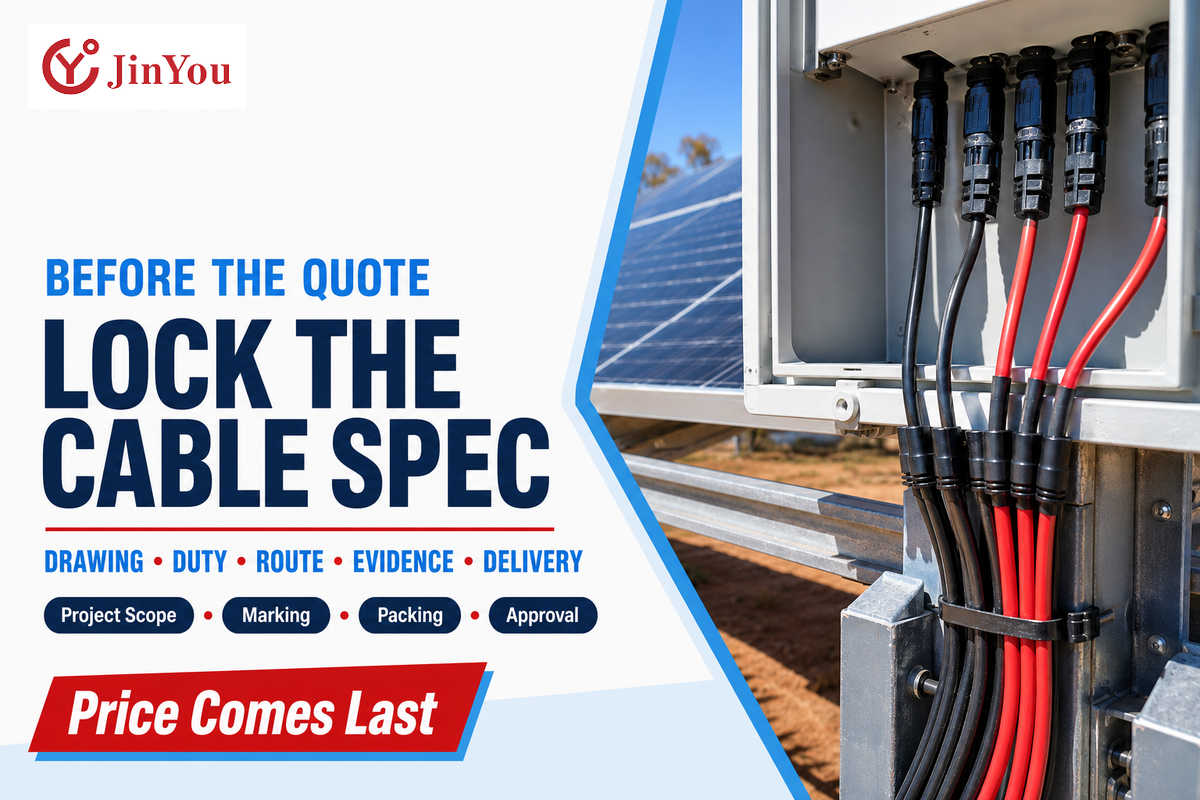
A reliable photovoltaic cable decision matches electrical duty, route, connector system, standard scope and delivered-lot evidence before comparing price. The 12-line RFQ Lock makes missing assumptions visible while they’re still cheap to correct.
JINYOU Cable designs and manufactures cable solutions for solar power, energy storage and electric vehicles from Shanghai, with custom original-equipment manufacturing support. Outline the project scope and detail drawing, marking, and packing instructions in your request for quote to ensure a clear understanding of the scope of the quote and the items still requiring approval for the project.
References & Sources
- IECEE, IEC 62930:2017 standard record.
- IEC, IEC 62548-1:2023 plus Amendment 1:2025 consolidated version.
- DIN Media, DIN EN 50618:2015-11 record.
- UL Solutions, Wire and Cable Application Guide.
- U.S. Department of Energy, Solar Photovoltaic Cable Management Best Practices.
- Sandia National Laboratories, PV Connectors project.
- TÜV Rheinland, international requirements for PV cable manufacturers.
Technical transparency: JINYOU product values in this article are manufacturer-published first-party information checked on September 11, 2026. The final assessment of whether the values meet the requirements shall be subject to the applicable code, authority, designer, certificate scope and approved project documentation.