
Get in touch with JINYOU Cable Company

Updated September 2026
PV1-F cable is a familiar photovoltaic-cable designation associated with TÜV Rheinland’s 2 PfG 1169 test basis. It tells you something about the document family behind an older cable marking. It does not confirm that a cable fulfills the requirements for a new project in terms of specification, product listing, construction, route, or acceptance.
It is therefore not necessary to determine whether the name is generally considered “good” or “obsolete.” Rather, the project route and market needs must be determined, the correct product evidence compiled, the required conductor size computed from the given inputs, and the installed interfaces assessed. This guide provides a means for engineering, procurement, and quality teams to perform this function. Product ranges, order details, and quotation decisions continue to be the purview of the commercial solution, and as such, won’t be repeated here.
The short version
Treat PV1-F as an identity clue, not an acceptance verdict. Match the marking, datasheet, certificate, and order record, then complete the market-specific listing and installation checks.
What the PV1-F Designation Actually Identifies
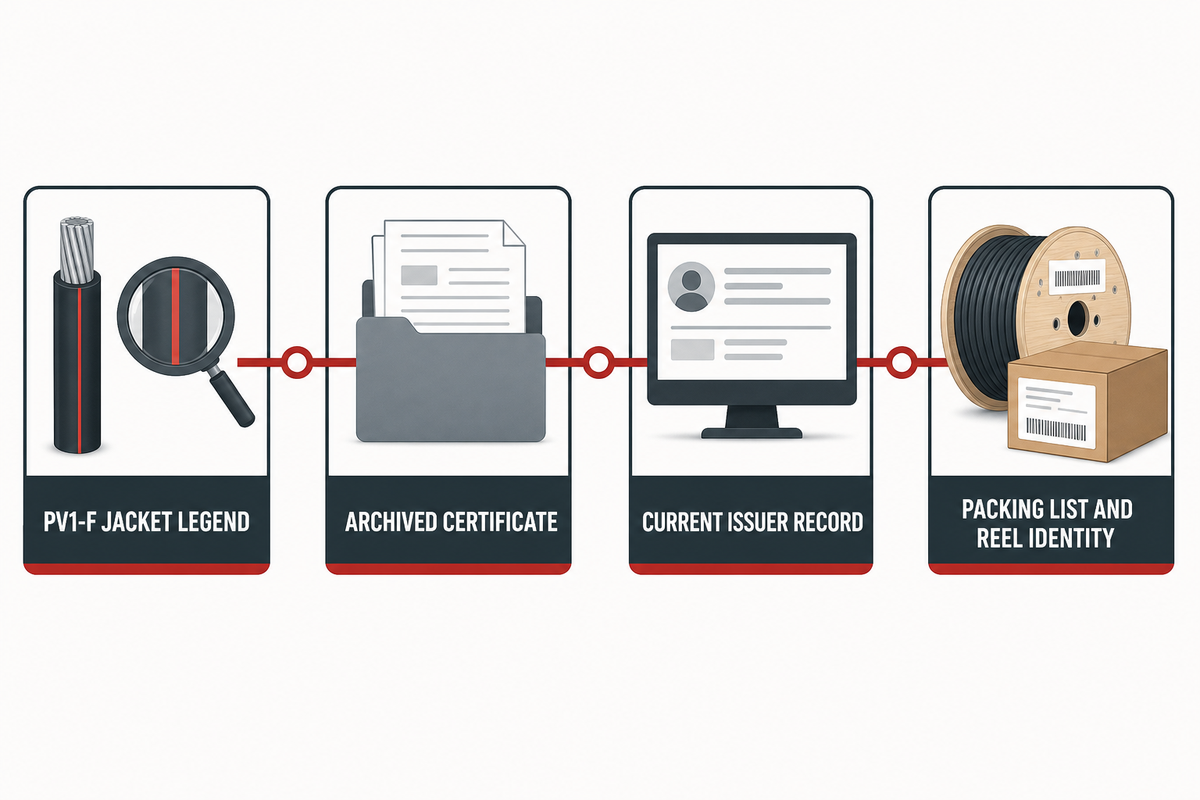
PV1-F appears on cable jackets, data sheets, quotations, archived certificates, and search results. In the reviewed documents for this guide, the designation is associated with 2 PfG 1169/08.2007. This is useful provenance: it allows a reviewer to identify the document family and the tests a supplier is referring to. Provenance isn’t the same as current authorization for a specific market or project.
Two archived Jinyou documents help explain the distinction better. Certificate T 50352147 identifies a PV1-F single-core family, while T 50488532 identifies a twin-core family. Each document gives a type, voltage, temperature limits, and an issue date. Both have a notice that states that the certificate is valid only until 27 October 2017 for the European Union. 2020 was the year the twin-core document was issued which supports the fact that the issue date can’t be used as a surrogate for validity in the current market. Those historical files can be found in the Jinyou certification document index.
| Evidence category | What it can establish | What it cannot establish alone |
|---|---|---|
| PV1-F jacket legend | A marking to compare with controlled documents | Current certificate status, route approval, or delivered-unit traceability |
| 2 PfG 1169 reference | The historical test-document route being claimed | Automatic equivalence to IEC 62930, EN 50618, or a United States listing |
| Archived certificate | Certificate identity and the scope printed on that document | Current validity when the document itself states a limitation |
| Controlled datasheet | The stated construction, ratings, dimensions, and product range for its revision | Independent certificate status or delivery of the described product |
| Current issuer record | Holder, model scope, standard, status, and limitations shown by the issuer | Conformity of an unidentified reel or approval for every market |
| Purchase order or submittal | The construction and evidence the project requested or approved | That the physical delivery matches the approved description |
| Packing list and reel identity | A traceability bridge between shipment records and physical units | Material properties or installation suitability |
| Complete listing mark | Identity evidence for a particular listed unit when checked against the directory | Approval of the circuit design or installed route |
| Incoming or field inspection record | Observed condition and test results for its stated sample or scope | Unmeasured characteristics, root cause, or lifetime performance |
| Terminology to match across the inquiry and records | PV1-F solar cable; PV1-F cable specification; PV1-F datasheet; solar PV cable; standard solar cable; types of solar cables | Evidence of current certification, listing, or project suitability |
A defensible specification uses the designation to find the correct evidence. It never allows the designation to stand in the place of evidence.
| Search or document label | Published evidence to check | Acceptance boundary |
|---|---|---|
| solar project; solar industry; solar energy; photovoltaic power; solar power; use in photovoltaic | The current route can reach 1.5 kV DC. | Do not assign a rating from an application label alone. |
| solar systems; solar energy systems; solar modules; solar panel arrays; residential solar; residential and commercial solar | Use the 90 °C normal continuous maximum and the 120 °C / 20,000 h condition only within the exact IEC scope. | Identify the module, array, and installation context. |
| solar farms; floating solar; floating solar farms | The 1.5 kV DC scope does not establish site exposure suitability. | Add the actual water, ultraviolet, routing, and support conditions. |
| cable PV1-F; DC cable; core solar cable; extension cable; solar wire; older PV1-F; cable price | Archived families show 1 × 2.5–16 mm² and 2 × 2.5–16 mm², DC 1.0 kV, and AC 0.6/1 kV. | Match the exact document, model, and supplied unit. |
| PV cable specification; compare PV1-F; key differences; differences between these two; types of cables | Retain the distinct 1 × 2.5–16 mm² and 2 × 2.5–16 mm² archived scopes. | Compare fields, not labels. |
| H1Z2Z2-K solar; H1Z2Z2-K solar cables; use H1Z2Z2-K; two solar cable standards; European standard | IEC 62930 reaches 1.5 kV DC and records 90 °C, 120 °C, and 20,000 h conditions. | Check the named standard, edition, certificate, and market route. |
| 1000V; 1500V DC; 1500V DC systems; rated for 1500V DC; UL 4703 PV wire; high voltage | Archived records show DC 1.0 kV and AC 0.6/1 kV; the newer scope can reach 1.5 kV DC. | Keep the document label attached to every voltage. |
| flexible tinned copper conductor; red and black; UV radiation; low smoke zero halogen | The archived construction range is 2.5–16 mm². | Verify compound, color, and conductor evidence for the supplied model. |
| flame retardant; fire safety; CPR | The EN 50618 note refers to an expected 25 years under its stated normal conditions. | Do not turn a standards note into a warranty or a fire-performance claim. |
Separate identity, status, and suitability
Often, reviewers simplify three separate decisions to one approval box. Identity asks whether the marking and records refer to the same cable family and supplied unit. Status is about whether the cited certificate or listing is in force and relates to the stated model and range. Suitability is whether the product meets the actual circuit, route, equipment, market, and contract. Deciding one doesn’t decide the other two.
This separation makes it easier to keep an evidence register. For each record, include the title, number, revision or issue date, the document issuing authority, the document holder, the model range, the standard and edition, any limitations, the source address, the date the record was retrieved, and the reviewer. Mark the record “historical” when it explains a designation but cannot support current acceptance. Mark it “pending” when a directory check, controlled revision, or unit delivered check is missing. This is more informative than filing every recognized logo under “certificate received.”
PV1-F vs H1Z2Z2-K Is a Standards Question, Not a Label Swap
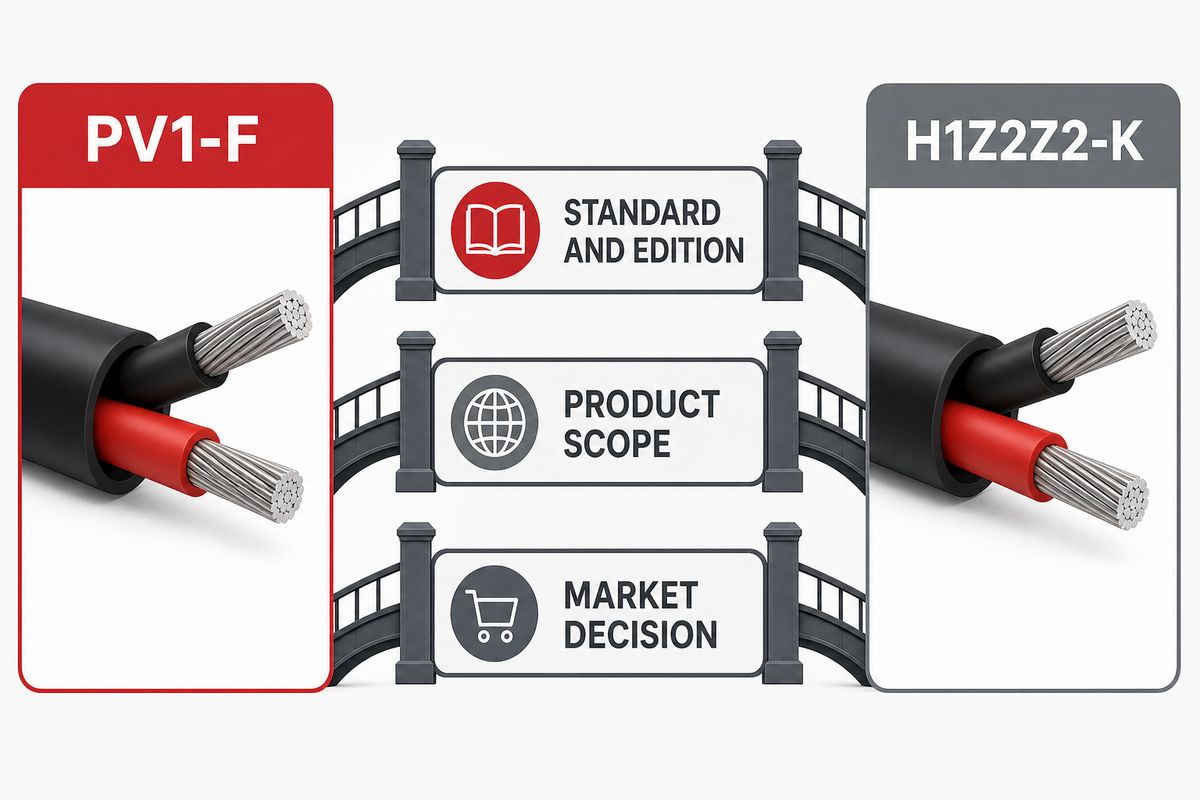
Commercial comparisons often reduce PV1-F versus H1Z2Z2-K to “old versus new,” or claim that one cable is simply better. Such broad comparison frames are not adequate for checking certificate fields or project acceptance. In order to make an adequate assessment, the reviewer requires the cited standard and edition, voltage scope, construction, conductor count, marking, certificate model range, target market, and project acceptance rule. A slash-separated product label can’t do that.
The current public records demonstrate the scope discipline required. The IEC publication record for IEC 62930:2017 describes single-core cross-linked insulated power cable with a cross-linked sheath for the direct-current side of photovoltaic systems, up to 1.5 kV between conductors and between conductor and earth. The record covers halogen-free low-smoke constructions and constructions that may contain halogens. A standard number therefore does not justify adding a halogen-free claim unless the exact product evidence supports it.
EN 50618 follows a different standards route. A national-standards record for EN 50618 describes low-smoke, halogen-free, flexible single-core cable for the photovoltaic direct-current side. Its frequently repeated 25-year figure appears as a note about the expected period of use under the normal conditions specified by the standard. That wording is not a universal manufacturer warranty or proof of service life in every installation.
Issuer records also require attribution. TÜV Rheinland Certipedia currently shows:
- R 50349329 for Jinyou H1Z2Z2-K single-core 1.5–240 mm² under EN 50618:2014;
- R 50482064 for the named Jinyou IEC 62930:2017 single-core product/model scope; and
- J 50483940 for Jinyou H1Z2Z2-K twin-core 2.5–16 mm² under EN 50618:2014, as the issuer records it.
These records aren’t blanket certificates. They’re three different scoped statements. They do not revive an archived PV1-F certificate or prove that an unexamined cable is interchangeable with one of the listed families. If the project is focusing on h1z2z2-k, assess the evidence related to the cable and then, for the product-related discussion, use the H1Z2Z2-K cable only.
Why the numbers still need a document label
Technical values can be accurate and still be misapplied. The archived Jinyou single-core PV1-F certificate identifies a 1 × 2.5–16 mm² family; the twin-core certificate identifies a 2 × 2.5–16 mm² family. Both show DC 1.0 kV and AC 0.6/1 kV ratings, an ambient range of -40 °C to +90 °C, and 120 °C as the maximum conductor value printed on those certificates.
These numbers explain the scope of the archived documents. They do not establish current validity for the European Union, and they must not be copied into a new specification unless the proposed product and applicable route are verified.
The IEC 62930:2017 publication record describes a different scope: rated DC voltage up to and including 1.5 kV between conductors and between conductor and earth. It states a normal continuous maximum conductor temperature of 90 °C and limits use at a maximum conductor temperature of 120 °C to 20,000 h. The 120 °C figure is therefore not a normal continuous operating target. Nor does the IEC scope prove that the terminal, connector, enclosure, or nearby equipment permits the cable to operate at that temperature.
Four labels should always be associated with a value: the document, the product scope, the condition, and the decision use. For example, “1.5 kV DC” may be interpreted as a full project voltage approval without its IEC 62930 scope. Without a time limit, “120 °C” may be interpreted as a continuous rating. “2.5–16 mm²” without its family, single or twin core, may be used in the wrong construction. The labels prevent a valid source value from being interpreted as a false blanket claim.
This is also the reason a quote should include enough detail to include decimal and unit as well as limiting language and the count of conductors. If a new document or revision is proposed by a supplier, the comparison value may be replaced after the new scope is verified. The superseded value should be retained in the document with a clear disposition so different teams aren’t working with different versions of a product record.
In a substitution review, a two-column schedule should be prepared instead of comparing marketing names. The cable being requested should be in one column and the cable being offered in the other. Compare every field that the project controls: standard and edition, certificate or listing route, rated voltage, conductor count and range, conductor class and material, insulation and sheath system, dimensions, temperature conditions, environmental claims, connector and terminal compatibility, and permitted installation methods. A blank field isn’t an equivalence; it’s an unresolved information request.
Build the Market and Standards Route Before Reading a Datasheet
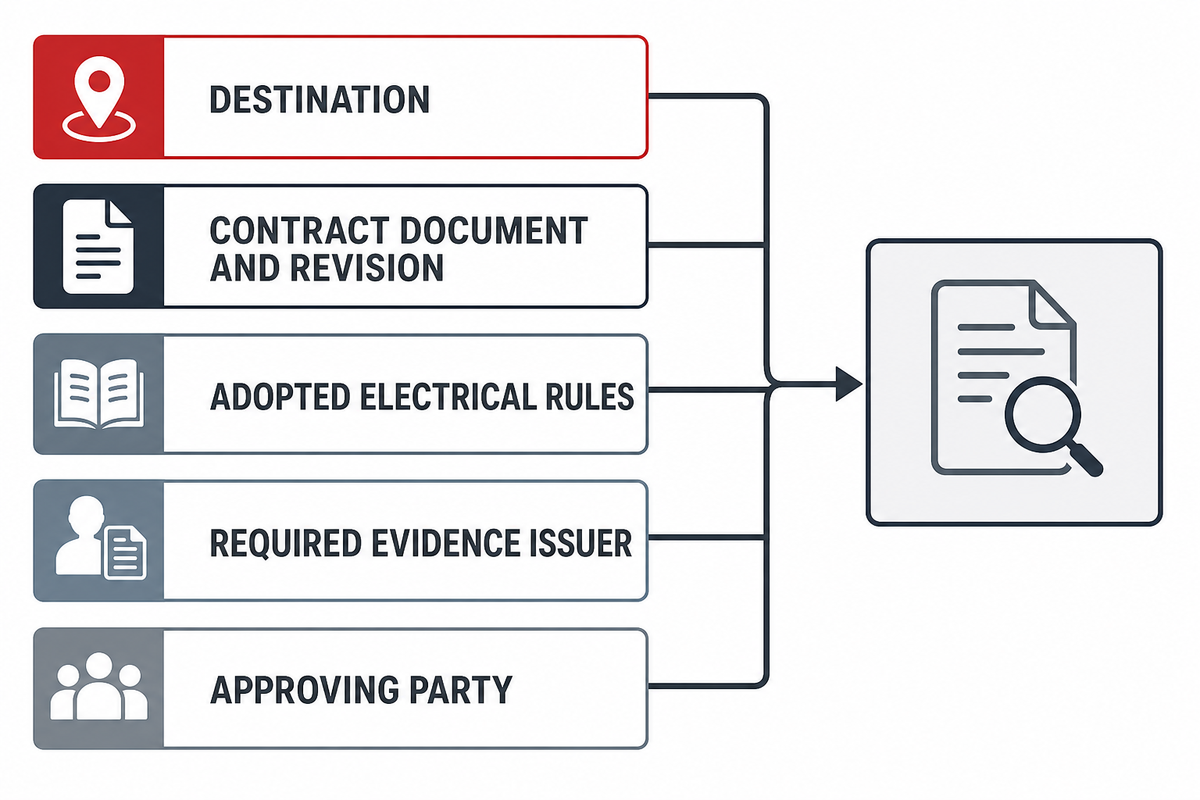
A cable document becomes relevant only after the project identifies the route it must satisfy. An international tender may cite IEC 62930. A European specification may cite EN 50618 and other project requirements. A United States installation needs the applicable locally adopted electrical rules, product listing, equipment instructions, contract documents, and acceptance by the authority having jurisdiction. A European or IEC certificate must not be described as a United States listing.
| Route | Start with | Do not infer |
|---|---|---|
| IEC-based project | Specified IEC edition, exact product evidence, project voltage and installation conditions | That citing IEC 62930 proves a named cable complies |
| European project | Contracted EN route, current issuer record, declaration/document scope, local requirements | That an archived PV1-F file remains valid |
| United States project | Adopted code, required listing/category, complete package mark, directory identity, equipment and installation rules | That jacket wording or a TÜV certificate supplies UL listing evidence |
UL’s official Wire and Cable Application Guide makes the delivered-unit issue explicit. Surface printing of wire or cable is considered supplementary data. The complete Listing Mark on the tag, reel, or smallest package is the evidence used to identify a particular listed unit. Where a UL listing is specified, compare that complete mark with the certification-directory record and the product delivered. Don’t add “UL listed” to an inquiry merely because a jacket legend looks familiar.
The solar cable standard and line router can help organize the first market-and-circuit questions. The responsible project team still decides the governing route and accepted evidence.
The implementation of the route should be described in the request for offer. A statement of route should specify the destination, the contract document and revision, the adopted electrical rules, the product standard or listing, the evidence issuer, and the approving authority. If multiple destinations are involved, a route for each should be provided. One certificate package shouldn’t be assumed to clear all countries because the cable construction appears to be similar.
Then control changes. If the destination, authority requirement, equipment instruction, standard edition, conductor range, or proposed product changes, reopen the affected checks and record the new evidence. This keeps an early technical approval from being silently reused after the commercial or installation basis has moved.
Read Conductor, Insulation, and Sheath Claims as Evidence
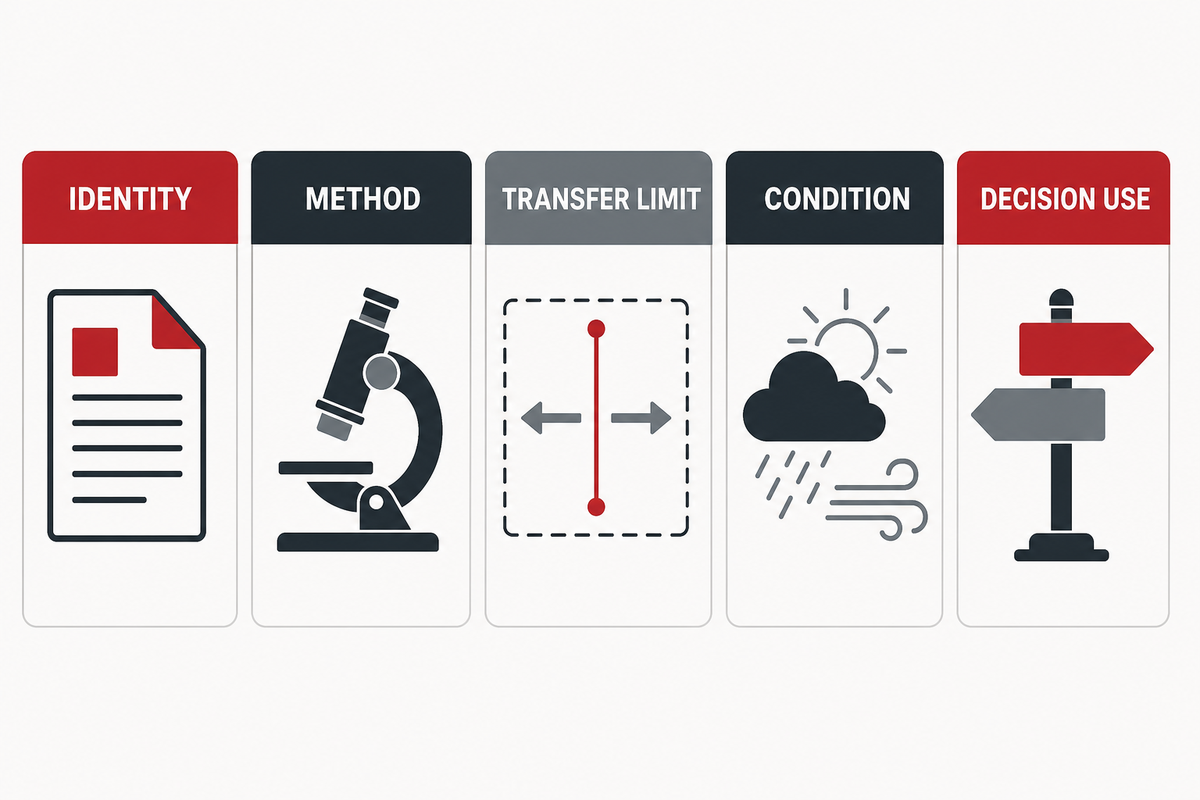
Material words in technical documentation may seem precise, but each of these words needs a product identity and a documented construction method. “Tinned copper” should lead to conductor class, nominal cross-section, strand construction, resistance data, and the document revision that describes the offered cable. “Cross-linked” should lead to the insulation and sheath system, test basis, temperature scope, and model covered. “halogen-free,” “low smoke,” “UV resistant,” “water resistant,” and “direct burial” aren’t equivalent properties.
The archived twin-core PV1-F construction form lists a tinned copper conductor, Class 5 conductor construction, halogen-free cross-linked polyolefin insulation and sheath, and dimensions for 2.5–16 mm². It doesn’t corroborate that all current products sold under the same name are manufactured with the same materials and dimensions. An offer in the market should carry an accompanying managed data sheet and supporting evidence.
It isn’t acceptable to change the document’s material description to a generic xlpe. Cross-linked polyethylene and other cross-linked compounds can be discussed in broad cable education, but acceptance depends on the exact formulation and terminology stated for the product. The same applies to the outer sheath: color, compound, thickness, outside diameter, and environmental claims must be read from the controlled product evidence, not inferred from a photograph.
Use a three-part reading rule:
- Identity: What manufacturer, product family, model, conductor count, cross-sectional range, and version of the document is being referred to in the statement?
- Method: With reference to which standard, test or declaration, or supporting record, has the statement been made and under which circumstances?
- Transfer limit: To which construction and lot does the statement pertain: the offered construction and lot or a family of documents and a sample?
A procurement team can use Jinyou’s testing and standards evidence to locate company-published documentation. Treat company web pages as first-party evidence. Independent certificate status is still from the named issuer’s record.
Apply the same discipline to incoming inspection. The datasheet describes the controlled product claim; the delivered reel still needs a traceability bridge. Log the reel or drum identifier, product legend, conductor count and size, length, packing condition, manufacturer identity, lot reference (if provided), and the revision document furnished along with the order. If the inspection plan requires either a dimensional or an electrical test, capture the test method, sample ID, equipment, acceptance criteria, result, and disposition. A passing test result for one sampled characteristic should not be considered evidence of all other claims regarding material or long-term performance.
Choose Cable Size From Circuit and Route Inputs
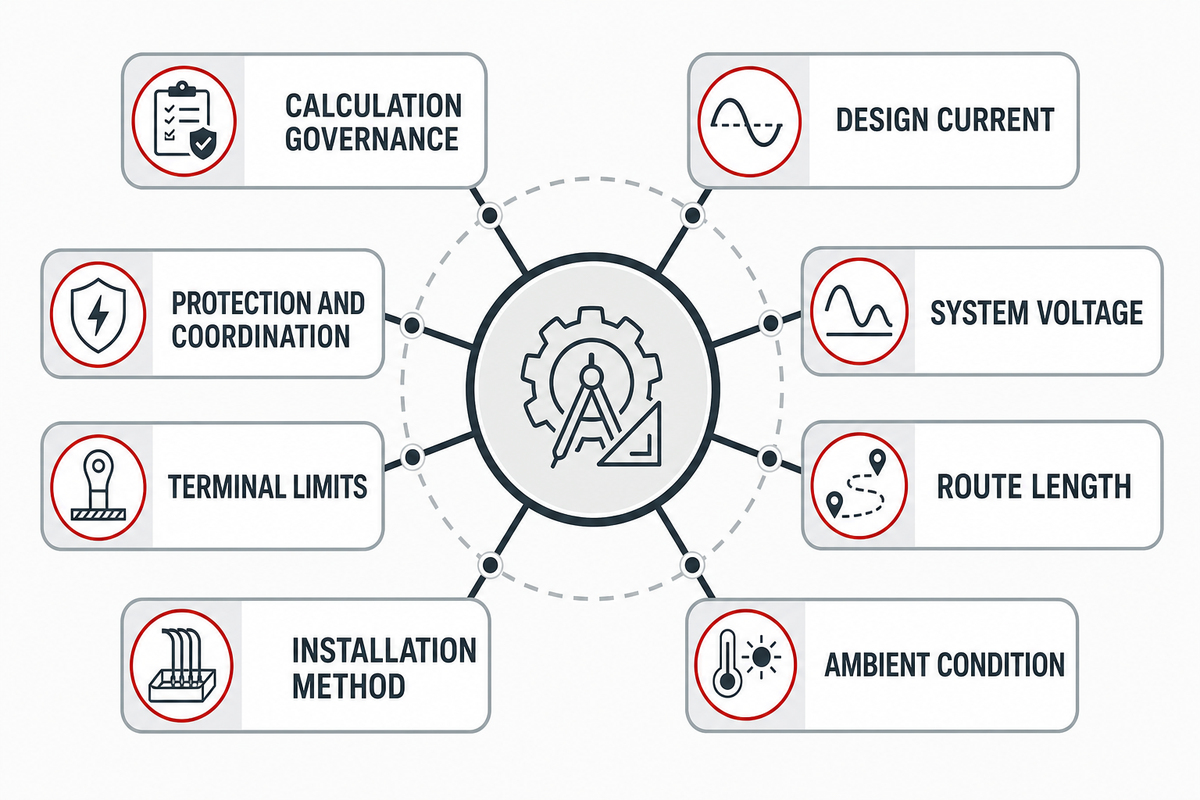
There’s no safe universal answer to “What size PV1-F cable do I need?” A 4 mm² or 6 mm² rule copied from another project hides the calculation basis. The same nominal current can lead to a different decision when route length, allowable voltage drop, ambient temperature, rooftop exposure, grouping, installation method, terminal limits, protective devices, or the locally adopted code changes.
Before an engineer assesses conductor cross-section between a solar panel string and downstream equipment, freeze an input register:
- module short-circuit-current basis, including the applicable listed ratings and manufacturer instructions for bifacial or multiple-surface exposure where relevant, string arrangement, parallel sources, and the design-current method required by the adopted rules;
- maximum system voltage, required cable voltage rating, and voltage basis as documented in the project;
- one-way route length, conductor material, resistance basis, and allowable voltage drop;
- ambient and rooftop temperature assumptions, solar exposure, and any correction or adjustment factors;
- installation method, raceway or free-air condition, conduit fill where applicable, bundling, and the number of current-carrying conductors;
- terminal temperature ratings, connector and equipment conductor-range limits, bend and pulling constraints;
- overcurrent protection, equipment coordination, fault duties, and the locally adopted code edition; and
- the tables, software revision, calculation owner, reviewer, and approval record.
While related, check voltage drop and ampacity individually; a section that meets a voltage-drop criterion may still fail an ampacity, terminal, protection, installation, or mechanical requirement. A cable with a high printed temperature doesn’t allow the designer to ignore equipment-terminal limits or installed-condition derating.
Engineering note: suppose a project records the circuit basis, route length, ambient condition, grouping, installation method, terminal ratings, and permissible voltage drop. Those inputs are sufficient to begin the applicable engineering calculation. They are not sufficient for this article to issue a conductor size, because the adopted rules, tables, correction factors, protective-device coordination, and approved design method still control the answer.
If the project already has the governing inputs, the DC string voltage-drop and cross-section sizer can be used to perform a preliminary check. Outputs from this software require project review and shouldn’t be misconstrued as approval or a replacement for the applicable calculation.
Keep the calculation auditable
A good calculation sheet documents more than the selected cross-section. It states the source of each input, units, applicable table or equation, conductor operating condition, correction factors, assumed conductor temperature for resistance, route length convention, protection basis, result, margin, and reviewer. It also includes the cable and equipment ranges against which the result was checked. This allows another engineer to reproduce the same conclusion if a module, inverter, route, or local rule is changed.
Run the checks in a controlled sequence: establish the required current basis, apply installation and temperature adjustments, confirm conductor and terminal limits, coordinate protection, calculate voltage drop using the declared route and resistance assumptions, then check mechanical and interface constraints. The order isn’t a universal design formula. It is a documentation discipline that prevents a favorable voltage-drop number from hiding a failed installation condition.
Treat Connectors, Routing, and Conduit as System Interfaces
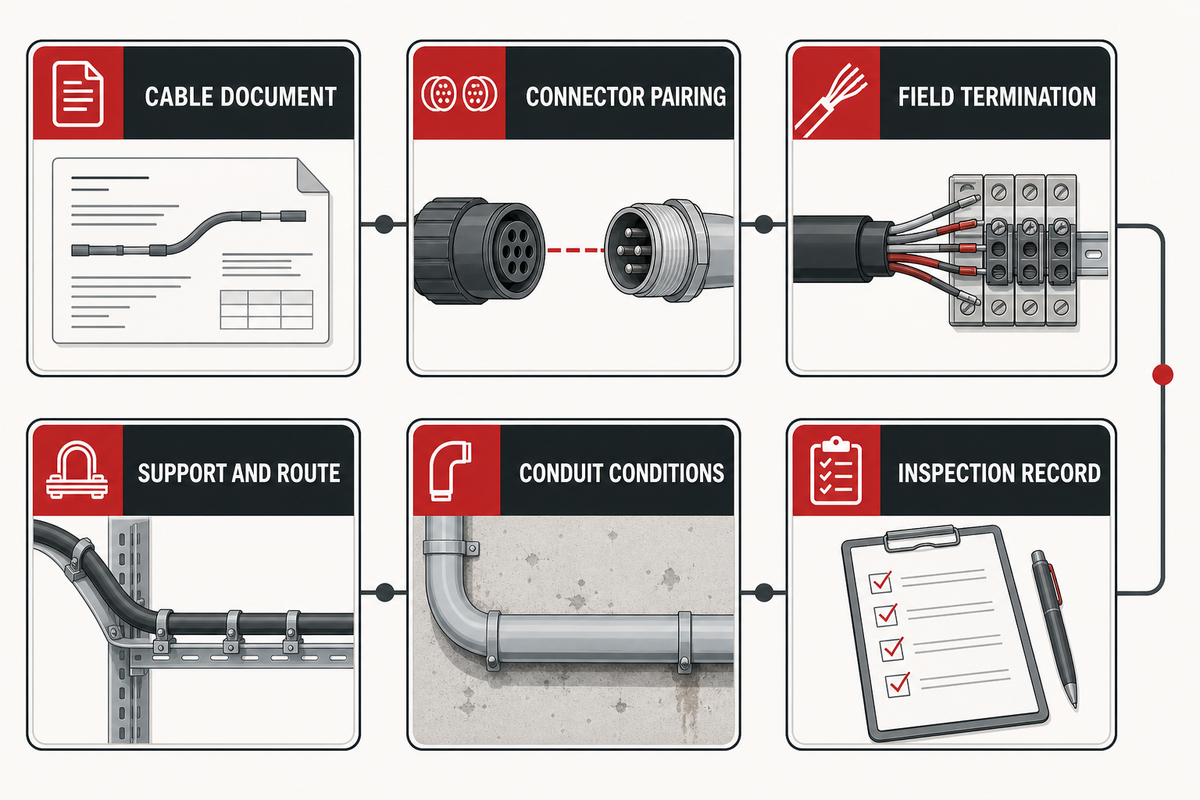
A correct cable document can’t resolve an improper connector, poor field termination, unsupported span, sharp edge, tight bend, unsuitable raceway or unrecorded route change. These are system-interface concerns. They deserve their own identity, instructions, workmanship control, and inspection records.
Sandia’s photovoltaic connector program addresses concerns associated with the safety risks related to poorly installed, poorly matched, poorly designed, and/or poorly manufactured connectors. A peer-reviewed study available through OSTI examined 6,276 harvested rooftop-PV connectors. While these are useful for inspection planning, the sample was supplied by one installer for residential systems and included connectors with known issues. It must not be turned into a universal failure rate or a PV1-F cable-performance claim.
Can PV wire be run in PVC conduit?
Sometimes a project can use an approved wiring method involving PVC conduit, but the PV1-F name alone can’t answer the question. Verify the cable or conductor listing, the applicable raceway and wet-location rules, the route, the number of conductors, fill, temperature, support, bends, entries, pulling methods, equipment terminations, and the requirements of the local authority. PNNL’s solar PV conduit guidance repeatedly directs readers to local code officials and manufacturer instructions. This isn’t a broad approval to install a PV1-F route.
For connectors, record both the mating halves, manufacturer and family, part numbers, conductor size and construction, cable outside diameter, assembly tool, preparation dimensions, torque or assembly method as indicated, and inspection outcome. A photograph of heat damage can document condition; it cannot establish root cause on its own.
Route changes should be treated equally to product changes. Moving a cable from a supported open route to conduit can impact temperature, fill, pulling, moisture, entry and inspection conditions. Grouping can even be impacted by adding adjacent circuits. Substituting a connector can change the approved conductor and outside-diameter range. Record the proposed change, the affected calculations and instructions, the approving party, and the as-built update before closing the field instruction.
Commissioning records should indicate precisely what was inspected rather than simply stating “cable OK”. For each inspection, indicate the circuit and location, the test and/or inspection method, the acceptance criterion, the status of the test instrument and calibration, if applicable, the inspection result and exception, if any, corrective action taken, if any, and the resulting inspection. This record does not turn a field inspection into a product certification. This record is intended to capture the as-built condition of the installation and connect it to the project acceptance decision.
Run the 4-Document PV1-F Cross-Check, Then Verify the Unit
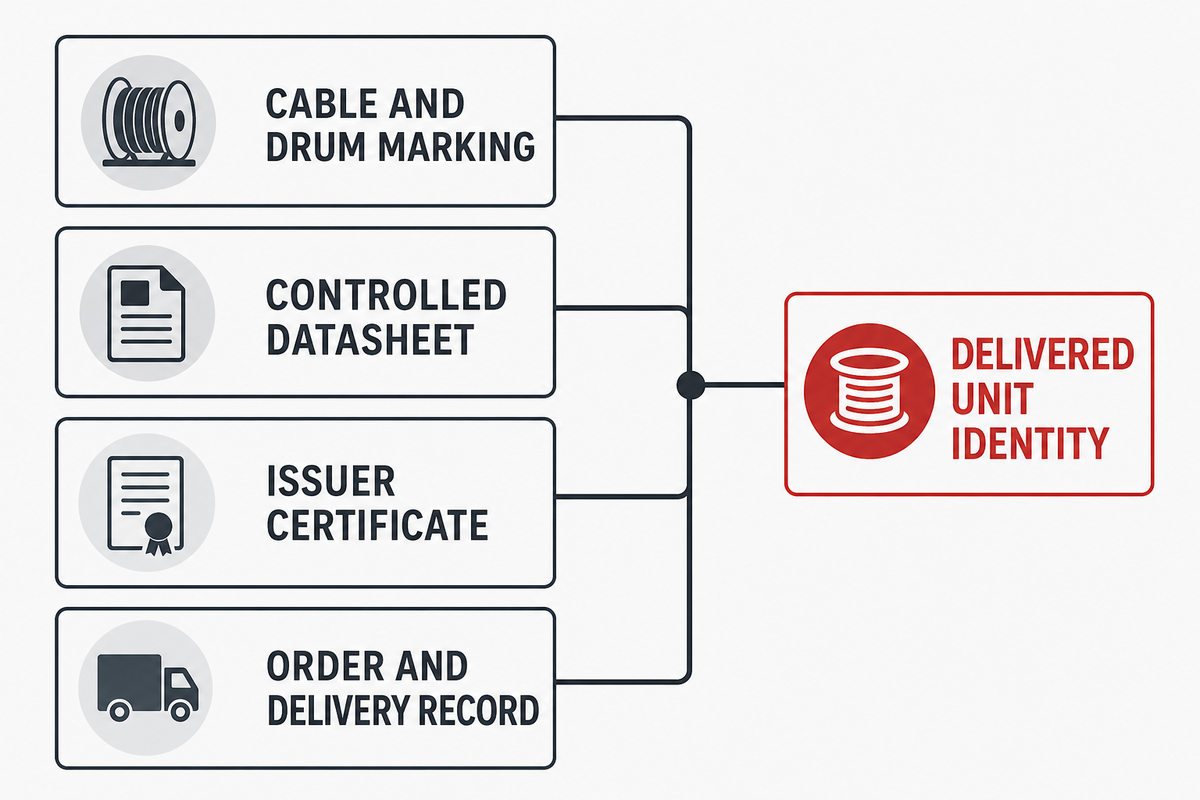
The 4-Document PV1-F Cross-Check is an editorial method for detecting identity drift before acceptance. It compares four records that tend to move through different teams:
| Record | Fields to match | Typical mismatch |
|---|---|---|
| 1. Cable/drum marking | Manufacturer, designation, standard legend, voltage, conductor count/size, lot or traceability code | The jacket names a related family but not the one on the approval document |
| 2. Controlled datasheet | Document number/revision, construction, dimensions, ratings, test references, environmental claims | A generic sheet covers a wider range than the certificate or delivered product |
| 3. Issuer certificate | Issuer, holder, certificate number/status, model, standard/edition, range, limitations | A recognizable mark is shown without a number or with an archived scope |
| 4. Order and delivery record | Part/model, construction, size, length, quantity, document pack, lot/drum identity, approved deviations | The purchase description is abbreviated and cannot be tied to the delivered reel |
Run the check field by field. Green means that identifiers agree and the evidence scope satisfies the requested construction. Amber indicates a missing or ambiguous field that requires a named owner. Red means the records identify different families, standards, ranges, or validity conditions. Do not close a red mismatch by writing “equivalent” in an email; obtain the controlled evidence and a project decision.
- Freeze the requested identity. Record the project market, standard and edition, circuit, conductor count and size, voltage, construction, quantity, and evidence required.
- Read the physical marking. Note the complete repeat legend and identify reel/drum without filling in or guessing the abbreviations.
- Compare the controlled datasheet. Verify the revision, model range, construction, ratings, tests, and claim conditions.
- Resolve the issuer record. Look up the certificate number and verify the holder, status, model/family scope, standard, range, and limitations.
- Tie the order to the delivery. Match purchase description, approved submittal, packing list, lot/drum identifiers, and deviations.
- Complete the market-specific unit check. For a United States listing requirement, verify the complete reel/package Listing Mark and certification-directory identity; jacket printing is not sufficient.
- Route every exception. Assign an owner, required evidence, due date, disposition and release condition. An unresolved exception is open.
Framework boundary
The four-document check verifies identity consistency. It does not certify the cable, calculate the design, prove a United States listing, approve the route, or replace the authority having jurisdiction.
Where available, a solar cable certificate verifier can help organize the certificate-number lookup. The decisive evidence remains the issuer’s own current record.
Use an exception log next to the comparison. Each row should state the mismatched field, the two conflicting values, the affected reels or circuits, the risk to the specified route, the evidence requested, owner, due date, and release disposition. “Supplier confirmed” is not a useful closeout by itself; attach the controlled document, issuer record, approved deviation, or other evidence that resolves the exact field. Keep rejected and superseded documents for future reviewers to see why they weren’t used.
Before they arrive, determine the manner in which the project will sample markings, drums, packing records, and traceability. The sampling plan and acceptance rule are the responsibility of the contract or inspection plan, not this framework. Should a discrepancy occur, implement the project’s hold and escalation process to the defined lot or affected scope. Do not quietly limit the finding to the first reel examined.
Inspect the Installed Route Before Acceptance
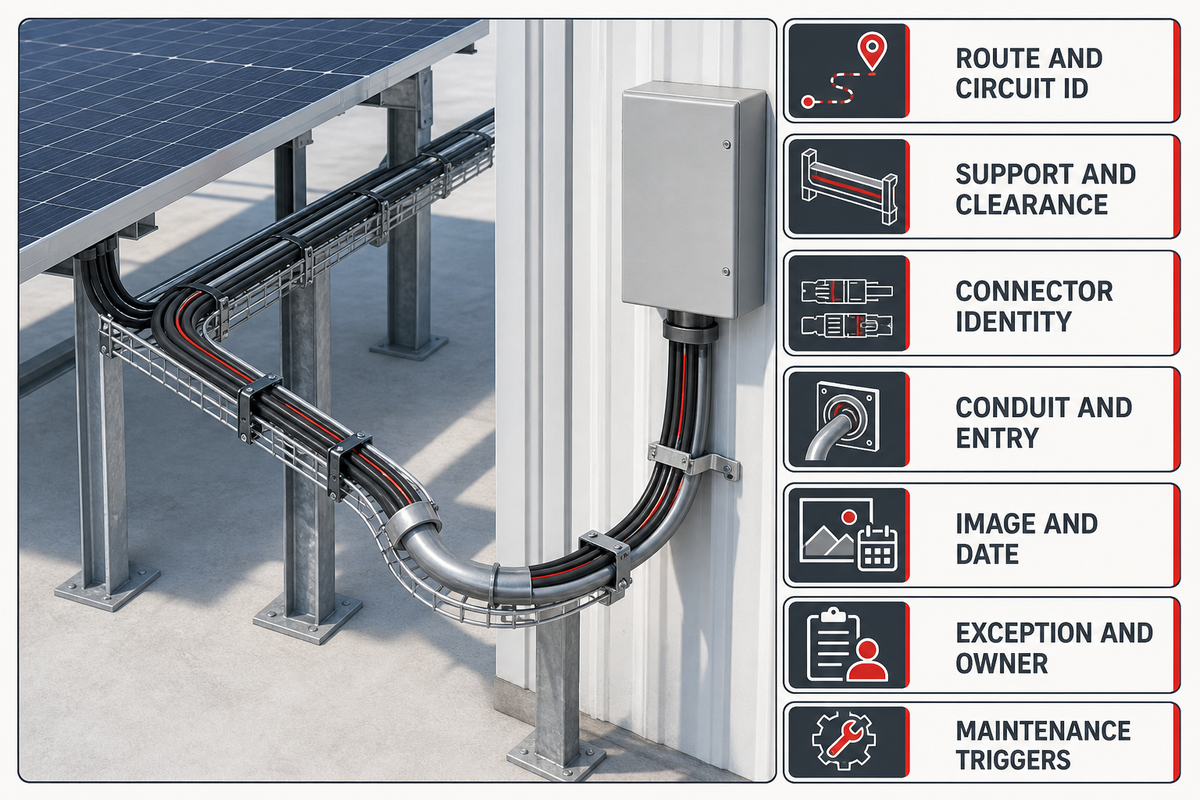
Document alignment is only one acceptance layer. The installed route can still have unsupported spans, edge contact, excessive bending, incompatible connectors, incomplete seating, contamination, poor segregation, unsuitable entries, damaged insulation, or unapproved changes. Record observations before assigning causes.
The United States Department of Energy’s DC string cable-management guidance notes that standard plastic ties can fail prematurely under heat, ultraviolet exposure, and chemical interaction. This creates an important time boundary: a clean day-one inspection can’t prove that support components will remain adequate through operating life.
Use an acceptance record that includes:
- route and circuit identifier, approved drawing revision, and any field change;
- support material, spacing basis, retained clearances, contact points, bends, and protection at edges or transitions;
- connector identities, assembly/inspection evidence, strain condition, seating, contamination, and visible heat or mechanical damage;
- conduit, raceway, entry, drainage or moisture conditions where applicable;
- photographs tied to location when permitted, and the observer and date;
- each exception, immediate safe-state action, responsible owner, disposition, and closeout evidence; and
- maintenance or reinspection triggers for ultraviolet degradation, loose supports, abrasion, route changes, abnormal heating, electrical alarms, storm events, or connector findings.
“Observation” and “cause” must remain separate fields. A discolored connector is an observation. The root cause may involve contact resistance, assembly, contamination, mismatch, mechanical loading, or another condition that requires qualified examination. The same logic applies to a damaged cable jacket.
Acceptance should also determine the next inspection trigger. Time may be a trigger, but operating evidence should also be considered: maintenance work, repeated alarms, storm or mechanical events, abnormal thermal findings, loose or failed supports, visible abrasion, animal exposure, water penetration, new vegetation, and route modification can all justify a review before the scheduled time. Identify the owner of the inspection trigger, the scope to be reinspected, and how the result is to be documented in the maintenance record.
Verify the corrected condition and the effects of the correction downstream. Replacing a support may change spacing or edge clearance; replacing a connector may require checking cable preparation and mating identity; rerouting a circuit may require revisiting grouping, conduit, and voltage-drop inputs. Close the exception only when the as-built record, evidence, and approval agree.
Prepare a Current-Evidence Specification Handoff
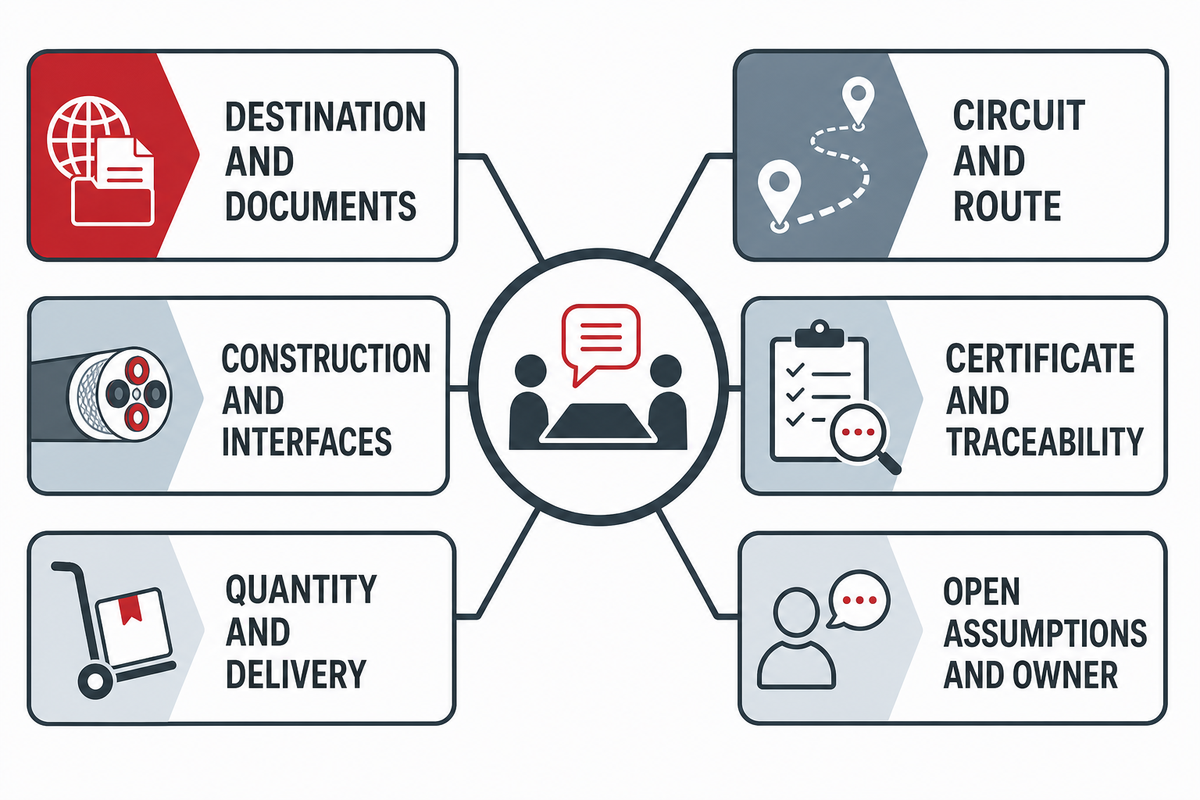
A guide has done its job when the buyer can state the unresolved product question precisely. Before asking for a model or price, send the supplier a compact handoff covering:
- destination market, governing documents and required editions;
- system voltage, circuit configuration, design-current basis, route length, installation method, temperature and grouping conditions;
- requested conductor count, cross-section, construction and interface constraints;
- required listing or certificate issuer, certificate number/status evidence, declarations, data-sheet revision, test documents, traceability and inspection records;
- quantity, drum/packing constraints, delivery destination, required schedule, document language, and approval owner; and
- every assumption that remains for engineering, authority, or contract review.
When those inputs are stable, continue to Jinyou’s PV1-F cable solution specifications for the model-specific and quotation discussion. That page owns the commercial decision. This guide remains the evidence and verification layer.
Ask the supplier to answer against the numbered handoff rather than returning an unrelated brochure. For each requirement, the response can state compliant, deviation proposed, not applicable, or information pending, with the supporting document and revision. Keep commercial acceptance separate from technical acceptance: price and schedule may be acceptable while a certificate scope, calculation input, traceability field, or interface remains open. The purchase record should show who closed each open item and the supporting evidence.
Frequently Asked Questions
What size is a PV cable?
No universal size follows from the words PV cable or PV1-F. The responsible design uses the circuit-current method required by the adopted rules, system voltage, route length, voltage-drop objective, ambient and rooftop temperature, grouping, installation method, terminal limits, protection, and equipment interfaces. Record the exact inputs and calculation basis; don’t copy a 4 mm² or 6 mm² answer from another system.
Is PV wire different from regular wire?
PV wire is evaluated and marked for photovoltaic applications under the applicable product route; ordinary building wire belongs to other categories and intended uses. The exact difference depends on the named standard or listing, construction, voltage, temperature, environmental claims, and installation rules. A broad “solar cable” description isn’t enough to decide whether a cable is suitable for a particular circuit or route.
What is special about PV wire?
Its product evidence addresses photovoltaic direct-current use and the conditions defined by the applicable standard or listing. For example, IEC 62930 defines a photovoltaic cable scope and temperature conditions. The special properties of a particular cable still come from its exact construction and controlled evidence. Do not assume that every product described as PV wire has the same halogen, wet-location, burial, smoke, or listing attributes.
Can PV1-F and H1Z2Z2-K cables be mixed in one string?
Don’t approve a mix from the names alone. The designer and acceptance team need to verify the governing project documents, electrical ratings, conductor construction, voltage-drop and ampacity calculations, connector and termination compatibility, installation conditions, markings, and evidence for each cable. If a transition is proposed, identify where it occurs, how it’s joined, which documents cover it, and who approves it.
Does a TÜV certificate prove that the delivered cable matches my order?
No. A current issuer record can establish the holder, certificate identity, model or family scope, standard, and status shown by the issuer. It doesn’t automatically prove that the delivered reel is that product. Match the physical marking and traceability, controlled datasheet, issuer certificate, order or approved submittal, packing list, and delivery record. Check that the model, conductor count, cross-section, voltage, construction, and relevant limitations align. If the contract requires sampled inspection or test evidence, connect its result to the same reel or lot identity. Also keep market-specific evidence separate: a TÜV certificate doesn’t become a United States UL listing, and a familiar jacket mark doesn’t replace the complete package evidence required for a listed unit.
Is a PV1-F cable guaranteed to last 25 years?
No blanket guarantee follows from the designation. The EN 50618 record describes an expected period of use under specified normal conditions in a note; that isn’t an unconditional product warranty. Actual service depends on the exact product, installation, temperature, ultraviolet exposure, routing, supports, connectors, maintenance, and other project conditions. Ask for the manufacturer’s written warranty terms separately from the standard reference.
When should I use a product page instead of this guide?
Use this guide to define the evidence and engineering questions. Use the product page after the requested construction and market route are stable and you need model-specific documents or a quotation.
References and Sources
- International Electrotechnical Commission and IECEE, IEC 62930:2017 publication and scope records.
- Bulgarian Institute for Standardization, BDS EN 50618:2015 project record.
- TÜV Rheinland Certipedia records R 50349329, R 50482064, and J 50483940.
- UL Solutions, Wire and Cable Application Guide.
- United States Department of Energy, Solar Photovoltaic Cable Management: Best Practices for DC-String Cables.
- Pacific Northwest National Laboratory Building America Solution Center, Wiring Conduit for Solar PV Systems.
- Sandia National Laboratories, PV Connectors project, and the peer-reviewed 6,276-connector study available through OSTI.
This guide is educational. It doesn’t issue a conductor size, certify a product, approve an installation, provide legal advice, or replace the applicable engineer, listing body, contract reviewer, or authority having jurisdiction.

