Get in touch with JINYOU Cable Company

Solar DC cable selection, document control, sizing inputs and RFQ evidence
H1Z2Z2-K cable refers to a product family for the direct-current side of photovoltaic systems, but the name doesn’t approve a project on its own. A defensible purchase also requires the right circuit conditions, cable size, connector system, document scope, installation route and shipment records.
This guide converts those isolated checks into an evidence-based buying process suited to solar designers, project engineers, quality teams and procurement managers. It complements the commercial specifications on JINYOU‘s H1Z2Z2-K cable range; it doesn’t replace the project calculation, destination rules or current issuer records.
Updated September 2026.
Quick answer
Use H1Z2Z2-K as the opening filter, then verify five things before comparing price: project and route fit; electrical and protection fit; cable and connector construction; document and jurisdiction scope; and delivered-lot traceability. If one gate lacks evidence, hold technical approval at that gate.
1.5 kV DCIEC 62930 public scope
90°Ccontinuous scope value
120°Climited to 20,000 hours
5 proofsbefore commercial comparison
What Technical Data Defines H1Z2Z2-K Cable, and What Does Not?
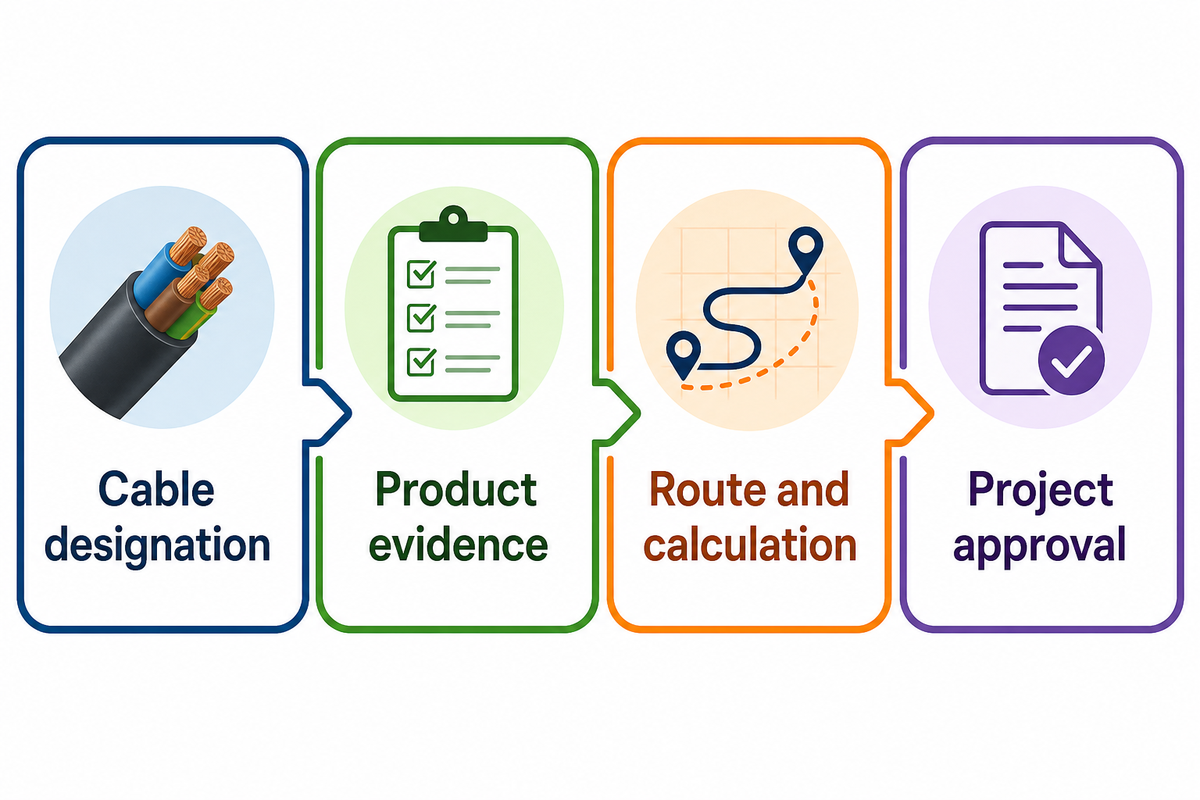
H1Z2Z2-K specifies cable for the direct-current side of photovoltaic systems. The publicly accessible BSI Knowledge catalogue entry for IEC 62930:2017 describes DC photovoltaic cables of up to 1.5 kV and defines scope related to continuous and limited service temperature. This is useful type-level context.
The designation isn’t a universal certificate number. It doesn’t tell you whether the exact offered construction has a current certificate, whether a connector pair is approved, whether direct burial is permitted, whether the cable is sized for your route, or whether a national fire-performance rule applies. In addition, it isn’t a justification for an unsupported character-by-character analysis of the name.
What does H1Z2Z2-K mean for a buyer?
Treat this as a specification family that triggers a controlled review. Request the manufacturer name, model number, core count, conductor size, construction, rated voltage, standard edition number and current product evidence. Once these are complete, map the fields to the route and the electrical calculation. Even if two reels have the same family name, they aren’t necessarily interchangeable when their documents, materials or approved uses differ.
Supplier catalogues may reorder the same search language as “PV H1Z2Z2-K cable,” “cable H1Z2Z2-K,” “solar cable H1Z2Z2-K,” or “photovoltaic H1Z2Z2-K.” Those labels don’t create four product types. Likewise, “DC solar cable,” “PV cable,” and “solar PV cables” are broad category phrases; only the designation, construction and current documents identify the offered item.
Construction copy may mention a single core, Class 5 flexible tinned copper conductor, cross-linked insulation, a cross-link method, an outer sheath, halogen-free material, low smoke zero halogen (LSZH) behavior, or XLPE. Record the compounds used exactly as the data sheet states; a generic synonym must not replace the actual insulation or sheath construction. These technical specifications and technical data also need the applicable voltage rating and temperature range. Behavior in the event of fire remains a separate, destination-specific evidence question.
Do not commingle: a familiar designation, a reference to EN 50618 or IEC 62930, a type-test report and a current certificate or listing answer four different questions.
Where Does an H1Z2Z2-K DC Solar Cable Fit in Solar Systems?
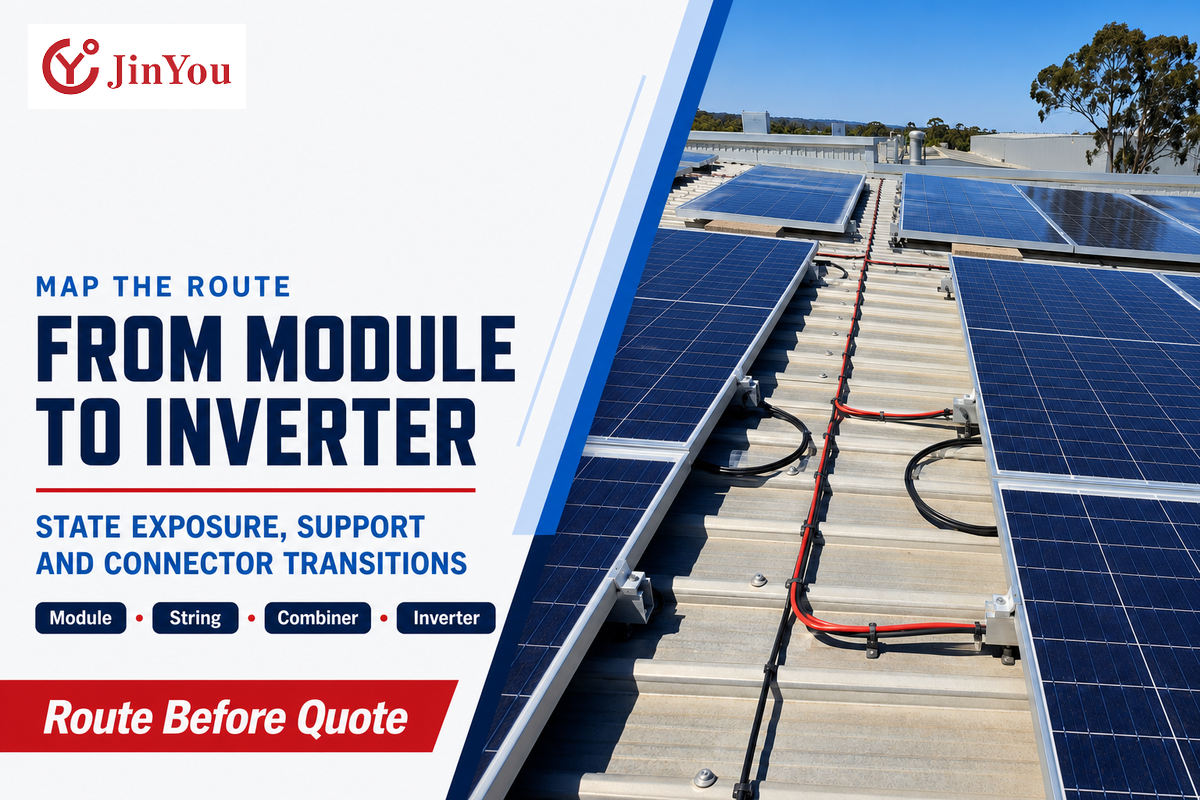
The real-world question isn’t simply, “Is this a solar cable?” The next question is, “Which part of this DC circuit, under which exposure and project rules, is this exact cable expected to serve?” The Solar Victoria wiring audit checklist shows why module, string, combiner and inverter-side DC routes require separate installation checks for support, mechanical protection, water exposure, interface connectors, terminations and documentation.
Map the route, then request a quote. Record whether the run is on a rooftop, in a tray, inside conduit, exposed to standing water, near sharp metal edges, subject to movement or vibration, accessible to rodents, or incorporated into a building. Then state the connector family at both ends and the transition points. This converts a vague cable request into an evidence question the supplier and designer can answer.
Solar panel arrays, solar systems, solar installations, solar farms, floating solar and utility-scale projects can all use direct current collection circuits, but those project labels don’t settle cable acceptance. Describe the connection of photovoltaic modules, strings, combiners and inverters on the drawing, then verify the exact route rather than assuming one cable construction fits every setting.
| Route condition | Evidence to request | Do not assume |
|---|---|---|
| Open rooftop string run | UV/weathering scope, support spacing, abrasion control, bend and termination instructions | A product name proves the installed support system |
| Conduit or below-grade section | Exact water/burial evidence, sealing and drainage method, local route rule, mechanical protection | Every H1Z2Z2-K construction permits permanent immersion or direct burial |
| Connector transition | Approved mating system, cable outside-diameter window, contact, crimp tool and process | Similar-looking connectors are compatible |
Which Technical Specifications Connect EN 50618 to a PV H1Z2Z2-K Cable?
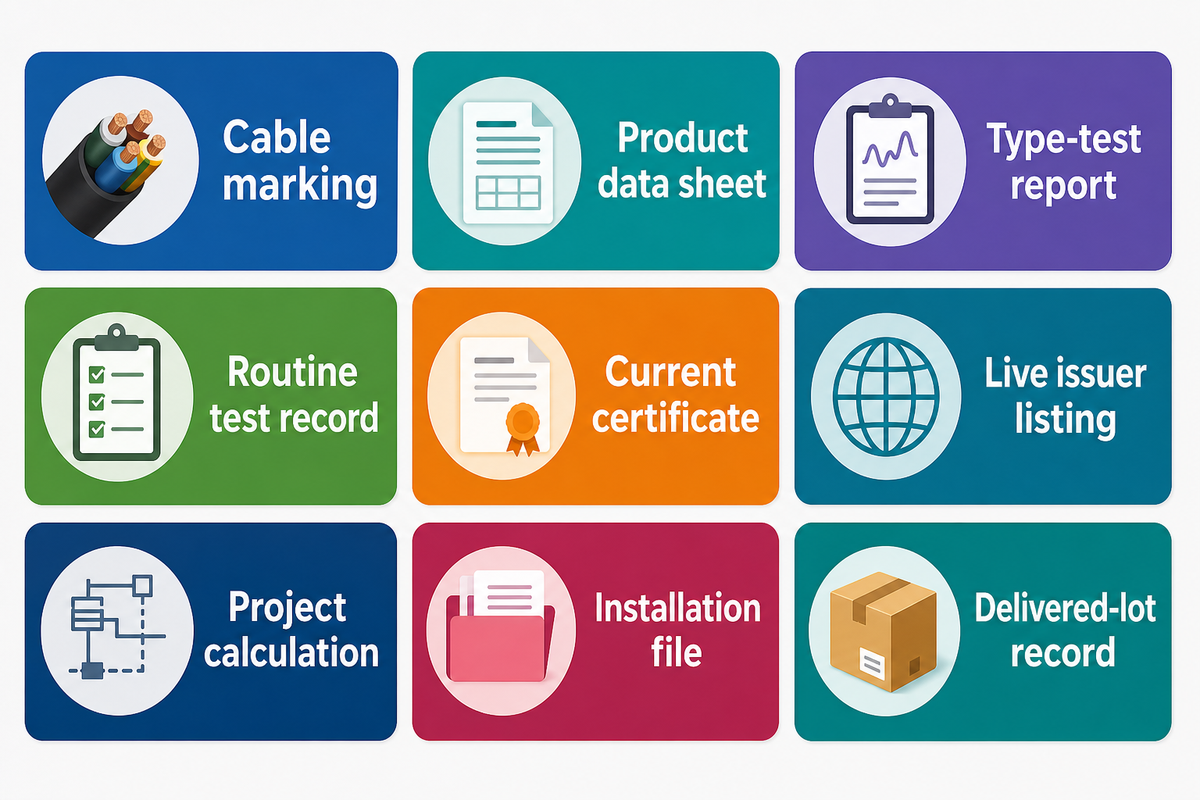
Begin with document identity. BSI’s public catalogue identifies BS EN 50618:2014 as its current release, while BSI Knowledge identifies IEC 62930:2017 as current. These catalog notes describe the status and boundaries of the document; they do not certify the named supplier’s product.
UL Solutions’ photovoltaic-cable guidance also distinguishes EN 50618 and IEC 62930 scope and separates testing, certification and database listing. That distinction matters when a quotation shows a standard logo or document identifier but not the holder, model, construction, size range, issue date and current status.
For the standard EN 50618, avoid writing “according to EN 50618” unless the edition, applicable scope and matching product evidence are identified. EN 50618 is a European standard reference, not proof that this exact offer is TÜV certified. A TUV logo or marketing phrase still requires a current issuer record tied to the holder, model and construction.
| Evidence type | Fields to match | What it cannot prove alone |
|---|---|---|
| Cable marking | Manufacturer, model, construction, size, voltage and batch marks | The complete technical or certification scope |
| Product data sheet | Model, core count, size, materials, ratings, edition and issue date | Current independent certificate status |
| Type-test report | Sample identity, method, standard edition, laboratory, date and result | That every production lot matches the tested sample |
| Factory or routine test | Order, batch, drum, method, acceptance limit, date and result | All type-performance or installation conditions |
| Product certificate | Issuer, holder, model, construction, size range, standard and status | Project sizing and route acceptance |
| Public issuer listing | Live record, holder, certificate number, scope, valid date and status | That the quotation or delivered drum is the listed construction |
| Project calculation | Current, voltage, route, ambient, grouping, drop, protection and terminals | Product identity or certificate status |
| Installation / jurisdiction file | Contract edition, national deviations, route, fire class and installation method | That the delivered drum matches the approved sample |
| Delivered-lot record | Purchase order, batch, drum, length, colour, marking and inspection result | The design basis or approval of an unrecorded substitution |
If the cable is a covered construction product, destination-specific documentation may add another layer. The European Commission explains declaration, technical-documentation and assessment duties before CE marking for products within the applicable scope, while national contact points provide country rules. Apply this conditionally; not every cable and destination follows an identical path.
JINYOU’s product page shows several document references. In this review, no live issuer result was found that independently confirmed their current holder, scope and status. Don’t interpret those references as current certificates; treat them as leads for a fresh issuing-body check. For a more reliable approach, use the certificate and documentation checks and the wider solar cable standards evidence guide.
Which Voltage Rating and Temperature Values Must Be Verified?
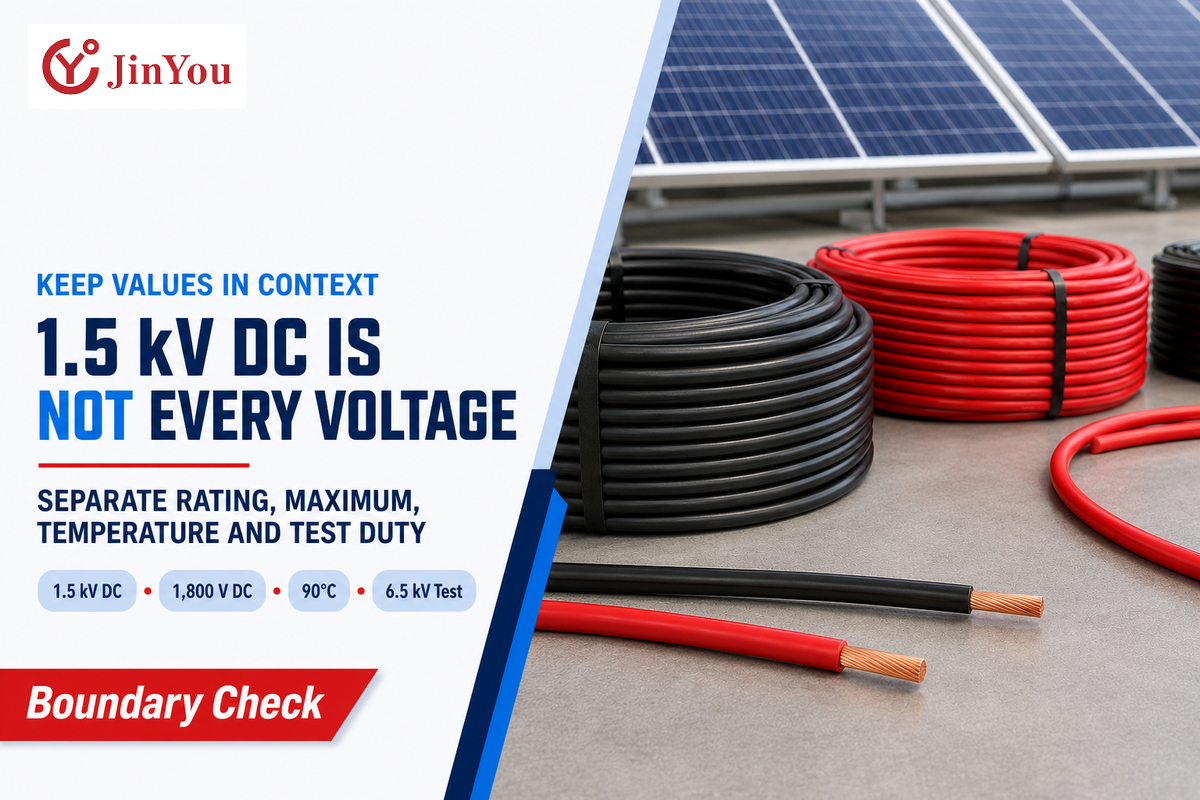
Numbers with the same unit can describe different boundaries. Rated voltage defines an operating boundary. Maximum system voltage is a different boundary. A factory withstand test is a production or verification condition, not the normal operating voltage. Likewise, the IEC 62930 temperature scope distinguishes continuous conductor temperature from temperature permitted only for a limited duration.
For this article, the exact H1Z2Z2-K target-page snapshot captured in September 2026 published the JINYOU range values shown below. These values should be associated with that page and the cited construction and the dated data sheet. Don’t migrate them to a differently named JINYOU cable page.
| Published field | JINYOU-stated value | Buyer verification | Boundary |
|---|---|---|---|
| Rated voltage | 1,500 V DC; 1.0/1.0 kV AC | Match circuit type, applicable document and marking | Not a cable-size calculation |
| Maximum system voltage | 1,800 V DC | Check cold-weather string maximum and every component limit | Do not use as the routine operating target |
| Temperature | -40°C to +90°C; 90°C continuous conductor temperature | Apply ambient, grouping, installation and termination limits | A material limit is not automatic ampacity |
| Limited-duration temperature | 120°C for 20,000 hours | Confirm the governing document and intended interpretation | Not a continuous rating |
| Factory withstand test | 6.5 kV for 5 minutes, no breakdown | Request test method and order-specific record | Not a permissible operating voltage |
The captured target page contains a 25-year design life. Interpret “design life” as the design objective on that page under the manufacturer’s conditions, not as an installed-life guarantee. The outcome may be affected by route temperature, water, mechanical damage, connector workmanship and maintenance.
How Do You Select Cable Cross-Section Without Guessing?
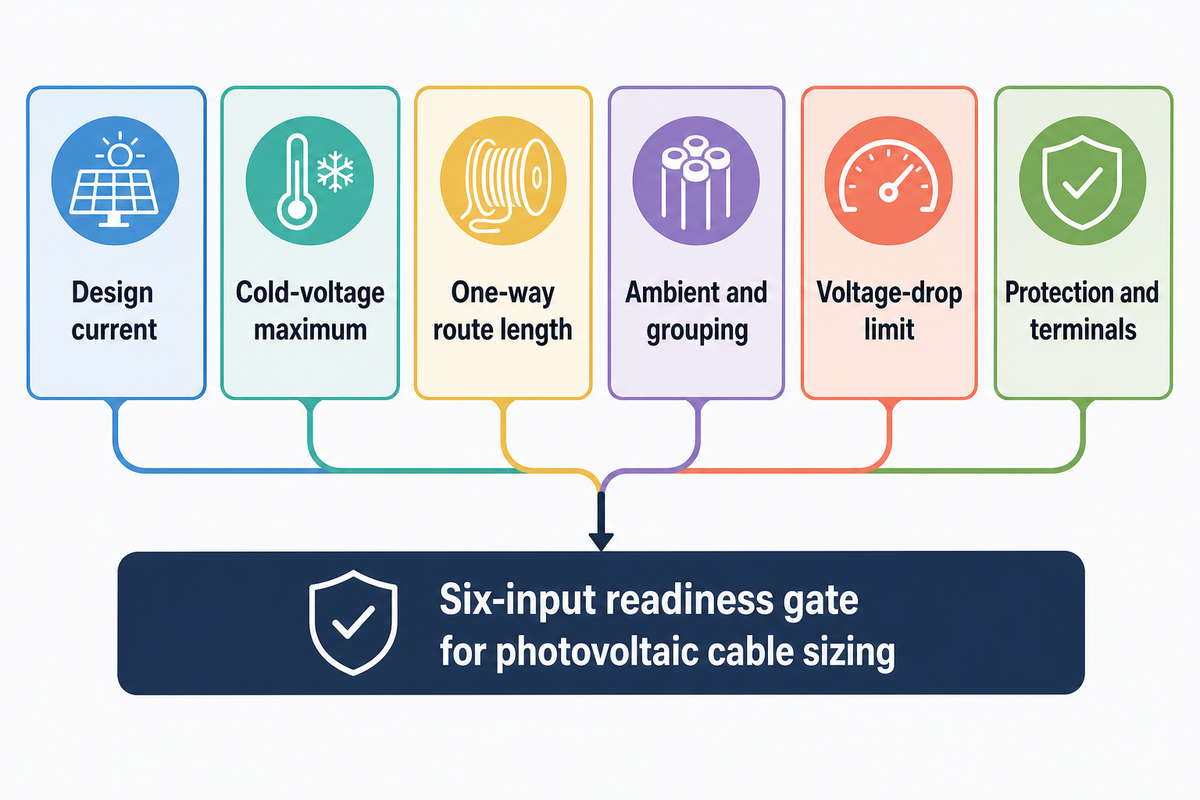
A published catalogue range only indicates what sizes may be provided. The captured JINYOU H1Z2Z2-K page publishes 1.5–240 mm² for single-core constructions and 2 × 2.5–16 mm² for twin-core constructions; that doesn’t answer whether a given circuit needs 4 mm², 6 mm² or another size.
The wiring guide for the University of Maryland Extension treats voltage, maximum current, ampacity, installation temperature, conductor application, overcurrent protection, total conductor length and voltage drop as separate inputs. A current GSES engineering article also treats current-carrying capacity and voltage drop as separate checks. Its recommendations are based on numerical values that are specific to the Australian standards and shouldn’t be considered as absolute for all cases.
If a quotation uses AWG instead of mm², require the supplier and designer to state the exact conductor area and the project calculation basis. A nominal conversion alone doesn’t establish ampacity, voltage drop, terminal fit or acceptance under the governing document.
How do you choose an H1Z2Z2-K cable size?
- Calculate the design current of the circuit and the required level of protective device coordination based on the applicable rules.
- Confirm the maximum circuit voltage at the lowest design temperature, not just the normal operating voltage.
- Record the length of the one-way route, the method of installation, the ambient temperature, grouping, the thermal environment, and the permitted voltage drop.
- Check the method of determining the ampacity and the correction factors for the cable. Then check the limits of the terminals, connectors, and equipment.
- Both ampacity/protection and voltage-drop checks must be carried out. The more restrictive compliant result must be used.
Illustrative voltage-drop check, not a size recommendation
Assume a designer has already established these project inputs: operating current 10 A, one-way route 30 m, and temperature-adjusted conductor resistance 0.0046 Ω/m. The total conductor path is 60 m.
Voltage drop = current × resistance per metre × total conductor length
10 A × 0.0046 Ω/m × 60 m = 2.76 V.
On a 1,000 V operating circuit, that’s 0.276%. This only tests the stated voltage-drop input. It doesn’t establish ampacity, protective-device coordination, fault performance, connector fit or compliance. Replace every assumed value with project-approved data before selection.
JINYOU provides a tool to check DC voltage drop for the planned route. Use the separate cable designation screening tool before sizing so that product type and conductor size aren’t confused.
When Does the Installation Environment Change the Choice?
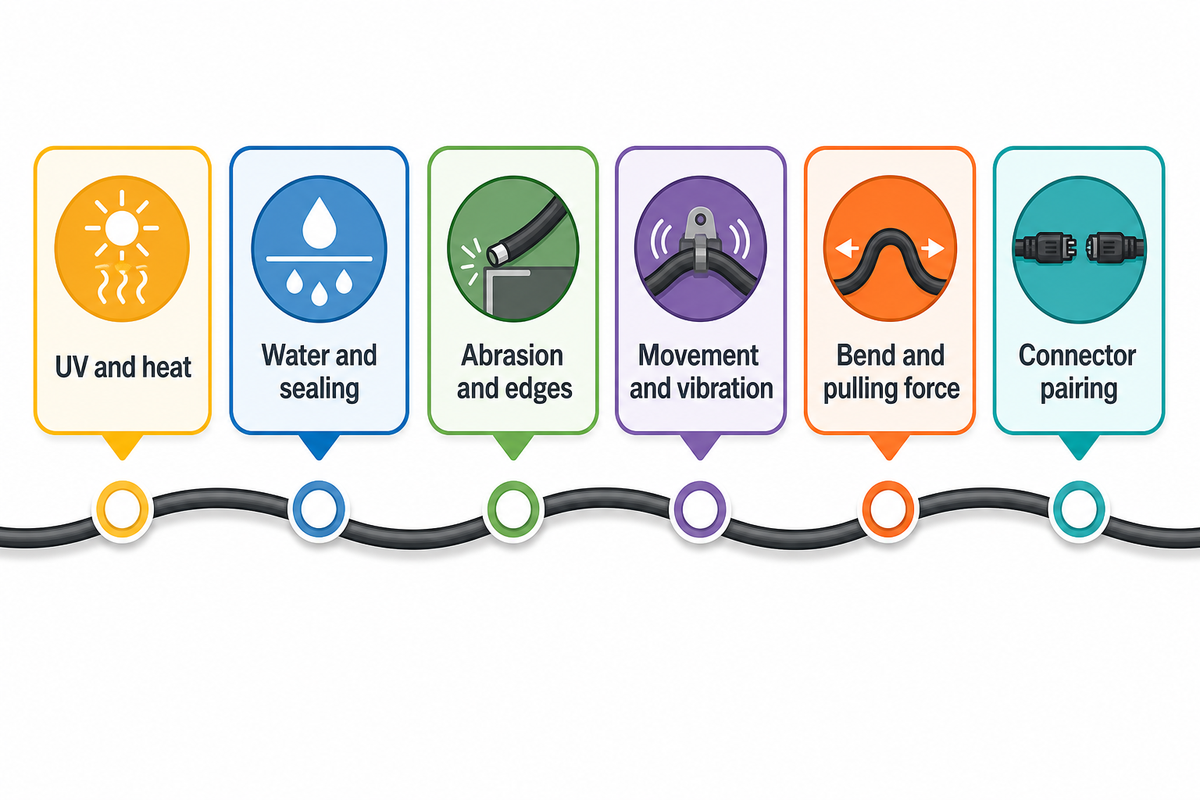
Engineering inputs and the documents you need are impacted by changes in the environment. The Solar Victoria wiring audit checklist separates mechanical protection, ultraviolet exposure, water ingress, sealing, support and termination. This is a good example of evidence of installed systems being different from product labels, although the rules apply to its own jurisdiction.
KBE’s installer guide identifies abrasion, roof contact, sharp edges, trapped rain or condensate, animal damage, heat, vibration, tight ties, bending radius and pulling force as separate route risks. Use these as field-practice examples; don’t use them as proof of JINYOU field history or a universal rule.
Route phrases need the same discipline. “Internal and external,” “fixed and mobile,” or “suitable for fixed installations” doesn’t automatically mean “suitable for direct burial.” If a specification cites AD8, water immersion, burial or another installation class, request the governing classification, test basis and exact product scope before applying it to the route.
Claims about durability, UV resistance, ozone resistant construction, weather resistance, or resistance to environmental stress remain product-specific. Match each claim to the tested construction and limitation; don’t transfer it from a generic solar-cable description to the offered reel.
Connector pairs are another type of system boundary. The IEC catalogue identifies IEC TR 63225:2019 as addressing the incompatibility of photovoltaic DC connectors of different manufacturers. The public abstract doesn’t approve a specific pair, so ask for the approved mating system, contact, seal, cable outside-diameter window, crimp tool and process.
Route, Rating, Record Triad
- Route: exposure, water, protection, support, movement, fire zone and connector transitions.
- Rating: voltage, current, temperature, grouping, drop, protection, termination and interface limits.
- Record: exact data sheet, test evidence, current scope document, approved drawing and delivered-lot traceability.
Approval is conditional until all three describe the same cable and project.
H1Z2Z2-K vs PV1-F: What Should the Comparison Actually Prove?
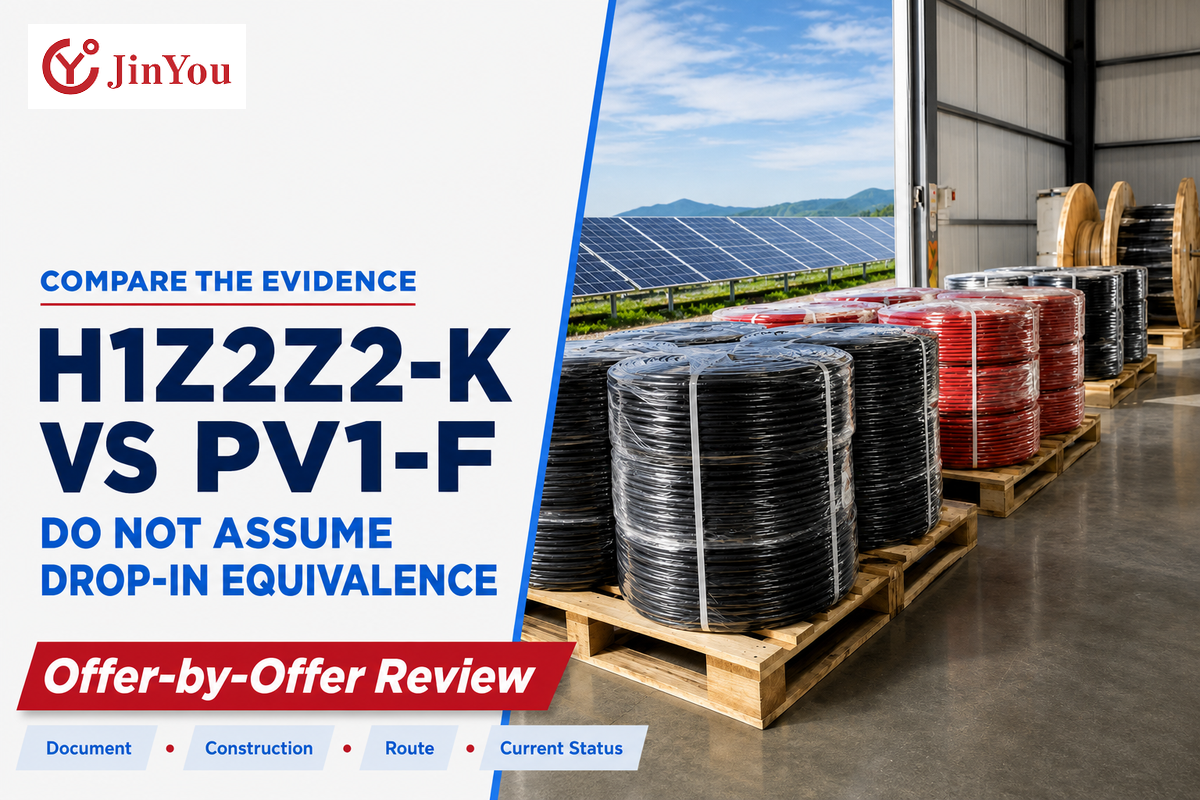
Avoid reducing the comparison to “new” versus “old.” For a new purchase, compare the exact governing standard or specification, rated-system boundary, conductor and material construction, test evidence, certificate holder and current status, installation limits and destination acceptance. For an existing installation, retain the original design and approval then decide if replacement is justified.
The distinction is time-sensitive. TÜV Rheinland states that its 2PfG 1169 and 2PfG 1990 certification bases were withdrawn on 27 October 2017 and affected certificates needed transition to EN 50618 or what the contemporaneous notice called IEC FDIS 62930. The former transition does not define the status of a particular JINYOU document; it describes the importance of the issuer’s present records and certificate basis.
| Question | Offer A | Offer B |
|---|---|---|
| Exact document, edition and national adoption | Record evidence | Record evidence |
| Current certificate/listing holder, model and size scope | Verify live | Verify live |
| Voltage, temperature, construction and application limits | Match project | Match project |
| Route, connector and termination acceptance | Confirm system | Confirm system |
If you need the commercial alternative’s own specification, refer separately to the PV1-F cable page. Treat neither page as justifying automatic equivalence.
Use the 5-Proof H1Z2Z2-K Acceptance Ladder Before an RFQ
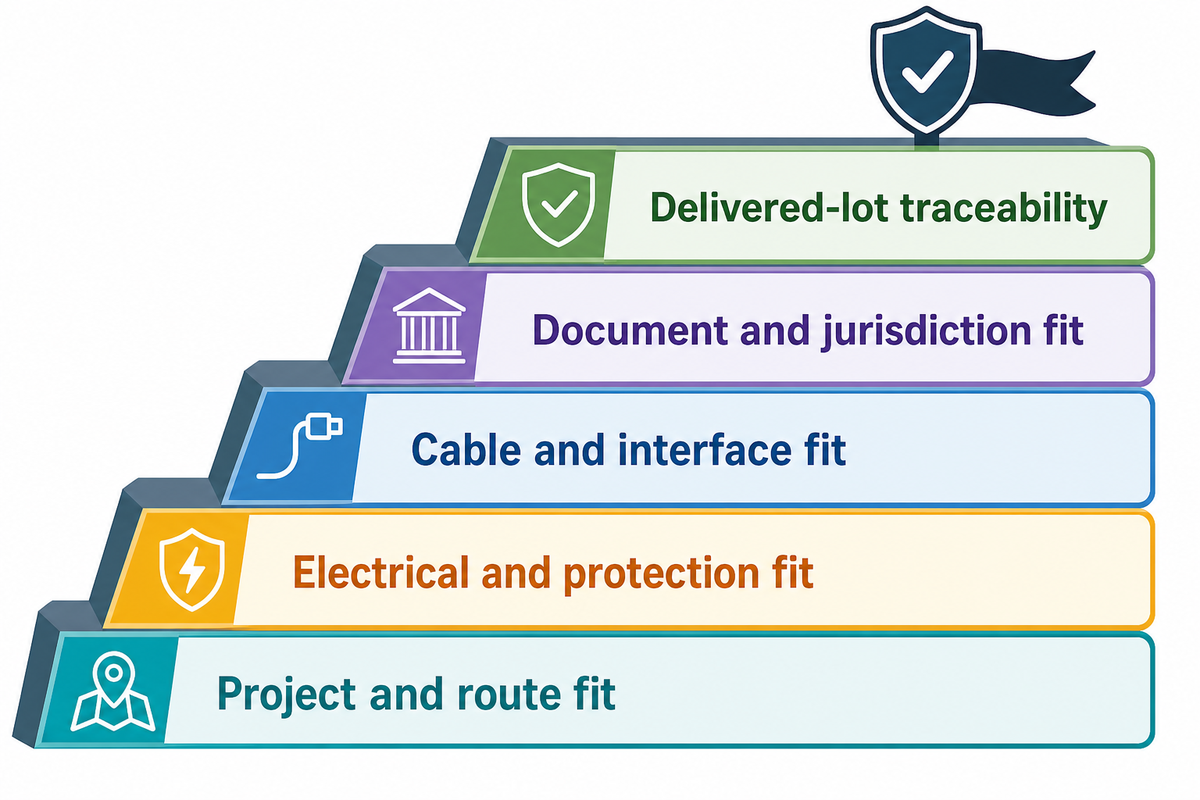
The Five-Proof H1Z2Z2-K Acceptance Ladder is JINYOU’s buyer-oriented editorial framework, synthesized from the evidence above. It isn’t an external standard and isn’t intended to be complete for all jurisdictions; consult the field wiring checks for installation-level evidence. Its purpose is to help prevent technically unequal quotations from being submitted as price comparisons.
- Project and route fit. Define the location and route, exposure, support, water/burial condition, fire zone and destination rule. Hold if the exact construction lacks route evidence.
- Electrical and protection fit. Provide design current, cold-voltage maximum, ampacity method, ambient, grouping, route length, allowable drop, protection and termination constraints. Hold if the calculation is incomplete.
- Cable and interface construction fit. Match conductor, insulation/sheath construction, size, core count, outside diameter, connector contact, seal, crimp tool and process. Hold if the mating system is unapproved.
- Document and jurisdiction fit. Match standard edition, test report, certificate/listing status, holder, model, size scope, intended use and any destination fire/performance file. Hold if an identifier cannot be verified.
- Delivered-lot traceability. Tie drum marking, size, colour, batch, length, inspection result and shipping record to the approved offer. Hold if the received lot cannot be traced to the evidence pack.
H1Z2Z2-K RFQ checklist—copy these fields into the inquiry:
| Owner | Send with RFQ | Approval evidence |
|---|---|---|
| Project engineer | Circuit voltage/current, one-way length, route, ambient, grouping, drop limit, protection | Calculation and route drawing |
| Installer | Support, bend, water, burial, edge, movement, connector and crimp details | Installation method and approved interface |
| Quality / compliance | Required edition, issuer, holder, model, size, construction, destination documents | Current scope-matched records |
| Procurement | Size, colour, quantity, packaging, drum length, sample need, delivery and inspection terms | Normalized quotation and lot record |
The captured target page publishes a minimum order quantity of 500 m per cross-section and colour. Confirm this time-sensitive term in the quotation. Mention size and color separately, but avoid letting the commercial field bypass a technical hold. Ask the supplier to trace test evidence to the supplied lot.
What Do Global Solar Search Patterns Reveal About Buyer Evidence Needs?
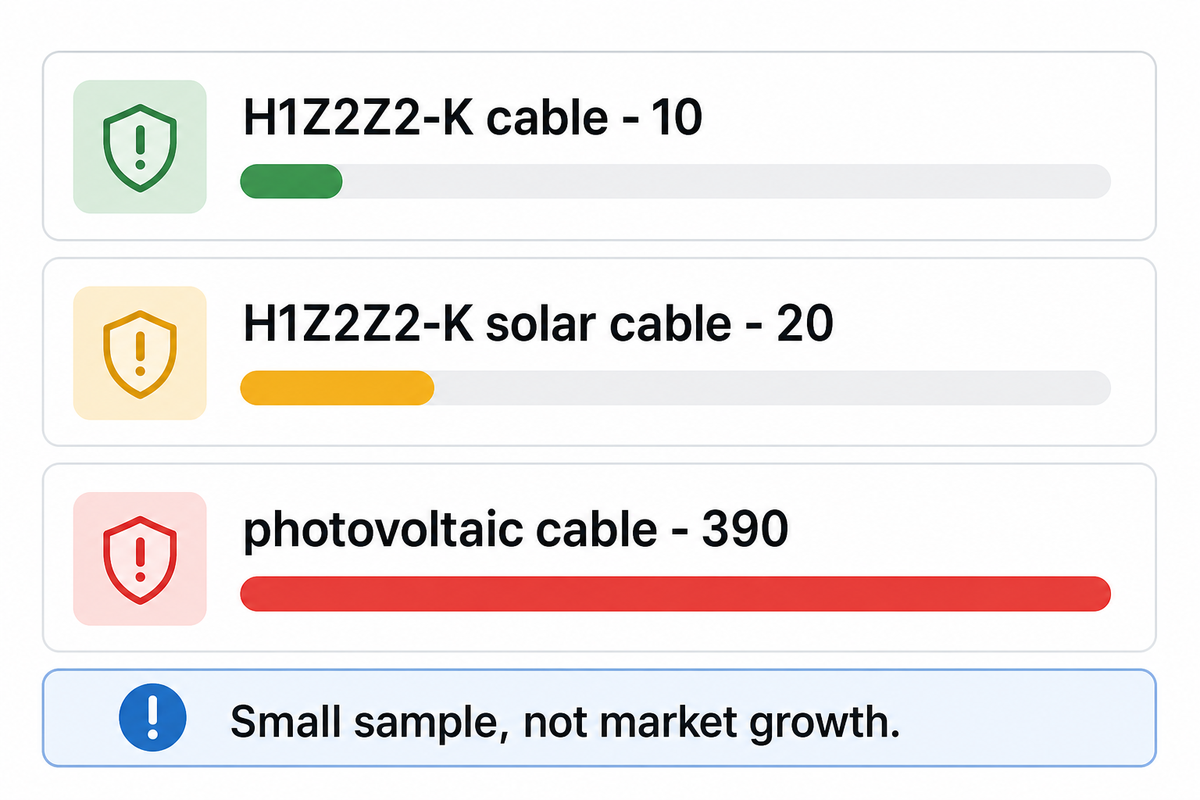
Current U.S. keyword data indicates a low-volume, exact-model interest, not a defensible market trend. For a JINYOU procurement team, the risk is overreading this small six-month sample: because no product-specific annual series exists, use the figures to prioritize buyer questions, not to claim shipment or market growth. The focus phrase returned 10 monthly searches and stayed at 10 across the six months exposed by the data wrapper. “H1Z2Z2-K solar cable” returned 20 monthly searches, with the six-month values rising from 10 to 30 near the end of the window. Broader “photovoltaic cable” demand was much larger at 390, but that’s a different query class; the University of Maryland Extension wiring guide shows why broader interest doesn’t remove route-specific current, resistance and conductor-length inputs.
These figures help prioritize content by answering buyer questions about the model, standard, voltage and size, and by explaining how the documents function. These data don’t enable analysis of year-on-year growth in H1Z2Z2-K sales, shipments, market share or demand. The wrapper supplied only six months, no credible product-specific market dataset was found, and wider photovoltaic deployment can’t prove H1Z2Z2-K product growth.
Broad phrases such as global solar, solar power, solar energy and solar industry describe markets much wider than this cable designation. JINYOU’s cable solutions may serve several project types, but those broad terms can’t substitute for product-level demand data or the evidence checks required by a particular installation.
H1Z2Z2-K Cable FAQ
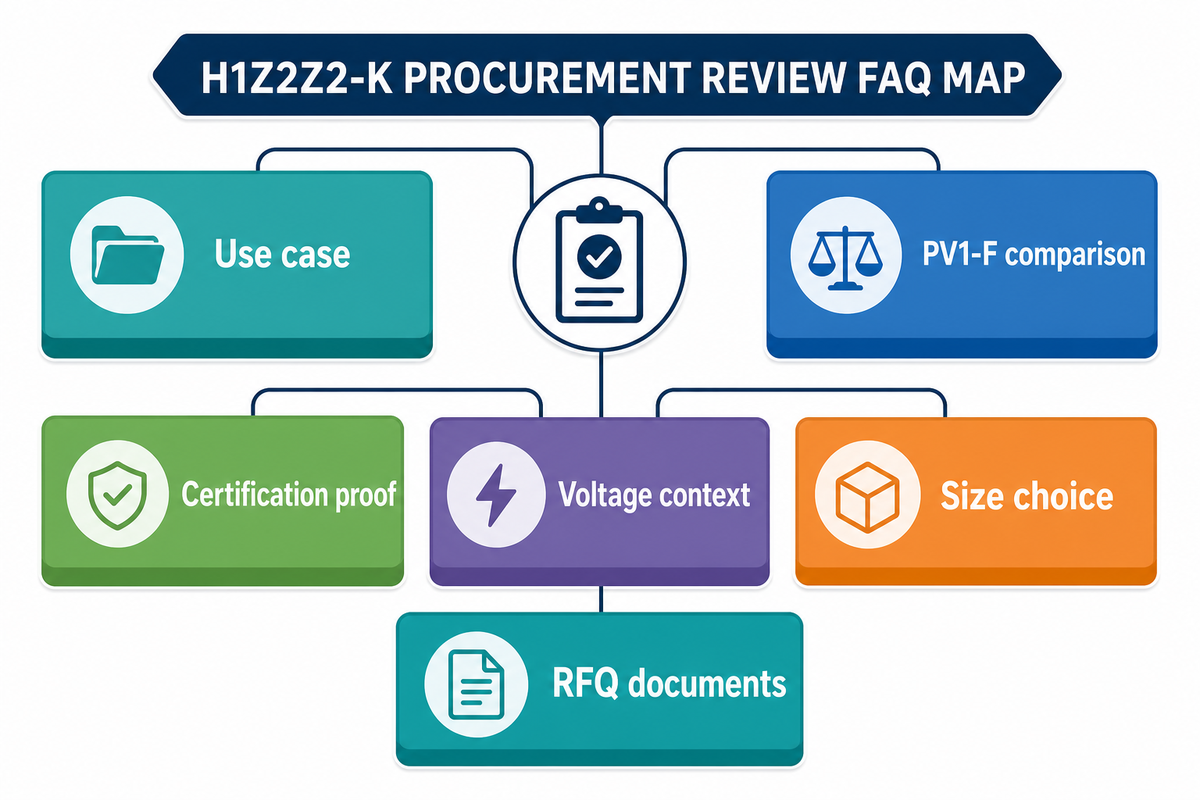
What is H1Z2Z2-K cable used for?
H1Z2Z2-K cable is used on the direct-current side of photovoltaic systems where the exact product construction, voltage, temperature, route and project rules are suitable. Typical evaluation points include module, string, combiner and inverter-side DC connections. Before approval, connect the cable data to the circuit calculation, route exposure, connector system and destination requirements. The product-family name doesn’t by itself approve the installed route.
Is H1Z2Z2-K the same as PV1-F?
Don’t assume they’re interchangeable. Start with the governing document and edition for each offer, then compare current certificate status, holder and model scope; rated-system and temperature boundaries; conductor, insulation and sheath construction; route permissions; connector/termination requirements; and project acceptance. Historical installation evidence should be preserved as its own record, while a new procurement needs current evidence. If only a family name or old PDF is available, classify the alternative as a candidate pending document review rather than a drop-in replacement.
Does the H1Z2Z2-K name automatically prove EN 50618 certification?
No. The name and a standard reference identify what to verify, but neither is a live product certificate. Current certification requires an issuing-body record that matches the holder, manufacturer, model, construction, core count, size range, standard edition and current status of the offered product. The quotation and delivered drum must also be tied to that scope. A technical sheet, logo, laboratory result or document number alone isn’t equivalent.
What voltage is H1Z2Z2-K cable rated for?
The IEC 62930 public scope reaches 1.5 kV DC. The captured JINYOU target page states 1,500 V DC, 1.0/1.0 kV AC and 1,800 V maximum; match each definition and dated product document to the design. Keep rated voltage, maximum system voltage and factory test voltage as separate boundaries.
How do I choose between 4 mm² and 6 mm² H1Z2Z2-K cable?
Choose only after calculating design current, cold-weather voltage, route length, ambient and grouping conditions, voltage drop, protection, fault duty, and terminal limits. Compare the manufacturer’s resistance data for both sizes, then use the more restrictive compliant result for the project.
Which documents should an H1Z2Z2-K cable RFQ request?
Request a dated technical sheet, construction and size schedule, type and routine test evidence, and any contract-required certificate or listing. Add connector instructions, destination fire documents, quality plan, drum marking, packing schedule, and delivered-lot traceability for every shipment lot submitted.
Turn your route and evidence pack into a quote-ready cable request

Send JINYOU Cable the circuit conditions, route drawing, size calculation inputs, connector system, destination document requirements, quantities, colours and lot-traceability needs. The team can review a standard or custom OEM cable request against the stated application.
Related JINYOU Cable Solutions
- H1Z2Z2-K cable product range for JINYOU’s published voltage, temperature, construction-range and ordering data.
- Solar cable standards for document-scope context.
- DC voltage-drop calculator for route-specific inputs.
- Quality testing and traceability for the evidenced delivered lot.
References & Sources
- IECEE: IEC 62930:2017 official public scope record for photovoltaic DC cable voltage and temperature boundaries.
- BSI: BS EN 50618:2014 catalogue record document identity, release status and publication metadata.
- BSI Knowledge: IEC 62930:2017 document status, scope and temperature metadata.
- UL Solutions: photovoltaic cable testing and certification EN/IEC scope comparison and certification/listing boundary.
- University of Maryland Extension: solar wiring and fusing engineering inputs for ampacity, protection, length and voltage drop in a United States context.
- Solar Victoria wiring audit checklist jurisdiction-specific field checks for protection, support, water and terminations.
- IEC TR 63225:2019 catalogue page public scope for photovoltaic connector incompatibility across manufacturers.
- European Commission construction-product guidance conditional declaration, technical-documentation and assessment-system duties.
- TÜV Rheinland: transition of legacy photovoltaic cable certification bases withdrawal date and transfer requirement context.