Quality, Testing & Compliance: Solar Cable Test Guide
JINYOU CABLE · TECHNICAL GUIDE
By Aurora
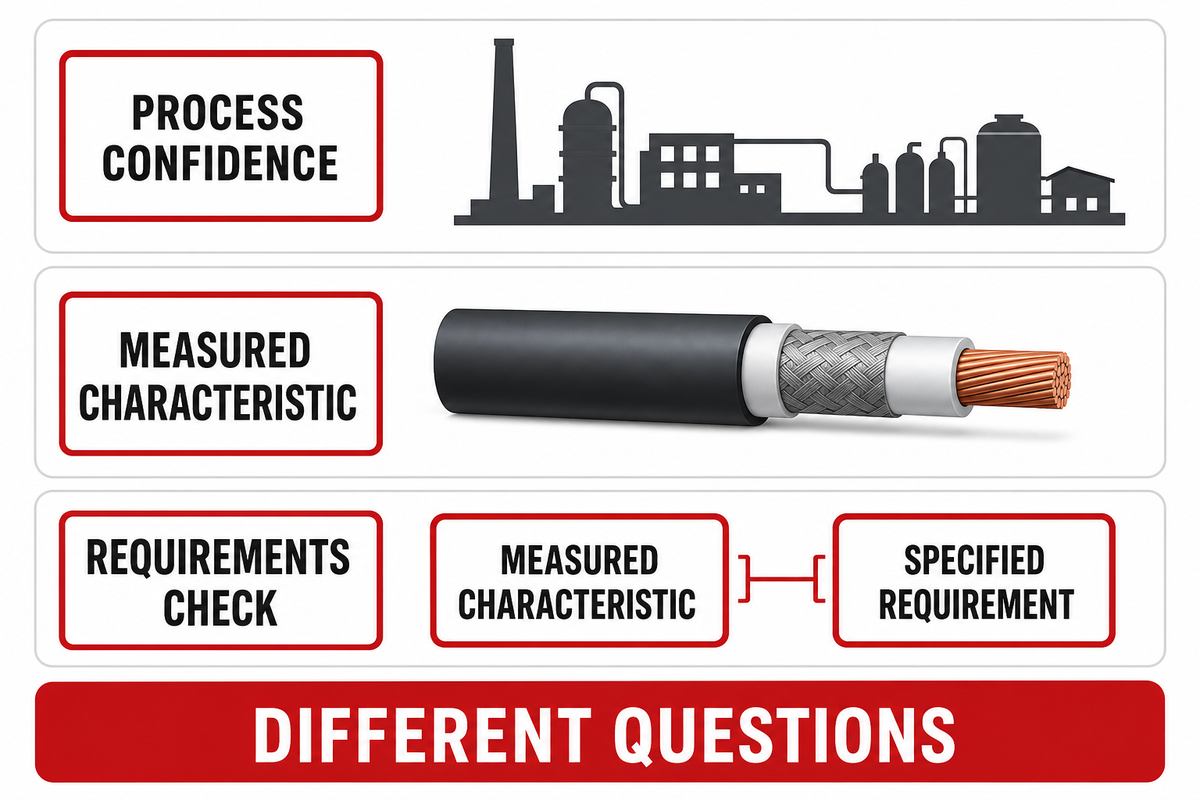
Quality, Testing & Compliance refers to three elements: consistency in the production process of a cable, what a test measures, and whether the evidence meets the specified requirement. For solar photovoltaic projects, answering these separately will help avoid a laboratory test being interpreted as a statement concerning an entire installation.
Your report may say “pass” while leaving the real question unanswered. Was the test conducted on insulation material, a complete cable or installed wiring? Did the test evaluate the material’s electrical behavior, aging or flame spread? This report describes the findings and their limitations. For project-specific requests, use the Quality, Testing & Compliance page from JINYOU Cable.
Quality, testing and compliance answer different questions
Quality assurance is about confidence in the processes used to meet the requirements. Quality control checks whether those requirements are met. Testing provides findings about stated characteristics; a conformity assessment considers specified requirements. Keep the processes, measured characteristics, and accepted criteria visible during review instead of treating a badge as the entire answer.
ASQ’s explanation of assurance and control puts inspection within this wider quality-management framework. In the manufacturing process of cable, a process record and a test result can provide different types of evidence. Neither should be discarded if the other is available.
NIST describes conformity assessment as a family of activities that can include declarations, samplings, tests, inspection and certification. Programs can integrate them. Labels such as type test, routine test and sample test need definitions within the governing program; they aren’t a universal testing schedule for every PV wire.
There are other competences to consider. ISO’s public description of ISO/IEC 17025 is about the competent, impartial and consistent operation of a laboratory. ILAC’s guidance also makes the accredited scope relevant. Even with accreditation, it cannot be assumed that a particular cable is recognized or accepted by all destination markets.
If a supplier puts forward a laboratory logo as an answer to a product question, ask for the relevant activity and scope. The distinction is important: “who can perform this test?” and “what conclusion does this result support?” are separate questions.
Electrical tests: distinguish conduction from insulation
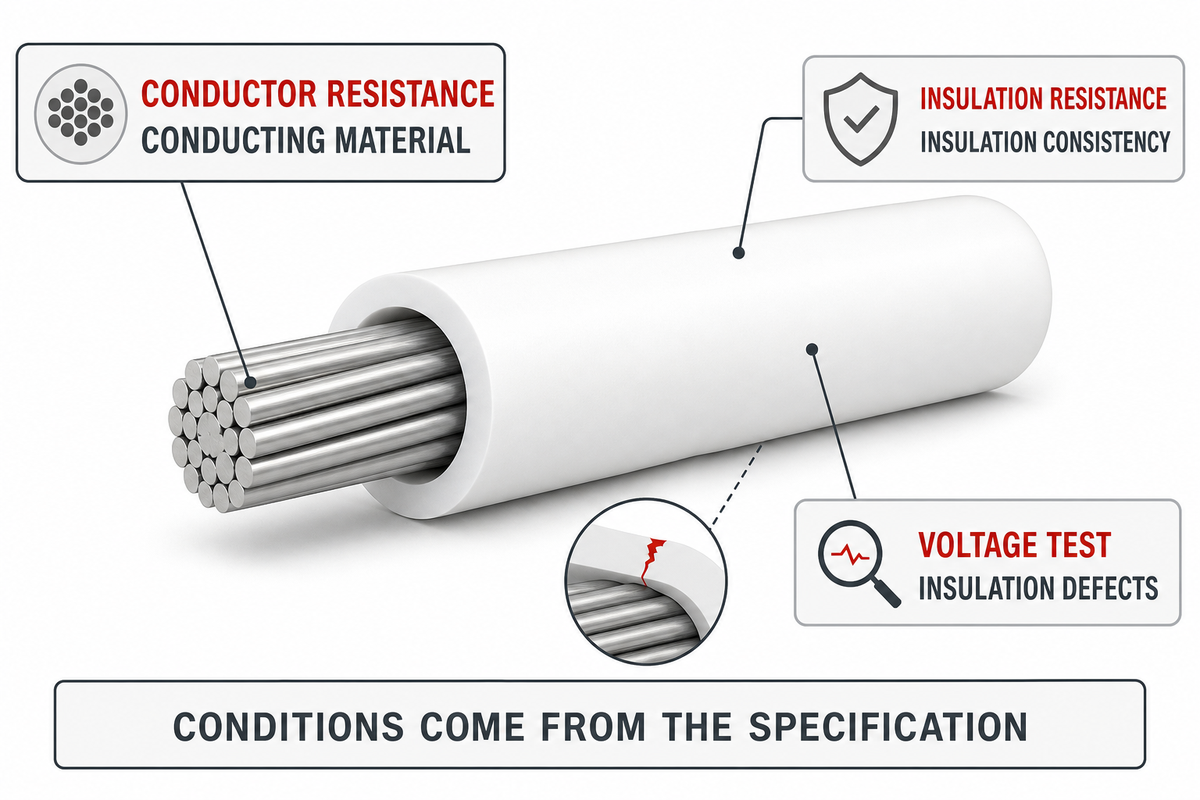
Conductor resistance, insulation resistance and voltage testing assess different electrical properties. Measuring the current-carrying metal can’t assess the state of the surrounding insulation. To compare solar cable quality, find the test name, the material or assembly tested, the reported unit, and the method that assigns the number its value.
BASEC’s electrical test descriptions distinguish these purposes. The conductor resistance test assesses whether the amount and quality of the conducting material are sufficient. An insulation resistance test can indicate insulation consistency or the presence of contamination. Voltage testing is intended to detect defects, including small discontinuities in insulation. The cable specification gives the test conditions and requirements.
“Most power cable specifications will contain details of the test voltages and durations to be applied.”
The 3-Question Test Meaning Matrix
The 3-Question Test Meaning Matrix can be used to support the following explanation. The categories extend beyond electrical measurements to separate the different findings behind a packet of “passed” results. The matrix doesn’t provide the tests required for every cable design.
3-Question Test Meaning Matrix: property, evidence and inference boundary
Test category
Read for
Do not infer from it alone
Conductor resistance
Conducting path and stated basis
Insulation condition
Insulation resistance
Insulation behavior under test conditions
Every environmental property
Voltage test
Response to a specified electrical stress
Permanent freedom from defects
Tensile and elongation
Specified material specimen behavior
Permitted cable pulling load
Hot set
Cross-linking assessment
All ageing mechanisms
Cold bend or impact
Response under defined cold conditions
Unrestricted installation conditions
Flame propagation
Flame spread in the tested arrangement
Smoke density or circuit survival
Smoke emission
Smoke under defined burning conditions
Halogen content
Gas or halogen tests
Specified chemical characteristics
All fire-performance properties
Imagine an example. Consider an illustrative comparison: one record reports resistance for a 10 m sample, while another expresses it per 1 km. Both show different cable length bases. Address that discrepancy before discussing the values. Just doing a sound resistance comparison doesn’t, on its own, answer the project’s question of voltage drop, power loss, or cable size.
Customers who request “the best test result” first must specify the property. Low conductor resistance and high insulation resistance aren’t competing versions of one cable quality value.
Mechanical and ageing tests: read the specimen and conditioning
Mechanical performance testing means demonstrating a stated specimen’s response to a stated treatment. When evaluating insulating or sheathing materials, the identity of the material and its conditioning history must also be known. Without a valid comparison basis, an unaged tensile value cannot substitute for an aged value, and neither establishes the complete limits of a cable installation.
BASEC’s material-testing overview differentiates tensile strength and elongation before and after elevated temperature conditioning. It also differentiates hot set, cold bend, cold impact, and abrasion. These tests assess differing responses of cable material; passing one of these tests leaves other properties unevaluated.
When reading a table, keep in mind that force in N and strength in MPa are different. Likewise, elongation at break refers to the extension of the specified sample. It doesn’t permit the extension of a completed cable by that amount during the installation of the cable.
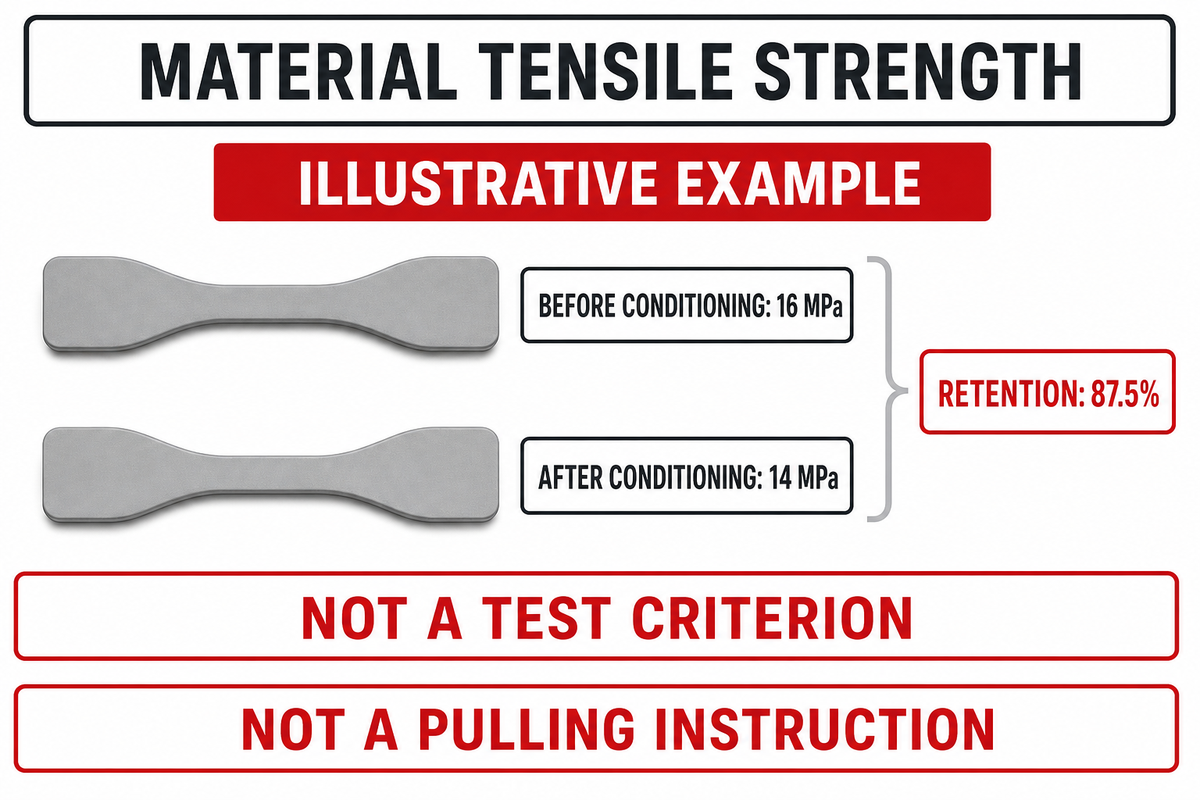
Illustrative arithmetic, not a test criterion: suppose a material record shows 16 MPa before conditioning and 14 MPa afterward. The later value is 87.5% of the earlier value. That calculation describes retention only. It can’t establish a pass until the applicable method, absolute requirement and permitted change have been checked.
Another hypothetical specimen begins with a 50 mm gauge length and reaches 100 mm at break. Its extension is 50 mm, or 100% of the initial gauge length. Field installers still need the manufacturer’s installation instructions. Neither that percentage nor the earlier 14 MPa reading is a pulling instruction.
Temperature labels also need careful reading. IEC’s public scope for IEC 62930:2017 describes single-core, cross-linked insulated and sheathed PV DC cables up to 1.5 kV. It states a normal continuous maximum conductor temperature of 90 °C and limits the 120 °C reference to 20,000 h. The limited-period condition belongs with the number.
Reports referring to 120 °C therefore need their precise context. The value isn’t an unrestricted service-life promise, and an accelerated ageing result doesn’t automatically translate into years of outdoor use. The lifecycle of a cable is a combination of exposure to heat, ultraviolet light, ozone, and mechanical stress.
Regarding the commercial comment “the cable passed aging, so why consider the route?”, explain that the scope is different. A laboratory sample and an installed cable aren’t the same. The test evidence is still useful. The route generates different questions.
Fire, smoke and chemical results are separate findings
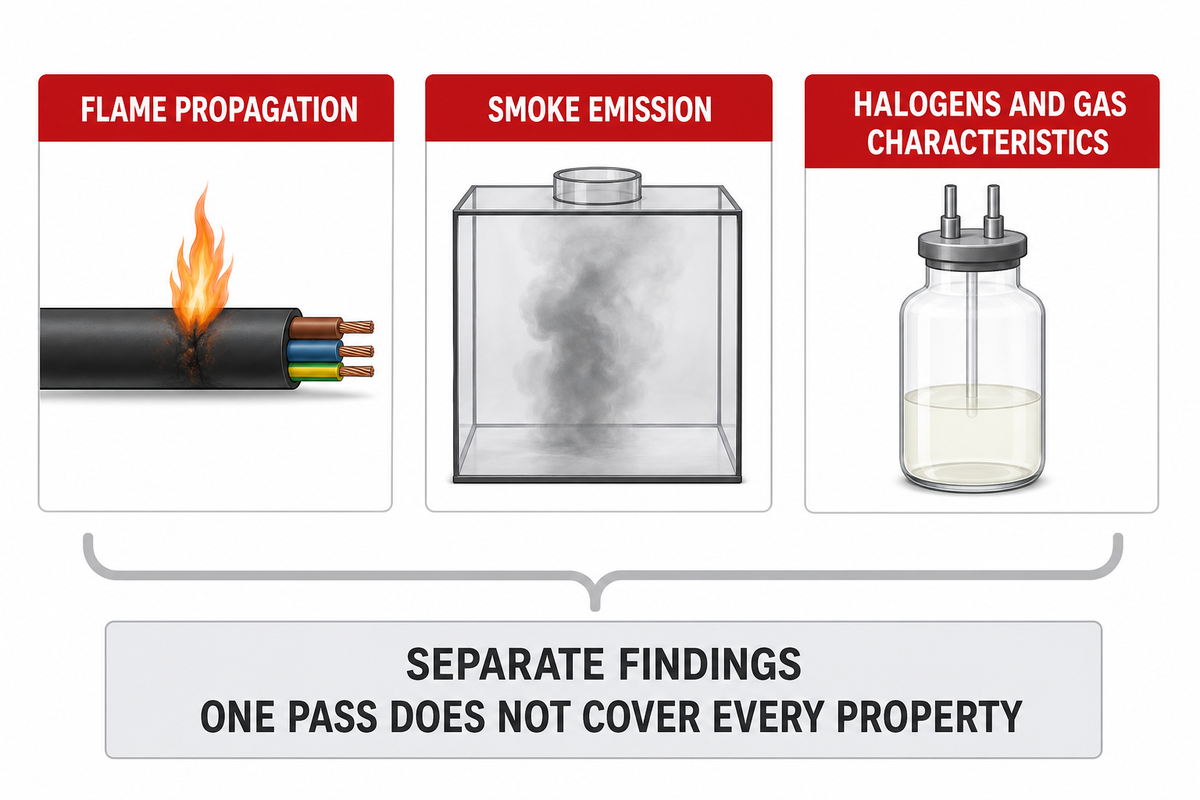
There are many aspects to fire performance. Smoke emission, characteristics of released gases and circuit integrity are different aspects of fire performance. A flame-retardant cable description can’t substitute for all the other required results. Properties must be evaluated individually. Once that’s done, check if the tested arrangement and reported scope meet the need.
Its chemical-testing guidance covers halogens, gas acidity and conductivity, alongside deterioration caused by ozone exposure. One of these findings shouldn’t be used to establish smoke emission or flame-spread performance.
For example, a procurement note requests information about whether photovoltaic cables are halogen-free. Answering this requires evidence and can’t be addressed by an unrelated electrical pass. One shouldn’t assume that all constructions within an international cable standard have the same material characteristics.
Regional approval routes must be left to the project’s applicable specifications and standards. The existing solar cable standards overview is the starting point for that discussion. This interpretation table can’t grant market authorization or determine suitability for every building application.
Why two valid cable results can look different
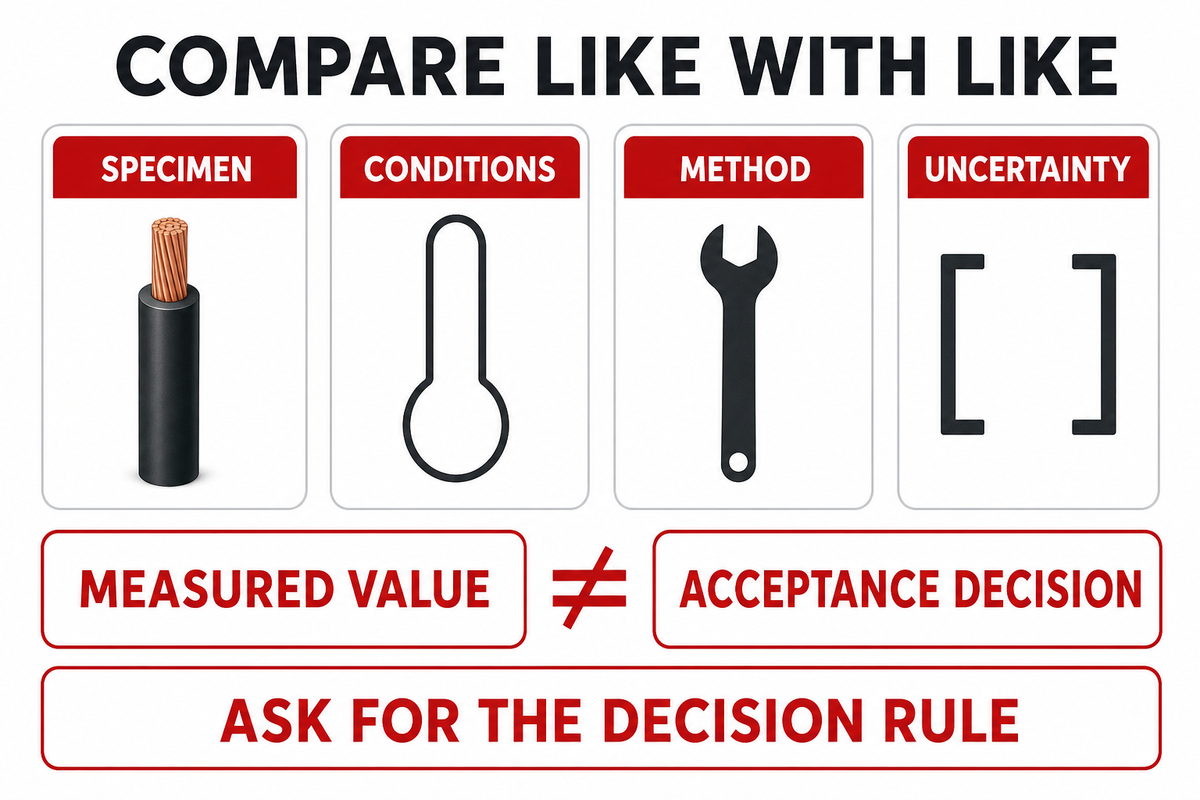
There are several reasons for variant results including variation in test specimens, test conditions, and measurement methods. The conformity statement depends on the reported measurement and its uncertainty in the context of the requirement. Don’t jump to the conclusion that a laboratory or supplier is incorrect if there’s a discrepant result.
Megger’s explanation of insulation diagnostics addresses charging, absorption and leakage currents, and the influence of temperature and humidity. Hypothetically, measurements taken at 20 °C and 40 °C aren’t directly comparable merely because both are labeled insulation resistance. Consider the stated method, and don’t speculate on how to fill in the gaps.
The pass/fail step requires thought as well. NIST researchers Steven Phillips and Michael Krystek explain how measurement uncertainty interacts with the decision rule used to accept or reject a product. The measured value and the acceptance decision are related, but they aren’t the same value.
For an invented dimensional example, assume a stated minimum of 2.00 mm, a measured value of 2.05 mm and reported uncertainty of ±0.10 mm. Simple comparison places the measured value above the minimum. Comparing the measured value to the limit doesn’t tell you how the lab accounted for uncertainty when issuing their conformity statement. The values provided in this example are not solar cable thickness requirements.
Classify the disagreement before comparing the outcome
Observed difference
Question to resolve
Comparison status
Ω versus Ω/km
Same length basis?
Unit basis unresolved
20 °C versus 40 °C
Same conditioning or permitted treatment?
Conditions differ
Before versus after ageing
Same specimen state?
Different observations
N versus MPa
Force or material strength?
Different quantities
50 mm versus 100 mm gauge basis
Same method and initial length?
Preparation needs review
Insulation versus sheath
Same cable component?
Different materials
Single cable versus cable bundle
Same fire-test arrangement?
Different test scope
Number versus “pass”
Which requirement and decision rule?
Decision basis missing
Sample versus installed circuit
Same assessed object?
Different system boundary
Use the 3-Question Test Meaning Matrix to determine the property and use this chart to identify the conflict. If a borderline result coincides with your buying deadline, ask the lab to explain the decision rule. Choosing the report that states “pass” doesn’t resolve the technical issue.
From a tested sample to a working PV installation
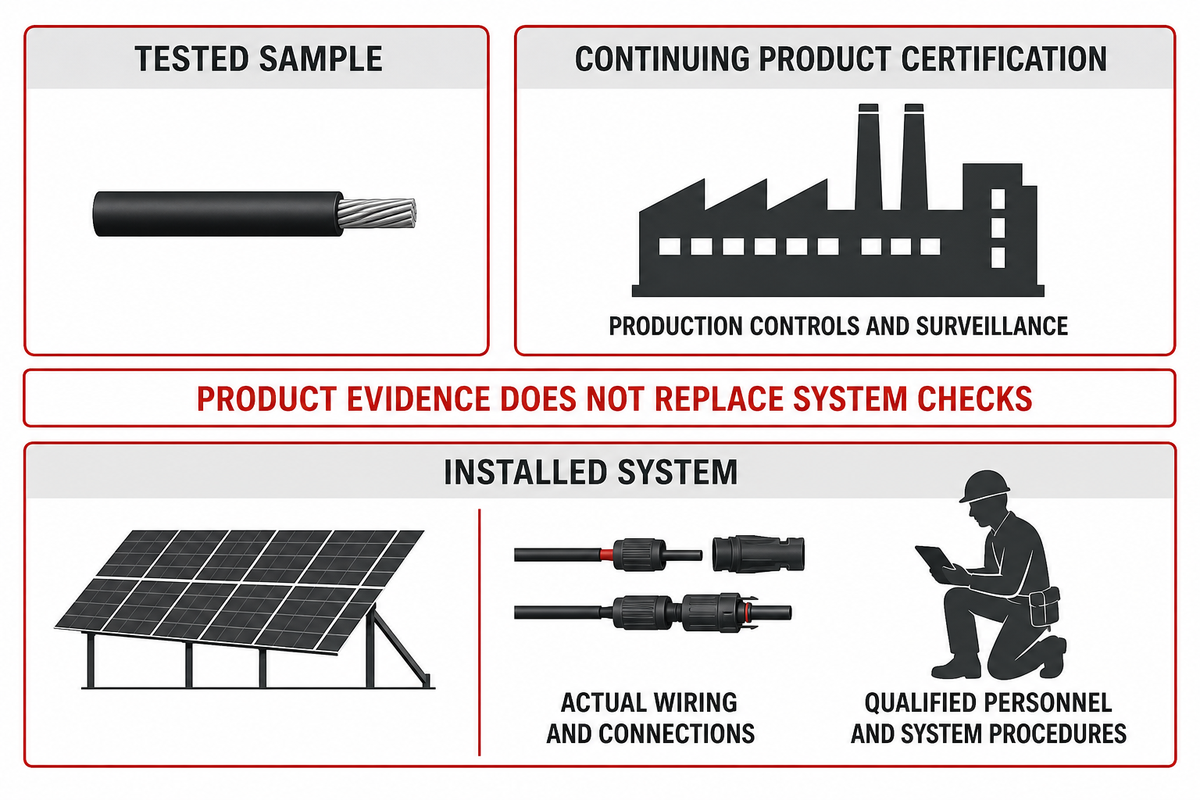
When considering a tested sample, a continuing product certification, and an installed PV system, there are different boundaries. A defined certification program can integrate sample testing and production controls and surveillance. Verifying the installed system still addresses the actual wiring and links. Therefore, long-term reliability requires more than an isolated favorable laboratory result.
According to BASEC’s January 2026 explanation, a one-off sample test differs from its product-certification program, which includes assessment of the factory and continued surveillance. This is the reason for the caution: a separate, defined program may use sample results as part of a broader conformity assessment.
UL’s Follow-Up Services describes checks against evaluated construction, including materials, cable components and traceability. Changes in cable production can be relevant to continuing evidence. Nothing in this general description establishes a current UL certification for a JINYOU model.
On an installation level, IEC 62446-1’s public scope pertains to documentation, commissioning tests and inspection for grid-connected solar PV systems. Product testing and certification do not stand in for those system-level tasks. An assembly of solar panels along with the PV module connection and DC cables installed will never be represented by a loose material specimen.
Sandia’s connector research studies defective, mismatched or poorly installed connectors. Meanwhile, DOE cable-management guidance studies support, routing, heat, UV radiation, and abrasion. These studies identify real-world installation and maintenance issues, and don’t estimate a generalized cable failure rate.
In the case of solar power systems, product evidence and installation evidence must be discussed separately in the context of quality and safety. Passing the cable test can’t isolate the cause of all electrical faults, connector problems or safety hazards on a rooftop. Qualified personnel need the appropriate system-specific procedures and documentation to investigate these problems.
Reading current guidance without inventing a new standard
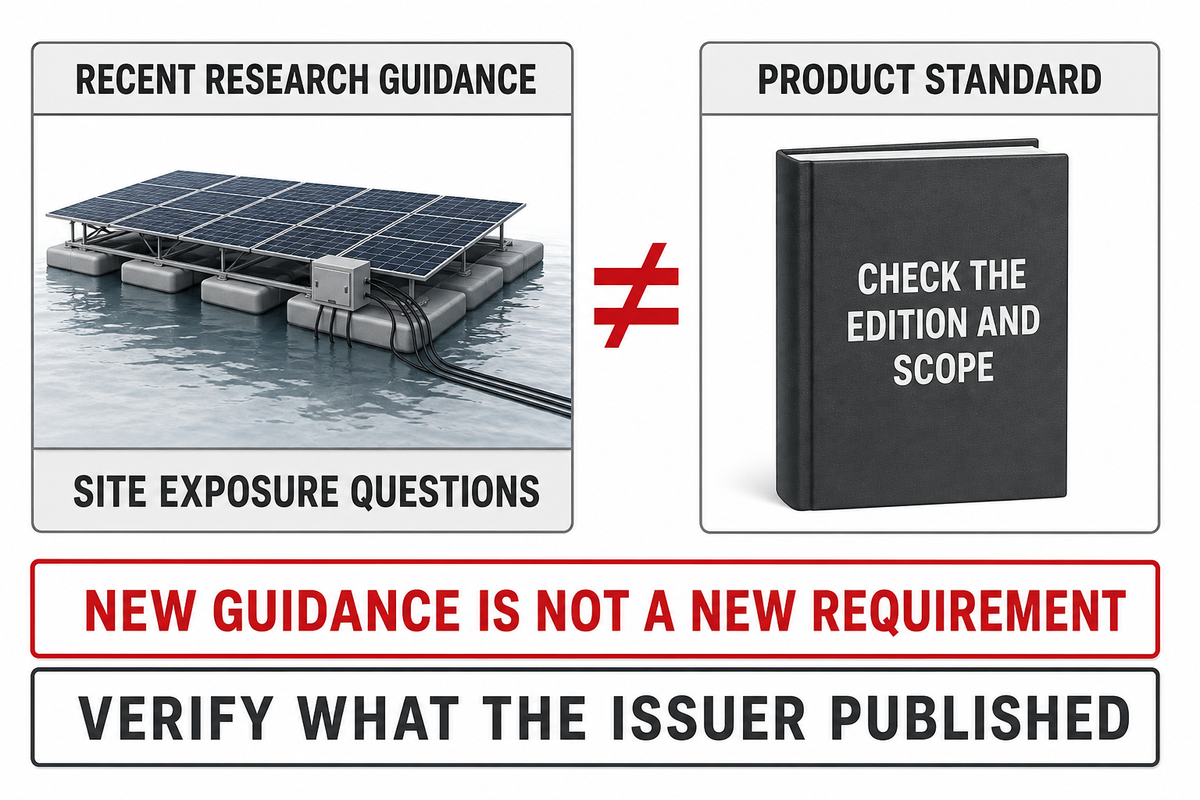
New application questions can be formulated based on recent guidance, even without the creation of a new mandatory test. Check what was published, who published it, and whether it provides a new normative requirement. A research summary, a certification-body explanation, and a revised product standard have different purposes, even when the same date is shown in the search results.
Questions relating to reliability, degradation, stress-testing and maintenance arise as systems operate in different water environments and are addressed by the April 2025 IEA PVPS floating-PV review summary. It doesn’t make an immersion rating for every solar cable. This finding can be used to determine what exposure evidence actually relates to the site for a floating solar project.
As of September 2026, IEC’s catalog lists IEC 62930:2017 as valid. Date of publication in a vendor document is not sufficient justification for a replacement edition. Likewise, a recent comment regarding testing standards or “industry standards for solar” should state the exact source from which it is derived before it can affect your acceptance criterion.
International standards and national cable standards have their own scopes: IEC 62930 and UL 4703, alongside EN 50618, should not be treated as interchangeable labels. The solar industry’s move into new renewable energy settings makes context more valuable. Different types of solar cables have different functions. Compare a specific item in the solar PV cable range with its applicable evidence; avoid pooling different constructions into one performance and safety claim.
Frequently asked questions about solar cable testing
Does a passed cable test guarantee service life?
No. A pass is specifically on the stated sample, method and requirement. Service conditions, installation and continued control of the product are all relevant. A specific lifetime claim needs its own evidence and criteria; a general test report isn’t sufficient.
What is the difference between conductor and insulation resistance?
The conductor resistance relates to the conductor. Insulation resistance relates to the insulating system for the given conditions. They probe very different properties and are reported on very different scales. First determine which resistance is reported in the investigation, and then examine the method, units of measurement, and the conditions of the report. A good outcome for one property isn’t a definitive result for the other.
Can two laboratories report the same value but different conformity statements?
Different conformity statements require more explanation than saying another lab was wrong. Verify that the requirement, specimen, measurement uncertainty and decision rule are all the same. NIST’s discussion on decision rules shows that accepting or rejecting results is more complicated than reading a displayed value. Ask each lab how they came to their decision.
Does halogen-free mean the cable meets every fire requirement?
No. Halogen-related characteristics, smoke emission, flame spread and circuit integrity are all different concerns. Ask for the evidence for the property that the project actually requests. An electrical test, material label or unrelated flame-test pass can’t be substituted for the evidence.
How should a buyer use a report that is difficult to interpret?
To start, write down one result with the measured property, the specimen, the condition, and the conclusion that was drawn. Ask the laboratory to explain the unfamiliar unit and decision rule. Keep the explanation associated with that result; don’t generalize it across all solar installations or families of cable. The task of document review is to check whether a certificate or delivery record is missing. Evidence is still required to support claims of “high-quality solar cables” regarding the claimed characteristic.
Read the finding before relying on the pass. A useful solar cable review identifies what was measured, under which conditions, and how the conclusion was reached. That habit keeps cable quality assurance grounded in evidence while leaving project approval with the people responsible for it.
References & Sources
Public pages checked September 2026. Method summaries describe test purposes; they aren’t a substitute for full standards or project specifications.
Shanghai Jinyou Jinhong Intelligent Electric Co., Ltd. has focused on new energy cable manufacturing since 2006, supporting solar/PV, energy storage, EV charging, and industrial or special-cable applications.
Use this guidance to prepare a clearer engineering or procurement discussion: operating environment, conductor and insulation expectations, route length, voltage, installation method, and project schedule.
Certificate evidence should be matched to the construction being specified. Public certificate evidence applies to H1Z2Z2-K solar cable constructions and should not be read as blanket certification for every JINYOU Cable product family.
PROJECT BRIEF
Move from article to specification
Share the application, required cable family, target standard, quantity range, and delivery window. The team can help structure the next engineering and procurement conversation.