“PV Control cable” is clearly an abbreviated product phrase. This example illustrates a real-world scenario where a simple product phrase can result in a complex series of questions. What does the path achieve? Which devices does the path connect? How will it be installed? What defines the interfaces? Until you’ve answered these types of questions, the cable label may provide no useful guidance for selection, approval, or installation.
This informational guide is intended for owners, engineering teams, installers, and procurement coordinators preparing a complete control/monitoring circuit record. This guide does not size conductors, determine a communication protocol, approve an installed route, certify a product, or augment the cable code, project specifications, equipment manual, or qualified professionals. Rather, this guide strives for a more complete record of the project: sufficient detail to allow the responsible technical and commercial teams to discuss the relevant issues without having to guess.
The primary method is the Signal Path Documentation Check. This method starts at one end of the device’s control/information/signal path, follows the path to the next end device, and records the physical path and open-ended questions, then returns those questions to the owner for response. This method of Signal Path Documentation is substantially different than a product-selection table. Documenting the signal path of a project is a request for a project-customized solution; it doesn’t create a solution from unrefined inputs.
Safety boundary: use this resource for recordkeeping, visual route observation, and coordinated control of discrete project components. It is not an instruction to work on energized equipment, open enclosures, disturb terminations, shields, or protective measures, or conduct testing. When a situation might potentially be safety-significant, you must follow the approved site procedure and refer the situation to the responsible qualified individual.
1. Record Circuit Role and Ask the Classification Question First
Solar arrays consist of multiple electrical paths. Conductors of hard-wired DC power, control circuits, monitoring circuits, instrumentation cable paths, networked communication circuits, and conductors associated with protection may be at the same location. They can co-exist while performing different functions and be described in different manuals of the controlled devices or project requirements.
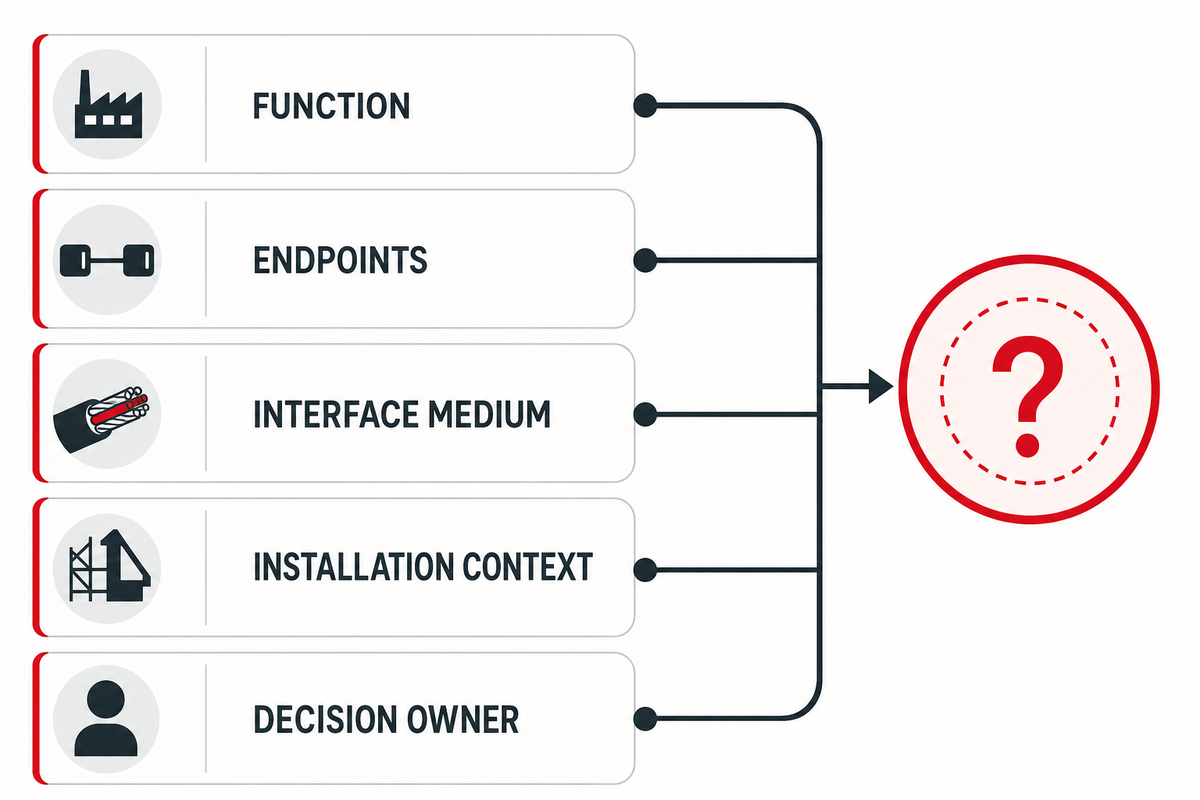
Because of this, “PV control cable” should be the first entry in a record, not the closing entry in a query. Before you request a cable model or construction, provide the following information in a clear, concise manner:
Function: Is the path carrying power, a status or control signal, measurement, communication, data, or some other defined function?
Endpoints: What device, terminal group, panel, controller, sensor, inverter, combiner, or gateway resides at each end?
Interface medium: Is the recorded interface hardwired, networked, or undetermined?
Installation context: Is the pathway contained in a tray, conduit, enclosure, tracker, equipment skid, a segment that’s buried, etc.?
Decision owner: What project function provides the classification, engineering interpretation, installation confirmation, and makes any product-specific decision?
Municipal photovoltaic inspection material generally distinguishes PV source or output circuits from other conductor categories. This is helpful as a record-keeping reminder: the role of a circuit must be defined, and must not be defined by proximity to solar equipment. It isn’t a universal classification standard for every case. For example, the City of Maitland solar photovoltaic inspection checklist demonstrates how inspection records separate circuit context.
An ambiguous label can create a procurement risk because the checklist separates PV source and output circuits from non-PV and inverter-output circuit conductors. The checklist helps a project team record that boundary; it does not classify every control path.
One useful first-line description reads: “Hardwired status path between [endpoint A] and [endpoint B]; route enters [location]; interface and owner requirements to be confirmed from the current equipment manual.” It’s more useful, and more honest, than calling a path “standard PV cable” when its function hasn’t been established. The same discipline helps separate the physical wiring record from the circuit-function record: each can be complete enough to review without pretending to answer the other.
2. Follow the Signal Path From Device to Device
Once the function of the circuit has been established, describe the circuit in the direction the project team will be required to understand the circuit later. Start from one of the ends that’s easily identifiable, then describe the transition and the circuit path toward the next identifiable end. Describe what you observed, what’s known, and what remains unknown. Don’t provide a detailed answer and hide what’s unknown by describing what’s likely to be a signal path shielding arrangement, performance or termination of the circuit. This is especially important when different contract packages document signal transmission and the solar wiring.
The Signal Path Documentation Check
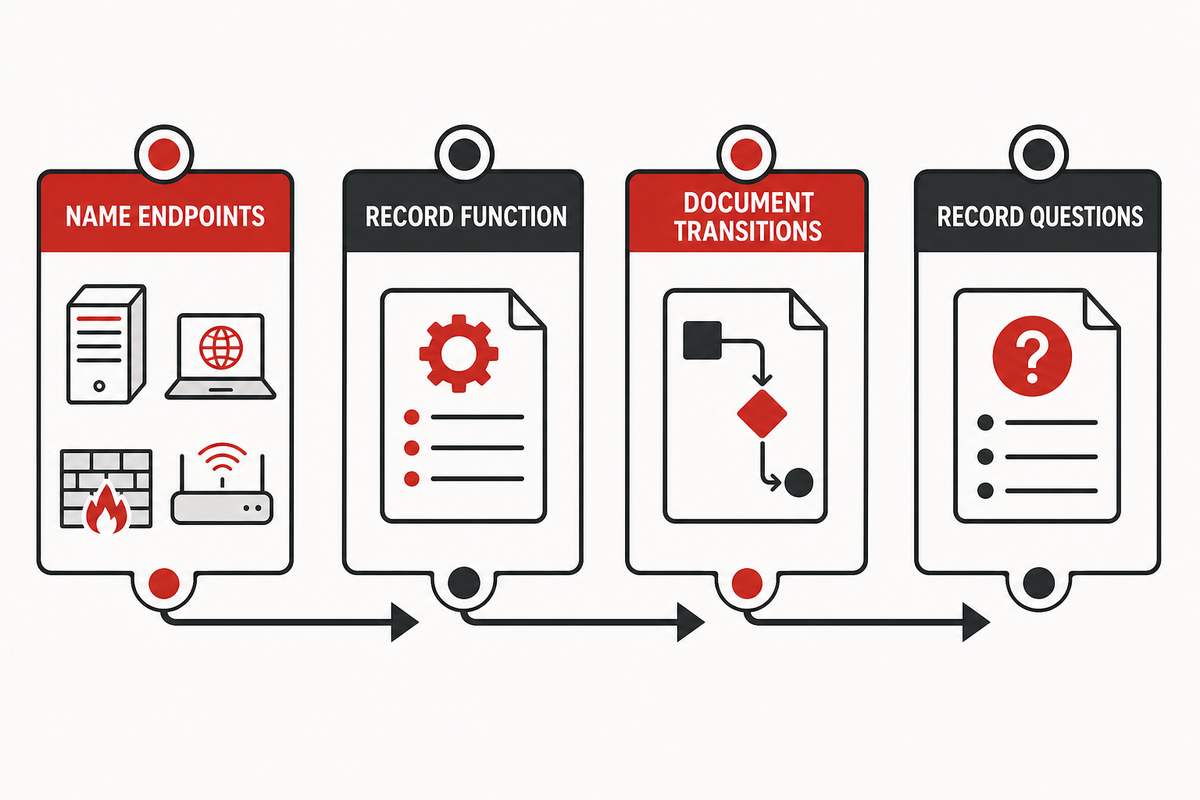
The Signal Path Documentation Loop has four passes:
Name the endpoints. Use drawing references, equipment identifiers, panel labels, or other controlled project identifiers. “From the solar system” is too general.
Record the known function. Document the function as shown on the drawing, device manual, or the responsible system owner. Indicate it as unconfirmed if there are no confirmations.
Document the transitions. Show entries and exits to and from trays, conduits, enclosures, moving elements, junction areas, and other systems’ interfaces.
Record unanswered questions. If the record is unable to determine the medium of the interface, the conditions of the environment, the need for separation, or the requirement of the equipment, provide the owner and source that’s needed to answer the question.
Some distributed energy resource systems include sensors, data transfer, and networked information exchange in addition to electrical hardware. NIST’s distributed energy resource guidance is useful here because it treats those connections as system-level interfaces, not as an afterthought of the power circuit. NIST SP 1800-32 isn’t a cable installation manual, but it supports the practical boundary: a networked path may need system-owner requirements that can’t be inferred from a generic cable phrase.
For a procurement or commissioning review, the risk is that a networked interface is treated as a generic cable path because its data-transfer and access requirements are left to an installer. This distributed-energy-resource context includes networked systems, sensors, and information exchange; record the system owner and open interface before a supplier makes a cable request.
Hardwired paths shouldn’t be assumed to be networked. For a networked path, this guide should not specify access, cybersecurity, shielding, or termination settings. Should the issue of electromagnetic shielding be raised as a project issue, note the source document and the owner of the decision instead of turning this guide into a shielding proposal. In either case, the goal to be achieved is the same: note the interface, record the issue, and assign it to the project’s controlled records.
3. Keep Separate Records, Then Reconcile Their Interfaces
Power wiring and control or monitoring paths can coexist in one PV installation, but their records shouldn’t be integrated into one undifferentiated “solar cable.” Separating records avoids a common error of deeming a DC array-cable designation as a selection or approval of a different control, monitoring, or communication path. When a drawing contains the phrase “photovoltaic cable,” maintain the same drawing and don’t extend this to other adjacent paths. The broader solar PV cable family is useful product context, but it should not replace the circuit-function record.
The official IEC publication page for IEC 62930 describes the scope as single-core, cross-linked insulated power cables intended for the DC side of photovoltaic systems. Having a well-defined scope keeps (parts of) a project team from wondering what a reference does and what it does not. Just having a well-defined scope does not address functional suitability or approve other nearby control, monitoring and/or communications paths. Review the IEC 62930 publication scope.
An ambiguous power-cable label creates a procurement risk because IEC 62930 describes single-core, cross-linked insulated power cables for the PV DC side up to 1.5 kV DC. In an RFQ or supplier review, retain that scope beside the equipment interface rather than treating an adjacent standard as control-path approval.
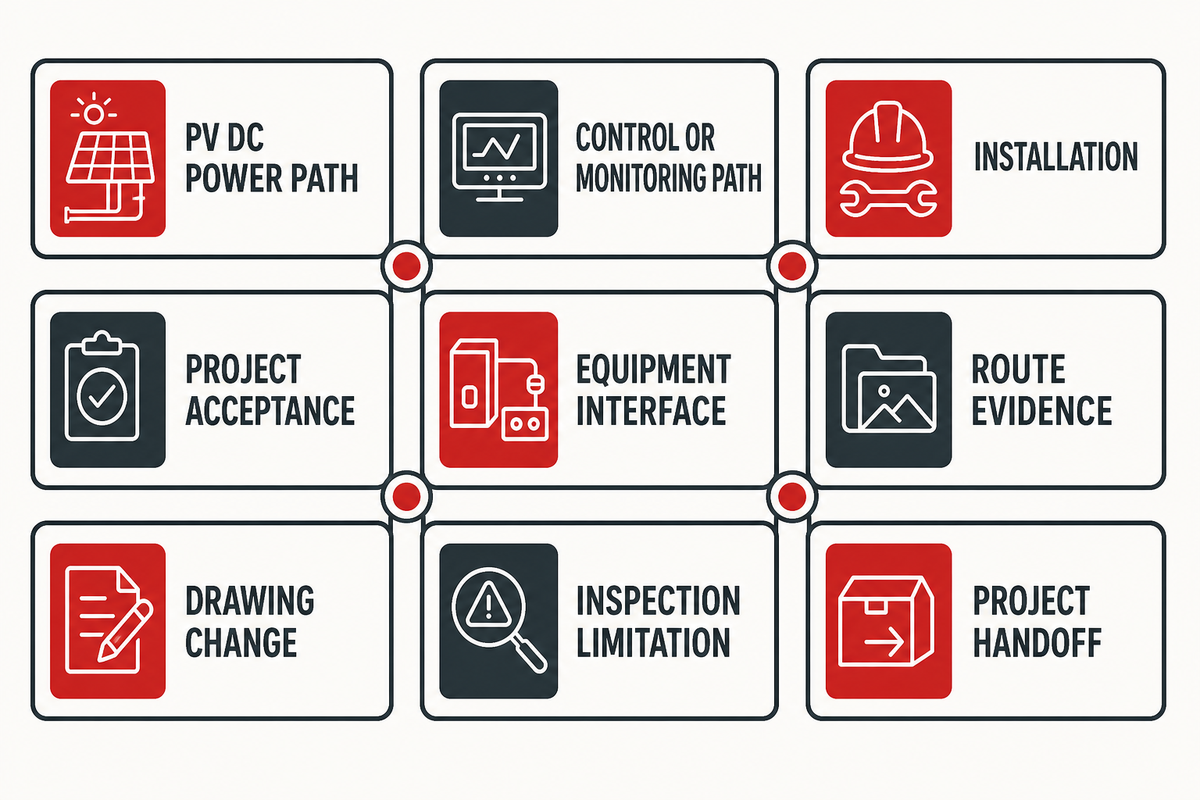
Record type
Questions it should answer
What it should not be used to prove
PV DC power-path record
Which power circuit and route are being discussed; which project documents govern that circuit.
That a separate control or data path is automatically covered.
Control or monitoring-path record
Function, endpoints, interface medium, route context, and system-owner questions.
That its electrical or equipment requirements can be inferred from a power-cable term.
Installation record
Observed route, supports, transitions, access limitations, and referenced drawings.
That visual observation has performed an electrical test or design review.
Project acceptance record
Who accepted which requirement under the controlled project process.
That a standard scope, a product page, or a field note is acceptance by itself.
Equipment-interface record
Available endpoint and device-document references, plus unresolved interface questions.
That a general guide has prescribed a terminal, protocol, or access setting.
Route-evidence record
Containment, support, transition, movement, and access facts for an identifiable segment.
That an observer has approved the route against a project requirement.
Drawing-change record
Which controlled drawing revision was consulted and what field difference remains open.
That an older or nearby drawing represents the installed condition.
Inspection-limitation record
What was visible, concealed, inaccessible, or outside the observer’s authorized scope.
That hidden wiring, internal equipment, or electrical integrity was checked.
Project-handoff record
Which model, document-scope, traceability, quantity, or quotation question requires response.
That an information guide has selected a product or accepted its suitability.
Reconciliation happens at the interfaces. A project may need to know where a monitoring path enters or leaves an enclosure associated with a PV DC circuit, where the records point to different drawings, or if an installation segment is shared. Record those interfaces clearly. Don’t make them evidence that the circuits are interchangeable.
4. Turn Device Interfaces Into a Request Record
Requests become actionable when they’re accompanied by evidence that a supplier, system owner, or engineering team needs them. Vague wording—“need PV control cable”—results in a vague answer. A circumscribed request identifies the path, the unknowns, and the person who can resolve the unknowns.
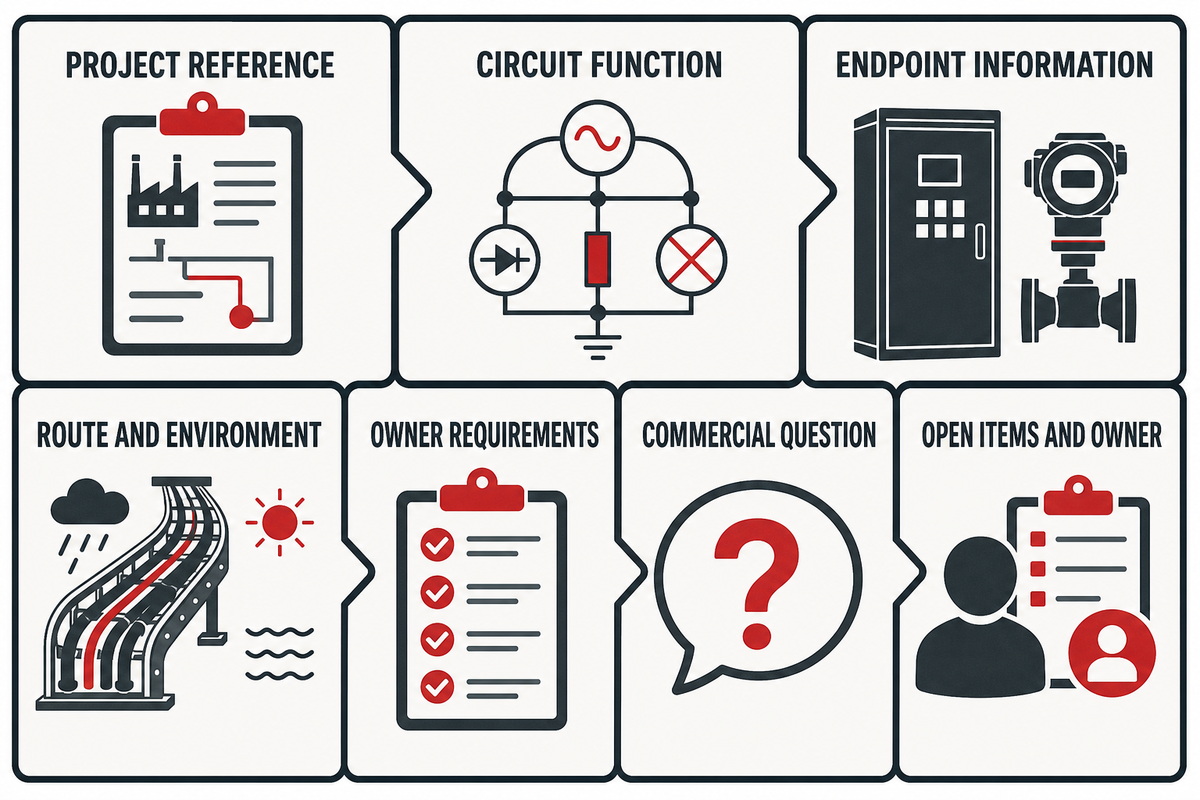
Use a request record with the following fields:
Project and document reference: project name or identifier, relevant drawing revision, and source of the current information.
Circuit function: The recorded function plus a clear “unconfirmed” marker where classification is still pending.
Endpoint information: equipment identifiers and available terminal or interface references, not pin/interface references that are improvised.
Route and environment: indoor/outdoor exposure, containment, movement, transition points, access constraints, and any conditions observed on the installed or proposed path.
Applicable owner requirements: project specification, jurisdictional requirement, equipment manual, or system owner direction (with version or revision, where available).
Commercial question: whether the team is seeking a model discussion, document-scope review, traceability information, quantity planning, or quotation.
Open items and owner: the missing fact, the role responsible for confirming it, and the evidence expected for closure.
Using this format enables the owner to make uncertainty visible where it matters most without making the request unusable. As an example, the equipment owner could confirm the interface while the route is documented. Likewise, the installation team could confirm the physical transition while the equipment manual is provided. Instead of asking one party to quietly make all decisions, this format separates the tasks.
This discipline is required of numerical data too. A reviewer is provided very little information by a value written as 24 V without a circuit, source, date, owner, etc. The same is true of 4 A, 60 Hz, 25 °C, 20 mm, 50 m, or 100 W. A value should only be documented if the drawing from which it was taken, an equipment document, a test record, or some other controlled source is included; none of these examples is a design value as specified in this guide.
5. Plan Route, Separation, and Support as Installation Evidence
Route context conveys meaning, not aesthetics. A path which enters a raceway, crosses a support, approaches a piece of moving machinery, or departs protected contained structure has a meaning for the installer and designer of the concerned system. The guide doesn’t specify a universal clearance, support interval, or installation rule; this is determined by the given project and the relevant authority. However, the guide does provide a means for the user to capture the facts which the implementing authority requires. These cable-management and wiring records keep a record of route facts while leaving route engineering to the authorized process.
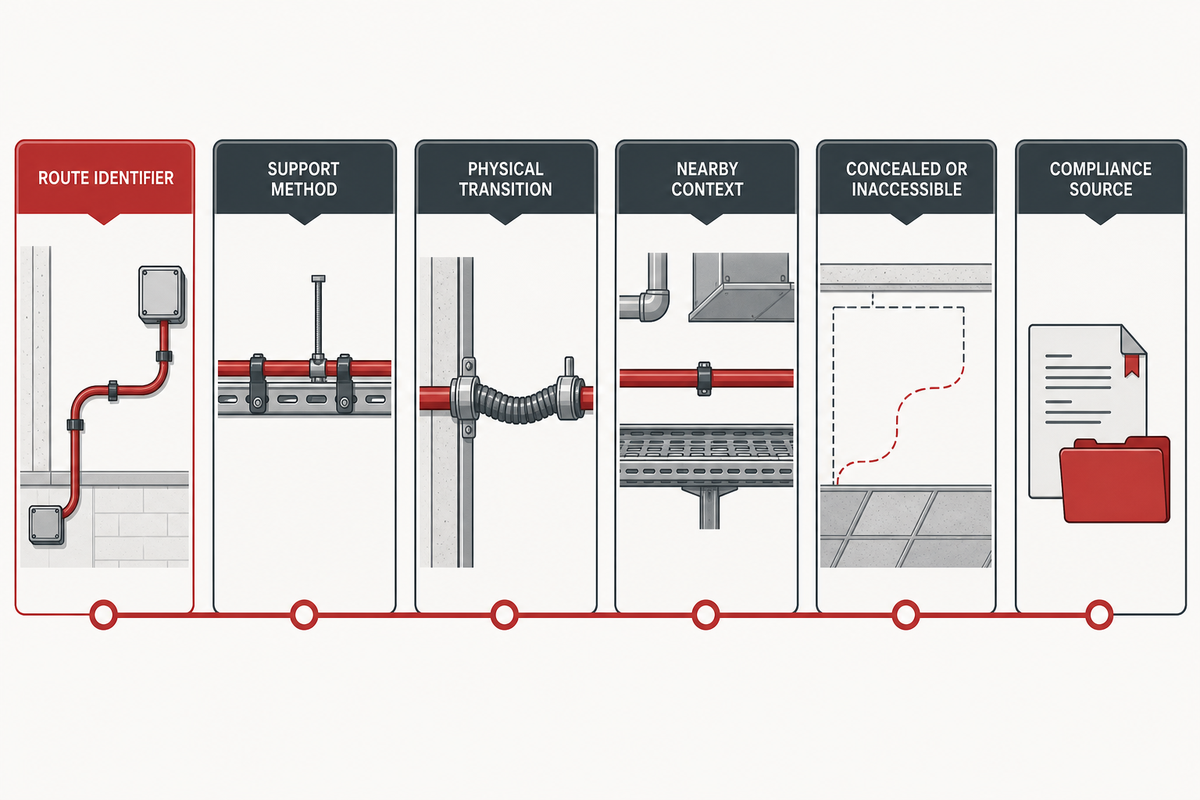
For each segment, describe:
the route identifier and its visible start and end references;
the containment or support method that can be observed;
each transition where the physical condition changes;
nearby movement, edge, access, weather, contamination, or maintenance context;
what part of the route is concealed or inaccessible; and
the drawing, inspection record, or owner required to determine compliance.
The San Clemente City photovoltaic inspection guide, for instance, includes conductor-management checks in its project-specific inspection context. That guide is not a global route prescription, but it illustrates why an installed path should retain support and management evidence instead of relying on a generic product label.
The safest wording is observational: “route exits containment at [reference]; support condition recorded in photo [reference]; applicable requirement to be confirmed.” Avoid declaring an observed arrangement compliant, noncompliant, durable, or unsafe unless the authorized project process has made that determination.
6. Read PV-Wire Standards as Scope Checks, Not Control-Circuit Approval
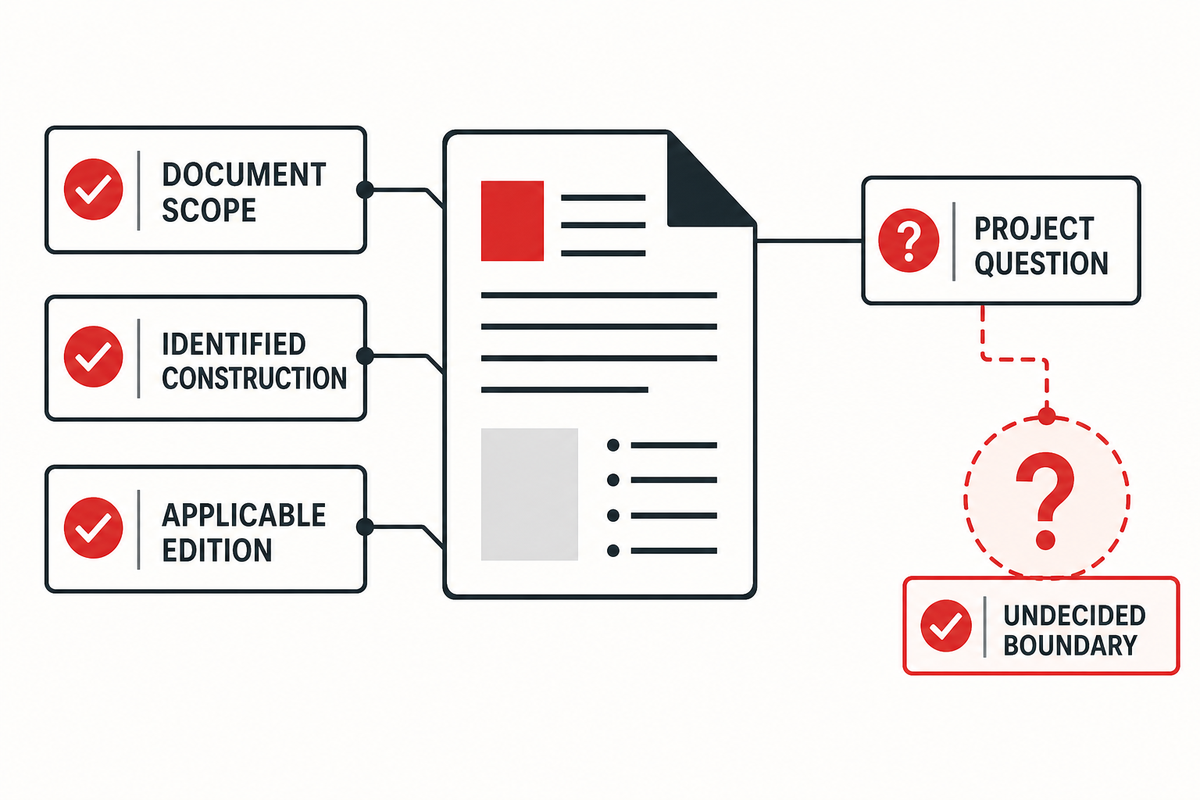
Standards and conformity documents are important evidence, but are limited in their context. It is necessary to understand what a document covers, which construction or product it identifies, which edition applies, and which project question it is being used to answer. Stay within these limits.
For this guide, the key distinction is simple: an IEC 62930 reference is about the scope of a DC-side photovoltaic power-cable standard. Its publication scope includes specified single-core power cables for the PV DC side up to 1.5 kV (1,500 V); that is a scope statement, not a universal approval for a control or monitoring function merely because the path is located in a solar project. The same discipline applies to a product certificate, a test report, a patent, a UL reference, or a supplier data sheet. None may substitute for project engineering, equipment manuals, evidence along the route, and acceptance.
Before a supplier or project owner treats a test report or certificate as approval, compare the stated scope, construction, and 1.5 kV DC limit with the actual circuit role. The risk is scope creep because IEC 62930 limits a DC power-cable reference while leaving a separate control-path decision unresolved.
For example, a given document may show a rated voltage or a type of insulation and sheath construction. Those technical parameters should be retained exactly as they were given and reviewed with regard to the project. They should not be copied into a request record as a substitute for identifying the circuit function, device interface, route, or acceptance responsibility.
A good review prompt is, “What particular option does this document provide? What does it leave undecided?” If the answer is, “It identifies a product scope,” don’t put in a route approval. If the answer is, “It describes an invention,” don’t put in a suitability claim. If the answer is, “It captures an inspection,” don’t put in an electrical test result.
7. Treat Adjacent PV-Wire Trends as Vocabulary, Not a Control-Cable Forecast
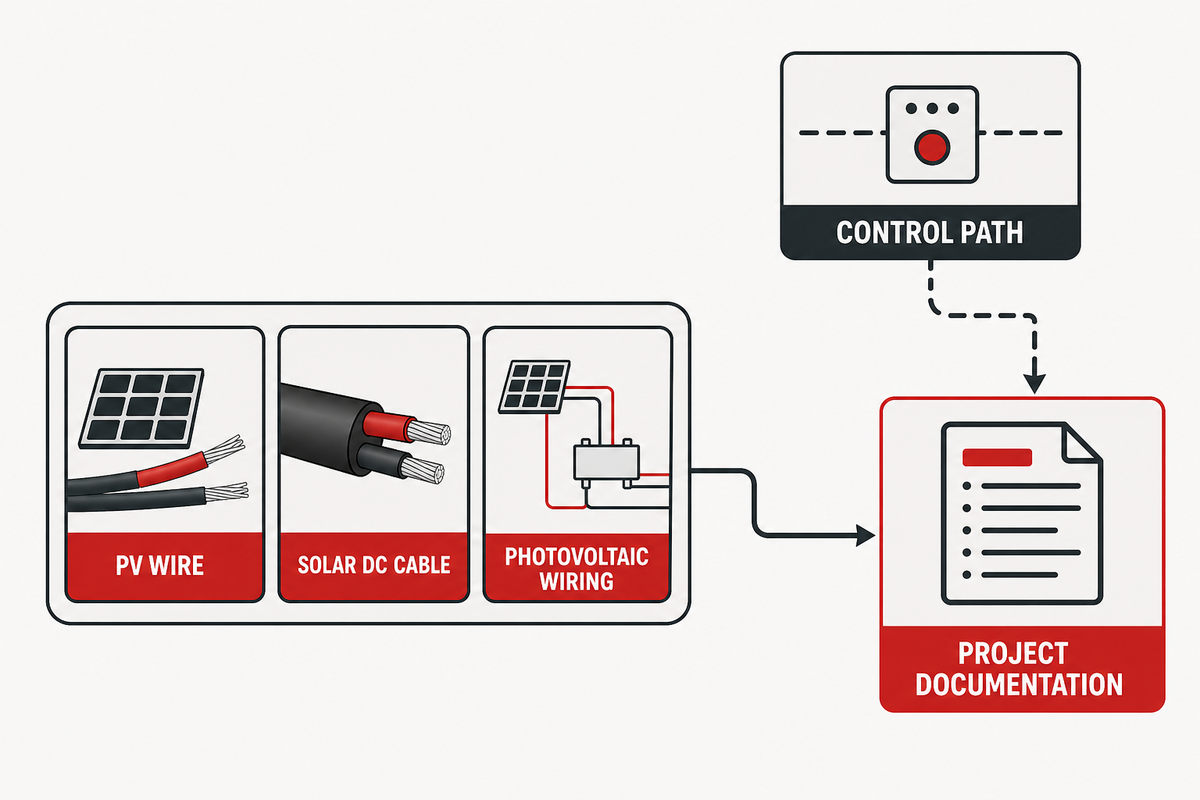
Most search results relating to solar cable mention pv wire, DC array cable or their price and availability in shops. These terms and others can be helpful when thinking about what a reader intends to clarify. However, they do not prove a particular control-cable trend, construction preference, performance outcome, or market forecast. They also shouldn’t be used to replace the project wiring documentation with a common search language.
Clarify the boundary of the editorial area. “pv wire”, “solar DC cable”, and “photovoltaic wiring” may show why some readers mix DC power lines with control or monitoring lines. These terms aren’t used to collapse the two categories. The terms mentioned in this guide are adjacent so that they can clarify the terms used. This guide therefore uses these adjacent terms only to clarify terminology, not to predict demand, recommend a product family, or claim that one class of cable is automatically a substitute for another.
Adjacent search vocabulary creates a procurement risk because shared phrases can make unlike circuits appear interchangeable. IEC 62930 gives a useful countercheck: its DC-side power-cable scope reaches 1.5 kV DC but does not decide the function, construction, or suitability of a separate control path. Supplier requests therefore need the device interface and route, not a trend label.
This also allows the article to have a different function from a solutions page. Readers who need definitions, record methods, or a handoff file can use this guide. Readers who want a dialogue about a particular product can get there with a better input for the project.
8. Create an Exception Record Before Calling a Cable Problem a Failure
An observation without an explanation isn’t a root cause. A drawing that’s missing, an unverified endpoint, and a route change or a damaged support are all worthy of attention, but the record should distinguish observations from conclusions. The separation also helps the project team avoid unnecessarily drawing closure to an unsupported failure or a procurement recommendation from a field note.
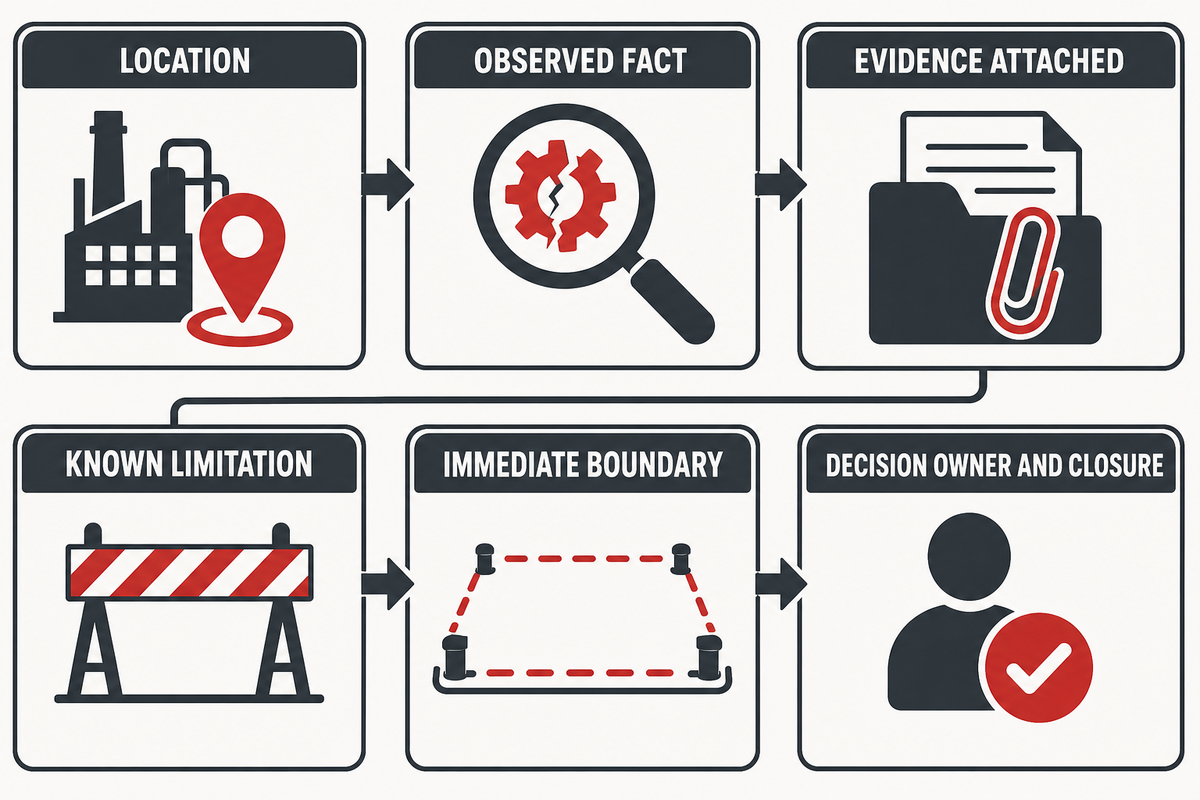
Use this exception record:
Location: controlled equipment, row, route, or drawing reference.
Observed fact: what was seen or reported, without assigning a cause.
Known limitation: what was not inspected, tested, or confirmed.
Immediate boundary: what work must remain under the approved site procedure.
Decision owner and closure: who evaluates the issue and what record closes it.
As a safety consideration, physical and electrical safety standards should take precedence over the inspection, testing, repair, and reporting of a PV system as described in the responsible procedure. The U.S. Department of Energy highlights the need for system safety before a recovery and a follow-up validation after a loss. Access the DOE operations and maintenance guidance. This isn’t a recommendation for a troubleshooting or repair action from this article.
Detailed exceptions provide key information that reflects the knowledge of the observer at the time. Precise exception records also prevent the term “cable failure” from being used to describe a route, device, record keeping, control system, or installation issue that’s currently undefined.
9. When to Move From This Guide to a Project-Specific Solution Request
Transition from this informational guide to a product specific discussion when the project needs a model, construction, quotation, quantity plan, document scope, traceability question, or a review against the supplied project requirements. These topics are all considered part of the solution process as they require project inputs and technical discussions.
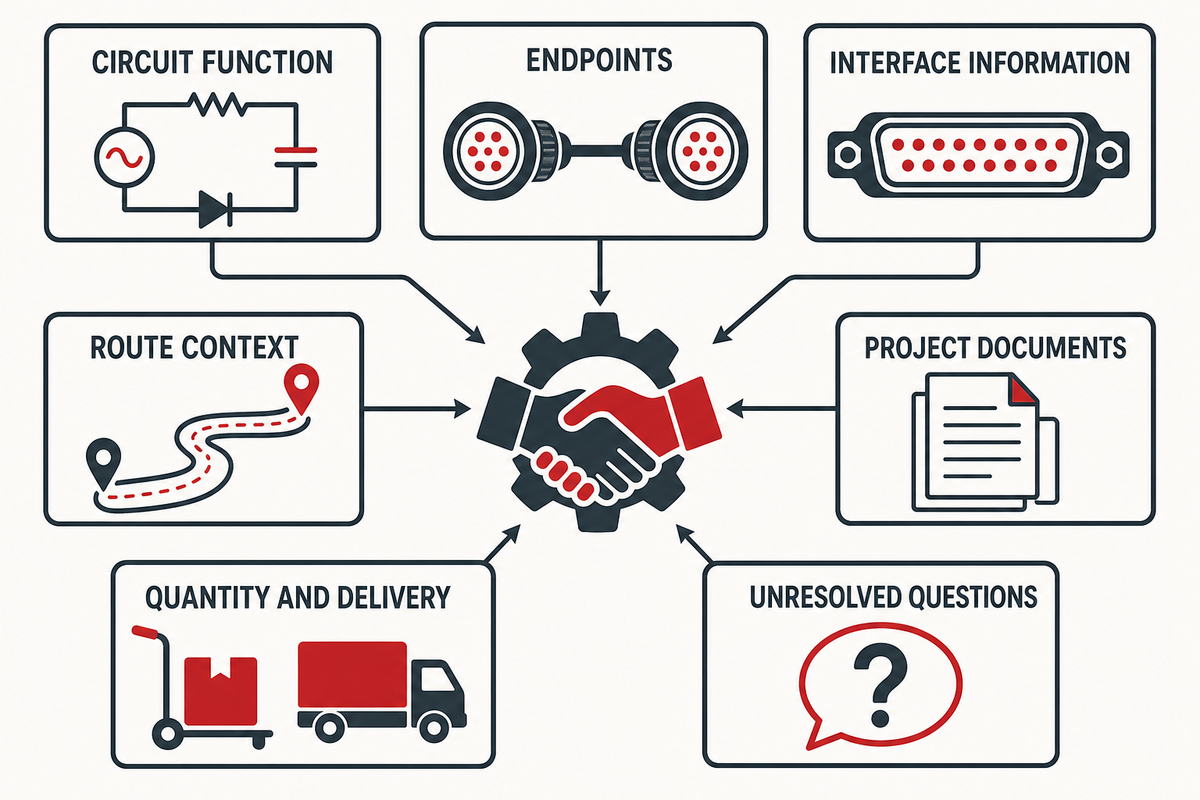
With this request record instead of a generic label, include circuit function, endpoints, interface information, route context, applicable cable and equipment documents, quantity, delivery needs, and unresolved questions. For the product and solution route, refer to Jinyou Cable’s PV Control Cable solution page.
Shanghai Jinyou Jinhong Intelligent Electric Co., Ltd supports renewable-energy cable projects from Shanghai. This guide deliberately leaves model, price, certificate scope, and project-specific suitability to the responsible commercial and technical conversation, where the relevant evidence can be reviewed in context.
A project-specific request is needed when a buyer wants a quotation, a supplier needs an RFQ, or an installer needs a document-scope decision. The risk is a selection based on an adjacent standard: IEC 62930 specifies a DC-side power-cable scope up to 1.5 kV DC, but it does not establish a separate control-circuit decision. Attach the relevant drawing, endpoints, and route evidence before requesting product suitability.
Frequently Asked Questions
What is the purpose of a PV control cable?
A path described in this way may be a control or monitoring path, or it may be a circuit for signal, power, or other interface. State the function, endpoints, and the route along with any requirements for the project-owner before you use the phrase to classify a product. Treating a control path as a DC power conductor in a photovoltaic system would be a mistake.
Is PV wire the same as control cable?
Not automatically: the IEC 62930 publication scope concerns single-core power cables for the DC side of photovoltaic systems and does not by itself decide the product for a separate control or monitoring path. A separate control or monitoring path requires its own functional and project context analysis. Do not assume a DC power-cable standard reference, product document, or a statement on the installation of a DC power line for one circuit is applicable to other circuit roles.
What information should be included in a control-cable request?
Provide the known circuit function, the device endpoints, the interface or open interface, the route and the context of the environment, drawings or equipment documents, applicable cable requirements, the number required, the delivery required, and the specific commercial or technical issue. Provide technical parameters along with their source document, and not as your recollection of that document. Mark unclear information as unresolved, and don’t provide an estimate. This gives the following reviewer a usable starting point.
A detailed request outlines its boundaries. One example could be noting an observed route but stating that a section of that route had been concealed, or noting an equipment label but stating that the equipment’s current manual wasn’t available. Finally, one could suggest that the project owner must confirm the interface. Statements of this nature keep any quote or document-request scope discussions based on the evidence that’s available, rather than moving a placeholder to a design conclusion.
Should control and DC power paths share one circuit record?
Keep them separate and then join their interfaces. For each function, avoid a power-cable misunderstanding that has been documented as a control-circuit approval. Where the lines intersect at equipment, cross a common route, or rely on the same project document, document that relationship and address the applicable requirements to the responsible owner.
What should happen when an installed route has an unexplained condition?
Record the location, observable phenomenon, associated evidence, and the limit of the checks. If the observation relates to a safety-related situation, follow the approved site procedure first, then direct the issue to the project owner for inspection, testing, design review, or installation. Visual observations shouldn’t be presented as a root-cause determination, an electrical test, or a confirmation of product-suitability.
Shanghai Jinyou Jinhong Intelligent Electric Co., Ltd. has focused on new energy cable manufacturing since 2006, supporting solar/PV, energy storage, EV charging, and industrial or special-cable applications.
Use this guidance to prepare a clearer engineering or procurement discussion: operating environment, conductor and insulation expectations, route length, voltage, installation method, and project schedule.
Certificate evidence should be matched to the construction being specified. Public certificate evidence applies to H1Z2Z2-K solar cable constructions and should not be read as blanket certification for every JINYOU Cable product family.
PROJECT BRIEF
Move from article to specification
Share the application, required cable family, target standard, quantity range, and delivery window. The team can help structure the next engineering and procurement conversation.