Get in touch with JINYOU Cable Company

Updated October 2026
For a project requiring EN 50618 and a 1.5 kV DC cable, select an appropriate H1Z2Z2-K product. The H1Z2Z2-K vs PV1-F decision changes for an existing installation: the replacement must fit its electrical duty, connectors and route. PV1-F is an older designation, and the voltage figures on individual product sheets differ.
H1Z2Z2-K vs PV1-F selection starts with the project standard: choose a matching H1Z2Z2-K product for EN 50618 work. Compare replacements by rated voltage, route and connector fit.
Quick specifications
- EN 50618 and IEC 62930 address PV DC cable ratings up to 1.5 kV between conductors and to earth.
- IEC 62930 specifies 90°C normal continuous conductor temperature; its higher-temperature allowance is time-limited.
- A PV1-F product can have separate insulation and sheath. The older name doesn’t mean a single insulating layer.
- Outdoor service, permanent immersion and connector fit are separate selection questions.
H1Z2Z2-K vs PV1-F at a Glance
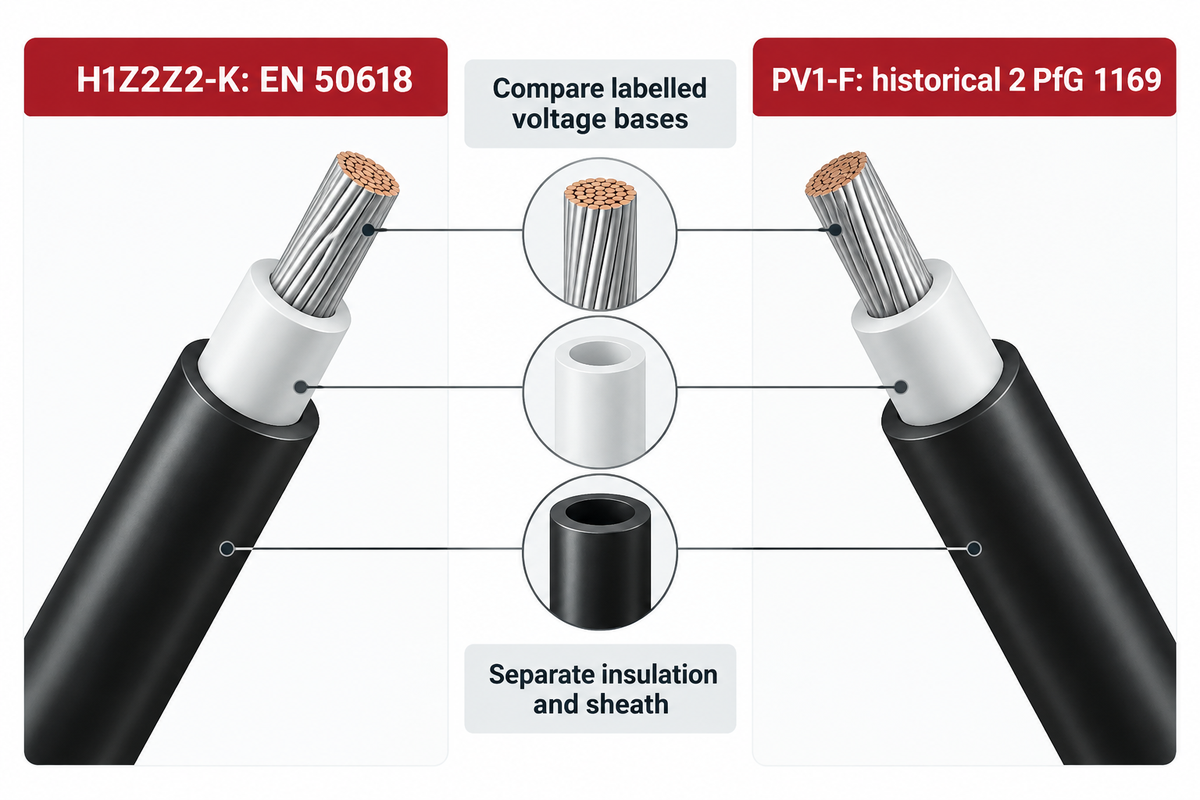
H1Z2Z2-K would be the right starting point for an EN 50618 specification; PV1-F would identify the earlier TÜV 2 PfG 1169 route. Both names appear on solar cable offers, but a purchasing comparison would require the exact product behind each name. The table separates common construction features from requirements that can affect the decision.
| Selection point | H1Z2Z2-K | PV1-F |
|---|---|---|
| Standard route | EN 50618 | Historical 2 PfG 1169 |
| New EN 50618 project | Select the specified, certified construction | A legacy-only certificate is not an equivalent offer |
| Rated DC voltage | EN scope: up to 1.5 kV on both voltage bases | Product-specific; compare the labelled bases |
| Conductor | Named products use flexible tinned copper | Historical LAPP example also uses tinned copper |
| Insulation and sheath | Separate cross-linked layers | Separate layers in the historical LAPP example |
| Core arrangement | EN 50618 scope is single-core | Use the offered construction’s own specification |
| Heat limits | Separate normal service from limited-duration peaks | Read the named product’s thermal conditions |
| Water exposure | Use the qualified construction and exposure conditions | Do not infer immersion suitability from the name |
| Existing-system replacement | Electrical and physical compatibility still apply | Existing condition and project requirements govern |
| Price comparison | Hold construction, quantity, usable length and commercial terms constant | |
Similarly, distinctions apply to residential and commercial solar systems. A small residential solar array would require the right connections, while a large solar power system would reject a cable that doesn’t meet the specified requirement. Product families in Jinyou’s solar and PV cable range have been separated for this reason.
Standards and Cable Markings
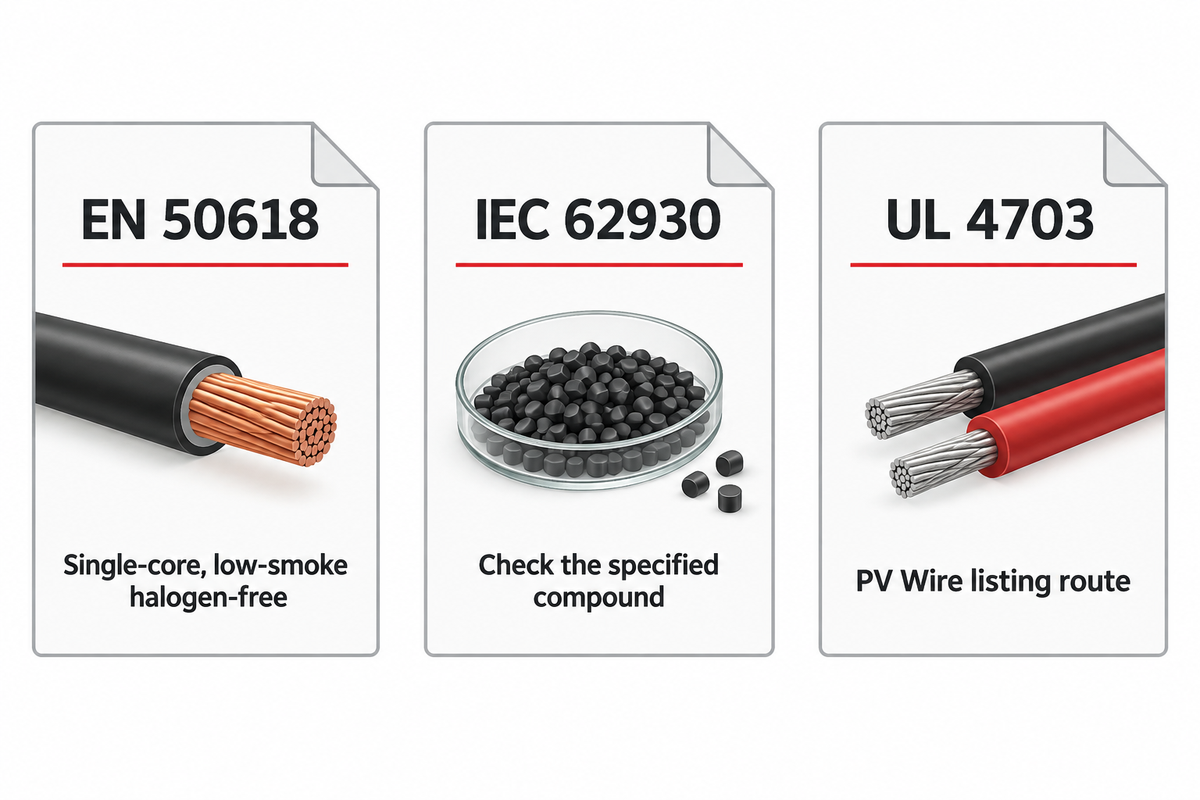
EN 50618 is the standard associated with H1Z2Z2-K; IEC 62930 is an international standard for photovoltaic cables. PV1-F is part of the older TÜV test-specification system. A certificate must identify the offered construction and applicable edition, because the issuer’s logo alone would not make different types of cables interchangeable.
In its 2018 notice, TÜV Rheinland reported withdrawal of 2 PfG 1169 and 2 PfG 1990 on 27 October 2017 and directed tenders toward the valid EN/IEC standards. For new work, specify the current project requirement rather than accepting an older certificate as an alternative. The historic issuer’s decision is different from the condition assessment of cable already installed.
The BS EN 50618:2014 scope describes flexible, single-core, low-smoke halogen-free cable. IEC 62930 includes both halogen-free low-smoke constructions and constructions containing halogens. Consequently, an IEC designation and a halogen-free material requirement need separate entries in a purchase specification.
For a US project, UL Solutions lists UL 4703 for PV Wire, separately from its wiring-assembly standards. EN or IEC markings do not replace the product listing and installation requirements specified for that project. Our guide to solar cable standards and document scope explains the documents behind these different routes.
Rated Voltage: Compare the Same Basis
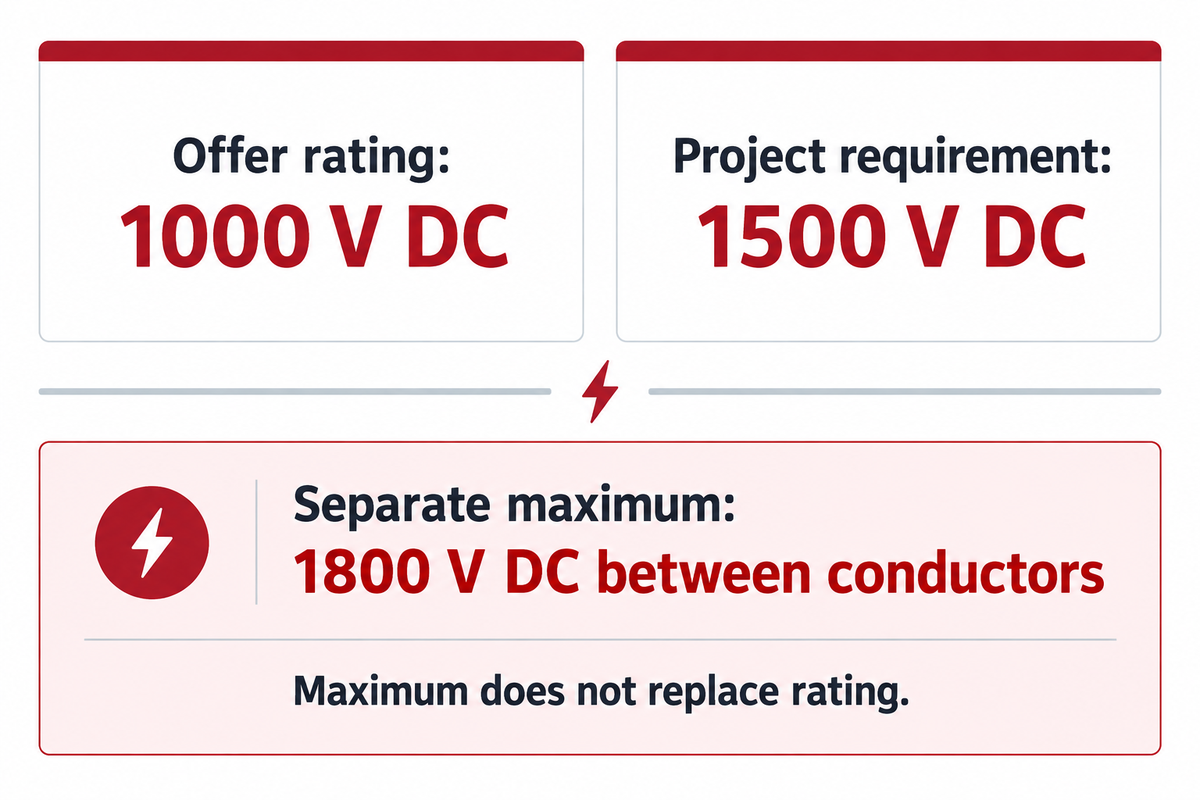
IEC 62930 covers rated DC voltage up to 1.5 kV between conductors and between conductor and earth. A maximum operating value printed elsewhere on a sheet is a different limit. When comparing PV1-F solar cable with H1Z2Z2-K solar cable for the same circuit, keep the conductor-to-earth voltage basis visible.
| Reference | Rated value | Separate operating limit |
|---|---|---|
| IEC 62930:2017 scope | DC 1.5 kV between conductors and to earth | Do not replace the rated basis with another limit |
| Jinyou H1Z2Z2-K product page | DC 1500 V | Order against the specified configuration |
| Jinyou PV1-F product page | AC 0.6/1 kV; DC 1000 V | Separately lists DC 1800 V between conductors |
| LAPP SOLAR XLR-R, February 2014 sheet | AC 600/1000 V; DC 900/1500 V | DC 1800 V, conductor/conductor, non-earthed system |
The historical LAPP PV1-F datasheet illustrates that “all PV1-F is rated at one voltage” is an unreliable shortcut. It’s a product example, given and dated, and isn’t a current recommendation for ordering. Its slash notation and separate maximum must be explicitly given with the numbers.
Selection example: A buyer needs 1500 V DC rated cable. One offer lists its rating as 1000 V DC and shows 1800 V elsewhere. That second number doesn’t bridge the gap, as the offered rating is still less than that required. The buyer checks the offer against the specification and looks for a matching product before comparing price. The designer retains the circuit’s voltage-to-earth requirement rather than comparing just the two conductors. Raising a headline number won’t correct the wrong electrical duty, and the supplier must resolve the mismatch before a reel is ordered for the job.
Conductor, Insulation and Sheath
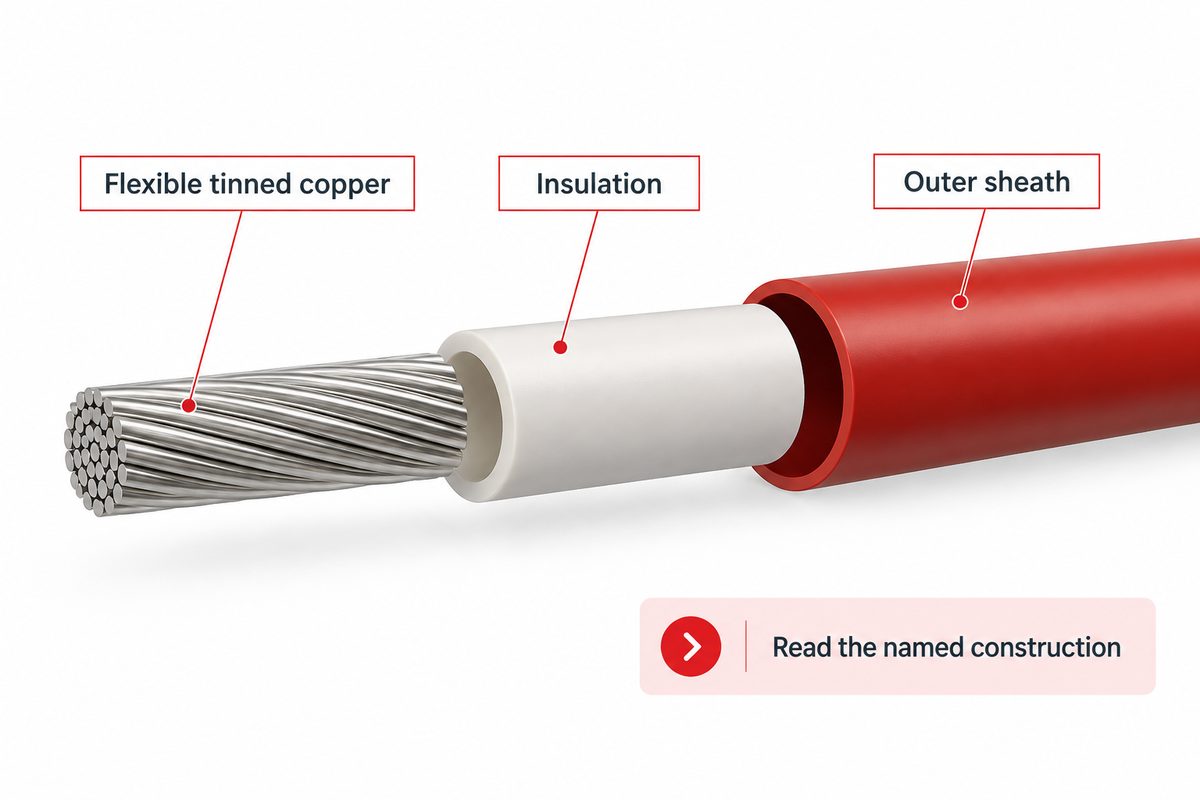
The H1Z2Z2-K design has both insulation and sheath, as does the historical LAPP PV1-F example. Therefore, construction differences are product specific and can’t be grouped as a simple “single layer” or “double layer” difference. The conductor material, flexibility, compound and outside diameter each affect how the cable is terminated and routed.
The LAPP data sheet states that it uses a Class 5 tinned copper conductor, cross-linked polyolefin insulation and a separate cross-linked polyolefin sheath. Jinyou’s H1Z2Z2-K cable also states a flexible tinned copper construction. XLPO denotes a polyolefin family, while XLPE denotes cross-linked polyethylene. These labels should be in line with the stated compound rather than being substituted because both materials use a cross-link process.
A copper conductor is also a different ordering choice from an aluminum conductor or copper-clad alternative. Swapping copper and aluminum alters more than the quoted metal cost: conductor size, resistance, and termination compatibility must align with the approved design. The cable manufacturer should quote the material named in that design.
Connector example: An installer considers replacing a single-core cable with a product of the same nominal conductor area. The diameter of the new cable’s jacket is different, so the connector’s seal and strain relief become part of the decision. A copper cross-section alone won’t resolve a poor jacket fit. The installer selects the connector’s permitted cable construction and approved contact, and implements the specified method of assembly. Trimming strands or shaving insulation to force the cable to fit the connector damages the intended assembly. The order for the replacement therefore indicates the cable and termination together, before work is done on the existing string.
Temperature, UV and Installation Conditions
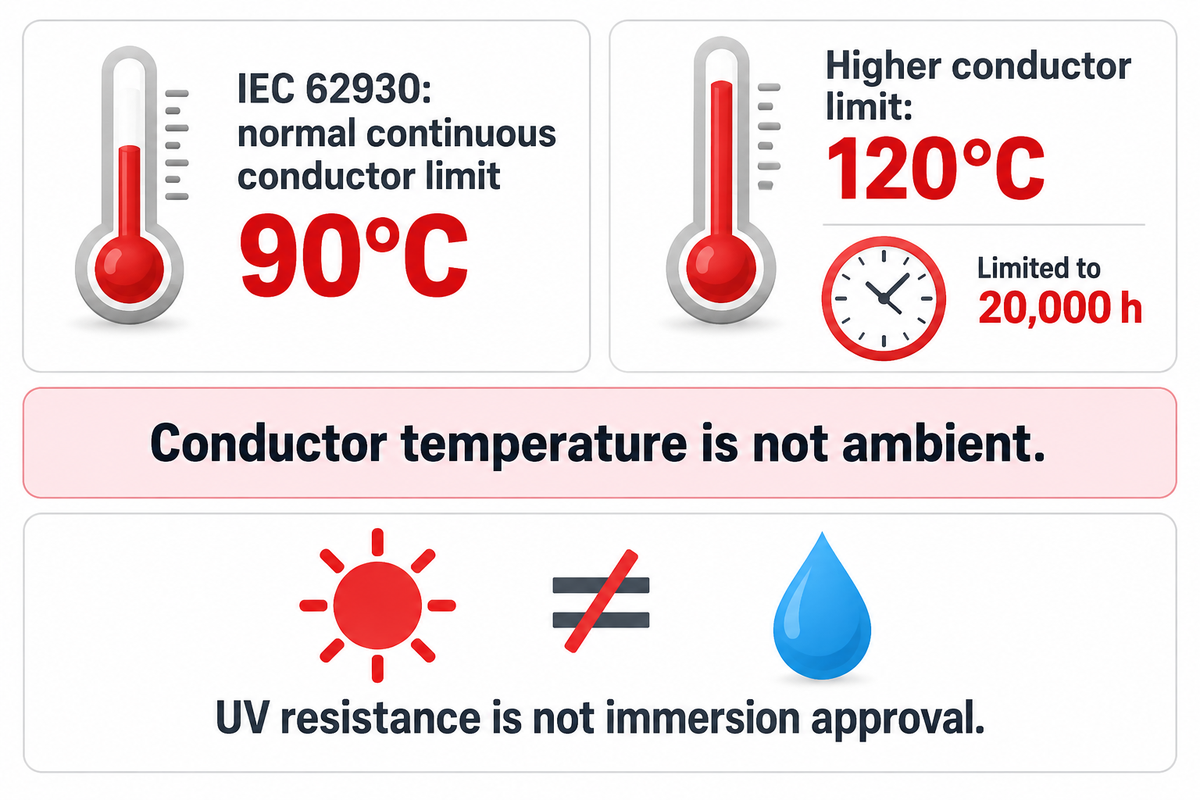
90°C is IEC 62930’s normal continuous maximum conductor temperature; use at a maximum conductor temperature of 120°C is limited to 20,000 h. These are conductor temperatures, not ambient-temperature promises. Heat from current adds to the installation environment, so higher voltage ratings do not remove temperature and grouping constraints.
“The cables are designed to operate at a normal continuous maximum conductor temperature of 90 °C.”
Jinyou’s PV1-F page provides an operating range of -40°C to 90°C and a separate maximum conductor temperature. Don’t transfer another standard’s time allowance to that product without its applicable thermal conditions. High and low temperatures also affect installation handling; a fixed service limit isn’t automatically a permitted bending temperature.
The European Copper Institute’s Cu0280 comparison of cable current-carrying capacities exposes another misleading comparison. The Cu0280 report describes a 120°C conductor and 60°C ambient basis for the EN table, and a 90°C conductor and 30°C ambient basis for the IEC table. Both give a 60 K rise. On that common basis, the report finds comparable capacities. One larger entry alone is not grounds for reduction of cable size.
How does H1Z2Z2-K cable perform in a high humidity environment?
H1Z2Z2-K cable designed for outdoor photovoltaic systems addresses exposure to the elements, but for a route that’s continuously wet a construction qualified for that condition is required. Humid air and intermittent wetting aren’t the same as continuous submersion. Specify the expected exposure separately from UV resistance so the selected product fits the route.
A historical LAPP PV1-F sheet explicitly states not to use it for permanent submerged or immersed applications. A UV-resistant outer layer is chosen for UV exposure. It isn’t an immersion rating. Prolonged exposure to sunlight and standing water shouldn’t be hidden in a generic “outdoor cable” description.
What are the laying methods of H1Z2Z2-K cables?
The supported route should be compatible with the specified H1Z2Z2-K product, its bend limits and the project installation method. Rooftop cable runs need support and protection from abrasion. Conduit, cable trays and buried sections each require their own installation conditions. An “outdoor cable” designation doesn’t select the laying method.
DOE and Lawrence Berkeley National Laboratory guidance describes failed supports leaving slack wiring that moves in wind and abrades against surrounding surfaces. UV radiation is only one stress. A higher-rated replacement cable still needs a route that prevents mechanical damage and avoids loading the module’s junction box.
Which Cable Should You Specify?
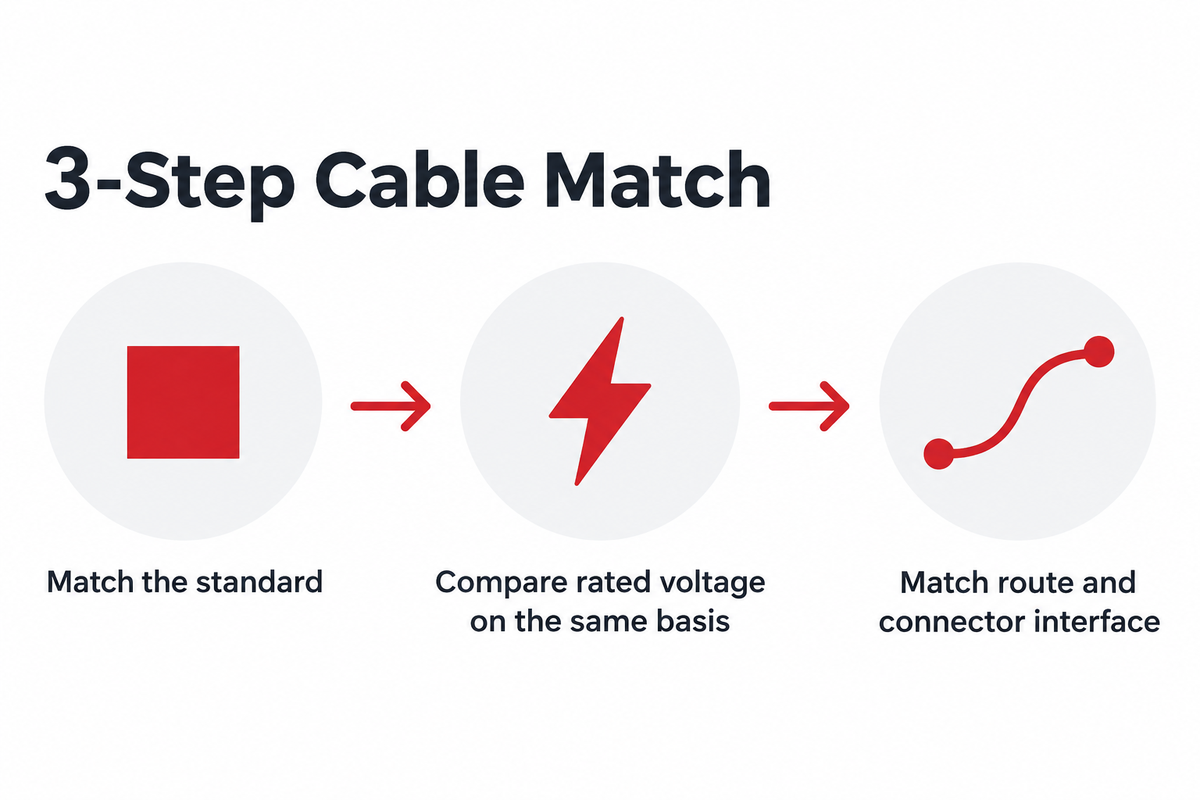
Choose a matching H1Z2Z2-K product for new EN 50618 work. For a documented legacy replacement, match the circuit and installation before choosing the designation. A US PV Wire requirement needs the appropriate listed product. The same is required for large solar installations and residential systems; the system size is not grounds to ignore product compatibility.
3-Step Cable Match
For a project, match the standard, compare the rated voltage on the same basis and then match the route and connector interface.
| Project condition | Selection response | What changes the offer |
|---|---|---|
| New EN 50618 installation | H1Z2Z2-K to the specified construction | Wrong standard or certificate scope |
| IEC 62930 specified | Product certified to the required IEC scope | Compound or project requirements differ |
| US PV Wire specification | Appropriately listed PV Wire | EN-only documentation offered instead |
| 1500 V rated-DC requirement | Compare the same voltage-to-earth and conductor bases | 1000 V rating with 1800 V maximum advertised |
| Existing PV1-F replacement | Assess the installed circuit and replacement interfaces | Duty, condition or termination differs |
| Continuously wet route | Use the construction qualified for that water exposure | Only outdoor or UV claims supplied |
| Connector change | Match conductor, contact and jacket dimensions | Same nominal area but incompatible seal fit |
| Twin-core proposal | Use evidence for the twin-core construction | Single-core certificate supplied |
| Hot or grouped route | Recalculate carrying capacity for the arrangement | Current table uses different thermal conditions |
Sandia’s PV connector work links defective connections to power loss, maintenance, and serious failures. In PV systems, treat the PV connectors and power cable as a matched installation. Detailed conductor sizing is in the circuit calculation. The H1Z2Z2-K sizing and installation guide covers the next step.
Price and Lead Time: Compare Like for Like
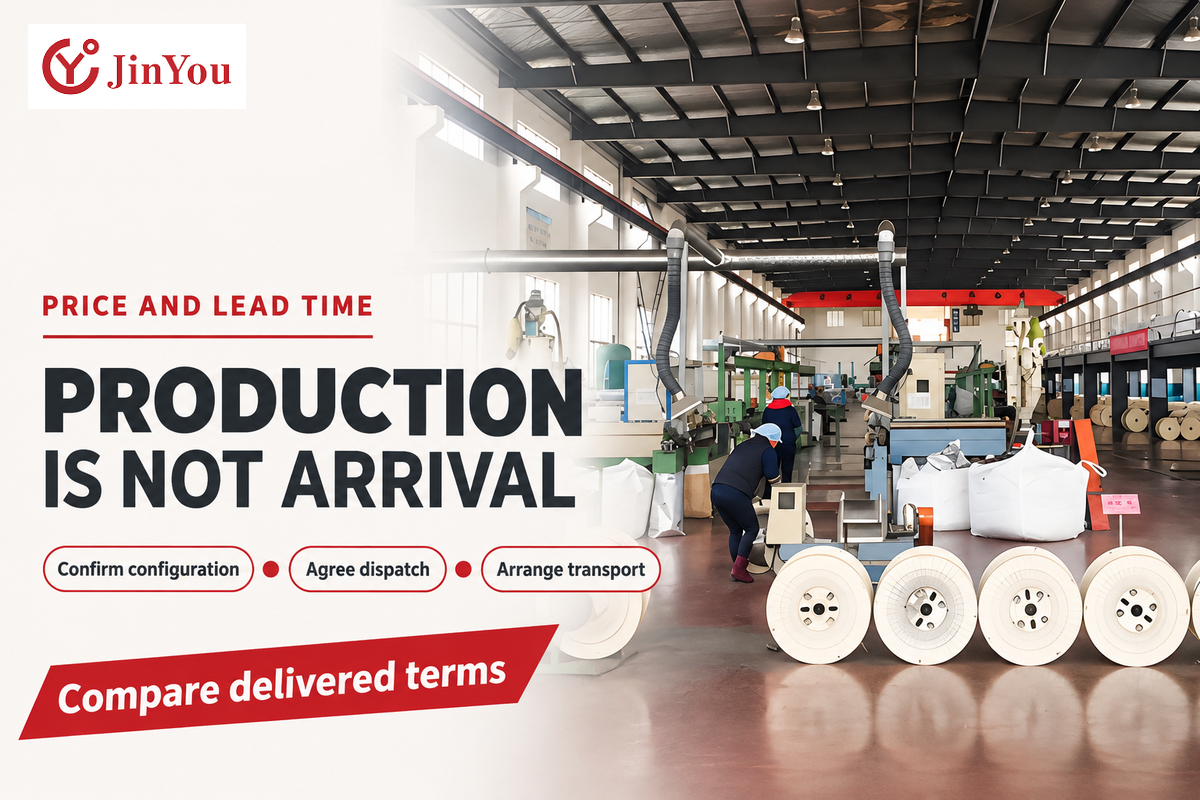
Jinyou’s PV1-F production scheduling baseline is 15-35 days after configuration confirmation. Transit and site acceptance add additional time to this. To determine price, compare the same conductor, size, quantity and delivery terms. Calculate savings only between offers meeting the same cable specification.
A useful quotation comparison holds the quote date and currency constant and lists net usable length. It separates reel packaging from freight. The scope of the requested certificate and test documents should be the same in both offers. A missing requested document can stop the buying decision, even if the material is available.
Procurement example: One offer states “available,” and another provides a production schedule after configuration approval. The buyer needs cable at site, so neither of these can be used to compare delivery schedules. Purchasing obtains a dispatch commitment for approved reel length and specifies the transport arrangement. Engineers resolve the voltage and document requirements before the production slot starts, and then finance compares the same delivered quantity and terms rather than interpreting the first supplier’s availability statement as a shorter project schedule. This prevents a lower unit price from being selected on an assumption about work that hasn’t been agreed.
Matching a Jinyou Cable to Your Specification
TÜV Rheinland record R50349329 lists H1Z2Z2-K single-core sizes from 1.5–240 mm² for Shanghai Jinyou Jinhong Intelligent Electric Co., Ltd., to EN 50618:2014. That gives a specific holder, model and construction to compare with an order. Twin-core solar cable requires its own applicable product evidence.
The issuer’s certificate record is different from Jinyou’s commercial selection pages. Our H1Z2Z2-K cable specifications identify the 1500 V DC family. Our PV1-F cable options list a single-core 1.5 – 35 mm² range and their own voltage figures.
For a new EN 50618 requirement, start with the H1 family. For a replacement requirement, the existing specification and connector information should be provided to define the proposed product to be compatible with the installed solar energy system. A certificate for one model isn’t a certificate for every product sold by the same supplier.
Before You Order: Specify an Acceptable Alternative
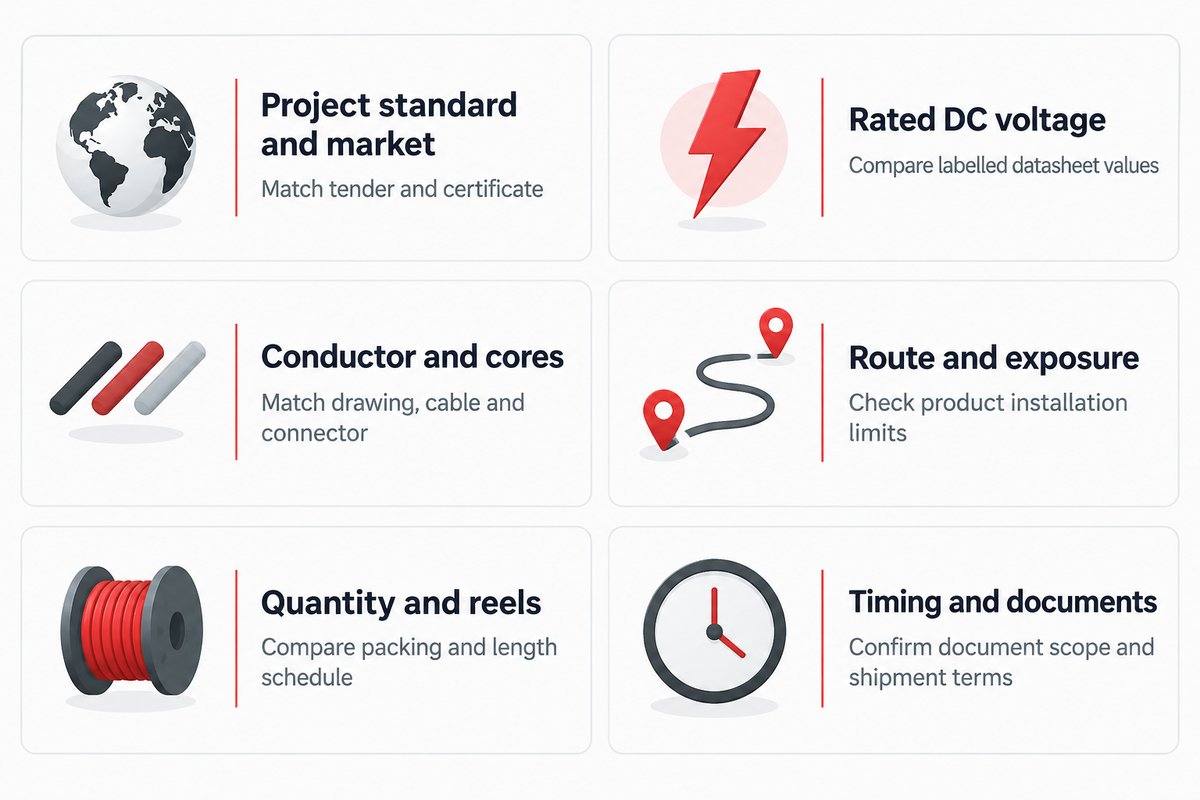
For an alternative solar PV cable, you need to provide a project standard, rated-voltage requirement and route description. The three inputs help identify which offers should be included in the comparison. Add conductor size, quantity and delivery requirements and have the supplier identify any discrepancies in the returned quotation.
Copy these fields into your cable enquiry:
| Parameter | Recommended range | Why it matters | How to verify |
|---|---|---|---|
| Project standard and market | For an EN project, name EN 50618:2014; use the project’s actual edition | Sets the product route | Match tender and certificate |
| Rated DC voltage | For a 1.5 kV requirement, state both conductor bases | Keeps rated and maximum values separate | Compare labelled datasheet values |
| Conductor and cores | Use the calculated mm² and specified core count | Preserves the circuit design | Match drawing, cable and connector |
| Route and exposure | State temperature, grouping and actual water exposure | Defines installation duty | Check product installation limits |
| Quantity and reels | State net metres and required cut lengths | Makes offers comparable | Compare packing and length schedule |
| Timing and documents | State required dispatch and site-arrival dates | Separates production from transport | Confirm document scope and shipment terms |
For a matched offer, send your cable specification to Jinyou with the destination and current order requirements.
Frequently Asked Questions
Can PV1-F and H1Z2Z2-K cables be mixed in one string?
Mixing cable types
Only when the project design accepts both products and their connection. Each section must meet the circuit’s electrical duty, environmental exposure and termination requirements. A matching nominal conductor area is insufficient when the jacket or contact dimensions differ. The transition also needs a supported, approved assembly; don’t improvise a joint between incompatible parts.
Is a PV1-F cable guaranteed to last 25 years?
Service life and warranty
No. Expected service life and a contractual warranty are different commitments. A cable’s life is affected by its operating temperature, weather exposure, route and physical condition. A warranty sets its own coverage and exclusions. For an existing installation, maintenance and replacement decisions should follow the installed cable’s condition and electrical duty, rather than a generic lifespan claim.
Does a TÜV certificate prove that the delivered cable matches my order?
Certificate and delivered product
No. The certificate identifies a defined product scope, while the delivered reel must also match the order. The holder, model, core count and size range need to align with the reel marking and lot documentation. A single-core approval can’t be transferred to a twin-core PV1-F product merely because the supplier offers both constructions.
When should I use 4 mm² solar cable?
Selecting conductor area
Use 4mm² when the circuit calculation and termination limits permit it. Current, route length, voltage drop, temperature and grouping determine whether 4mm², 6mm² or 10mm² is appropriate. Standard solar wire names don’t supply a universal cable size for residential systems or larger arrays.
When should I use twin-core instead of two single-core cables?
Choosing the core arrangement
Use twin-core when the approved design calls for a paired construction and the terminations suit it. Two single-core runs and one twin core assembly can have different bending and thermal conditions. The point where the pair separates at equipment also needs support. Keep the exact construction in the enquiry instead of carrying over a single-core PV1-F certificate.
Is PV wire different from regular wire?
PV applications and ordinary wiring
Yes. PV cable is specified for a defined photovoltaic application and product standard. Ordinary wiring may have different voltage, temperature or environmental limits. A solar panel connection from panels to the inverter needs the cable and terminals selected for that direct current circuit; appearance alone isn’t a selection method.
Is H1Z2Z2-K always more expensive than PV1-F?
Comparing the quoted price
No universal percentage premium applies to a PV1-F vs H1Z2Z2-K comparison. Price both offers on the same specification, date, net length and delivery terms. Keep the copper construction and required documents constant. The cheaper offer is useful only when the cable is suitable for the specified installation.
Should I replace all existing PV1-F cable?
Existing-system replacement
No blanket replacement decision follows from the designation alone. A qualified assessment should address damage, electrical duty and the existing installation. Changed system voltage or deteriorated insulation can require a revised specification. The PV1-F specification guide covers the product details needed for that assessment.
References & Sources
- New International Requirements for Manufacturers of PV Cables TÜV Rheinland, 2018 issuer notice.
- BS EN 50618:2014: Electric Cables for Photovoltaic Systems British Standards Institution.
- Solar Materials and Components Certification UL Solutions.
- IEC 62930:2017 International Electrotechnical Commission.
- Cu0280: Comparing PV Cable Current-Carrying Capacities European Copper Institute, Leonardo Energy.
- Solar Photovoltaic Cable Management: Best Practices to Support DC-String Cables US Department of Energy / Lawrence Berkeley National Laboratory.
- PV Connector Reliability Project Sandia National Laboratories.
- Certificate R50349329 TÜV Rheinland Certipedia, named holder and single-core scope.