Get in touch with JINYOU Cable Company

By Aurora · JINYOU Cable · Updated September 2026
Solar Cable Standards are product requirements for DC solar photovoltaic cables. IEC 62930, EN 50618 and UL 4703 cover different product scopes. Their ratings help describe a cable; installation rules and operating conditions determine how it can be used.
The “1500V DC” marking on a reel answers one electrical question. It doesn’t settle conductor size, connector compatibility or prolonged immersion. This guide to solar cable standards concentrates on the DC cables linking modules, strings and array equipment in rooftop solar and other PV installations. Standards relevant to AC wiring after the inverter, the battery cables, and general building wiring are not covered.
At a glance
- IEC 62930 and EN 50618 overlap, but their material and conductor scopes differ.
- UL 4703 addresses US photovoltaic wire; a US listing doesn’t automatically settle another market’s requirements.
- Voltage, temperature, sunlight, water exposure and wire size describe different limits.
- Read the named edition and applicable installation requirements before treating two cables as substitutes.
Standards, cable names, certification and installation rules
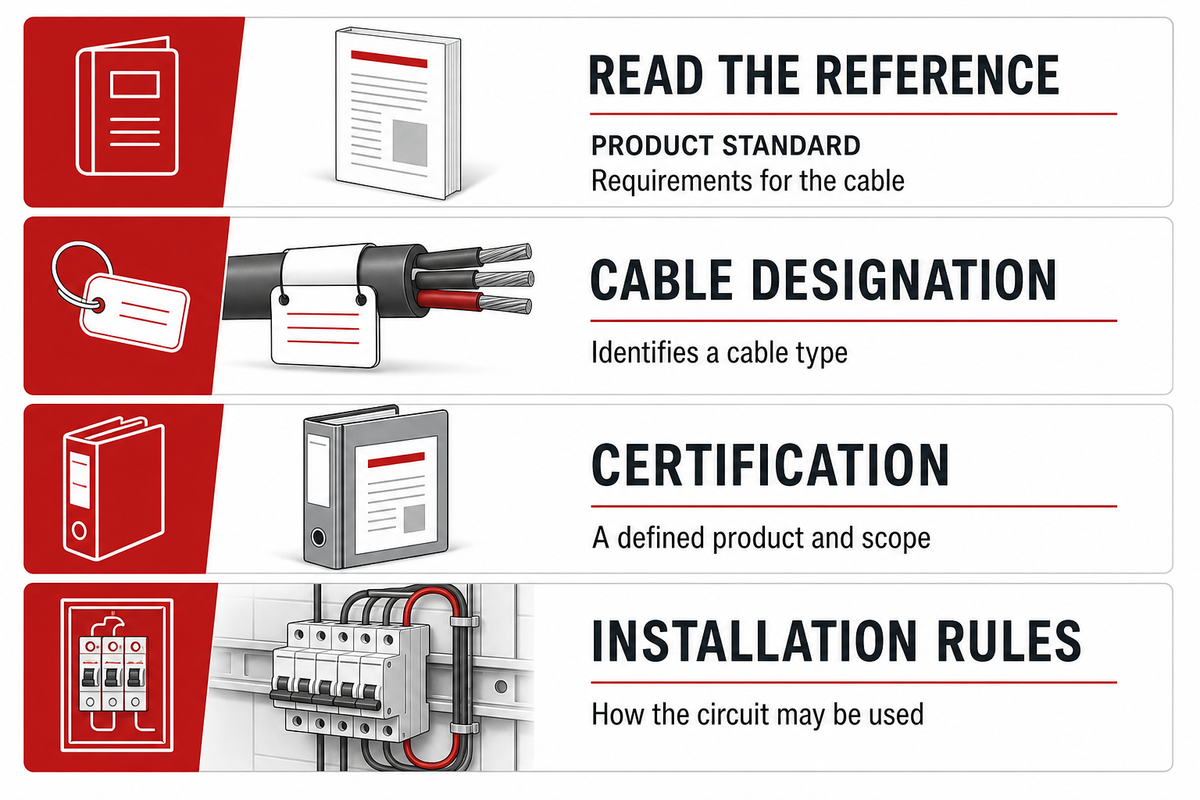
Product standards describe requirements against which a cable can be evaluated. Cable designations identify types; certification relates to a defined product and scope. Installation rules address use in solar systems. Those distinctions matter when a specification places IEC, H1Z2Z2-K and a certification logo on the same line.
UL Solutions explains the role of standards and certification category information in code compliance. A standard number by itself isn’t an installation approval. Start by classifying the reference, then read the rating or scope attached to it.
PV Standards Reading Ladder
Use this table to compare current and legacy reference classifications when sourcing and specifying DC solar equipment.
| Reference | Type | What to read next |
|---|---|---|
| IEC 62930 | International PV cable product standard | Construction and declared DC rating |
| EN 50618 | European PV cable product standard | Material scope and applicable European references |
| UL 4703 | US photovoltaic-wire product standard | Listed category, voltage and wet/dry ratings |
| H1Z2Z2-K | Cable designation | The standard and product data associated with the type |
| PV1-F | Legacy cable designation | Historical specification and present approval basis |
| Certification mark | Product certification identification | Issuer’s current listing and scope |
| IEC 62548-1 | PV array design standard | Array wiring and applicable edition |
| EN 50575 | Construction-use reaction-to-fire standard | Whether that construction application falls within scope |
| Locally adopted electrical code | Installation requirements | Project jurisdiction, circuit and wiring method |
European projects add a legal layer. The European Commission’s Low Voltage Directive guidance gives a DC voltage range of 75–1500 V. The April 2026 consolidated harmonised-reference record lists EN 50618:2014 in Annex I. That status supports a specific conformity route; it doesn’t resolve every obligation for an individual cable.
For relevant construction uses, BSI’s EN 50575 scope addresses reaction to fire separately from electrical and environmental performance. The Commission describes the construction-products transition by product family and applicable references. Avoid assuming one universal changeover date for every cable.
IEC 62930 and EN 50618: related PV cable standards
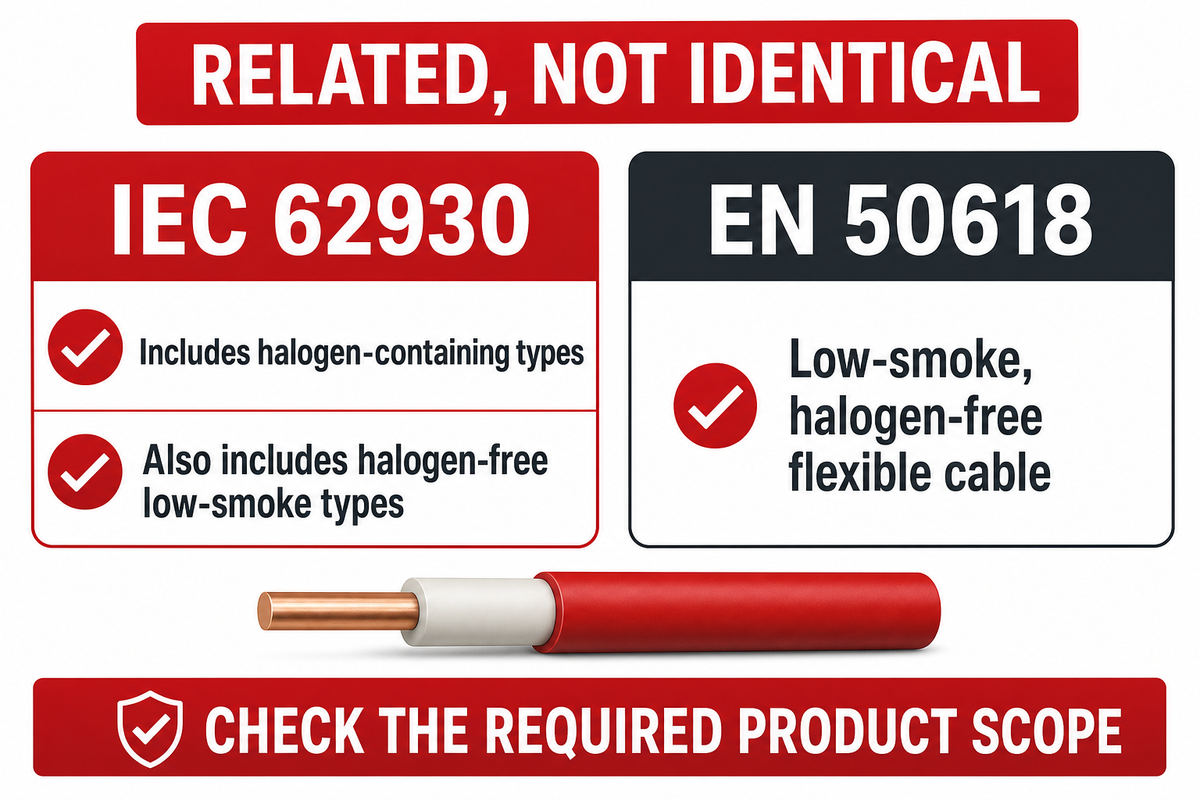
IEC 62930 and EN 50618 both address single-core cables for photovoltaic applications, but they are separate standards. A useful difference appears in their material scope: IEC 62930 includes halogen-containing cable as well as halogen-free low-smoke types. EN 50618 describes low-smoke, halogen-free flexible cable. Similar voltage ratings do not erase that distinction.
“This document includes halogen free low smoke cables and cables that can contain halogens.”
The language provides a clue: the common industry shortcut ‘IEC compliant’ does not necessarily encompass halogen-free material criteria, so if a cable requires this attribute, make sure it is clearly specified. The certificate doesn’t necessarily have all the answers that should clearly be stated in the project specification.
| Scope item | IEC 62930:2017 | EN 50618:2014 |
|---|---|---|
| DC voltage | Up to 1.5 kV between conductors and to earth | Up to 1.5 kV between conductors and to earth |
| Normal continuous conductor temperature | 90°C | 90°C |
| Higher-temperature condition | 120°C limited to 20,000 hours | 120°C limited to 20,000 hours, at maximum 90°C ambient |
| Material scope | Halogen-free low-smoke and halogen-containing types | Low-smoke, halogen-free types |
BSI’s EN 50618 description supplies the European conditions above. These are scope comparisons, not a declaration that every cable carrying either reference is interchangeable.
UL 4703 PV wire and the USE-2 boundary
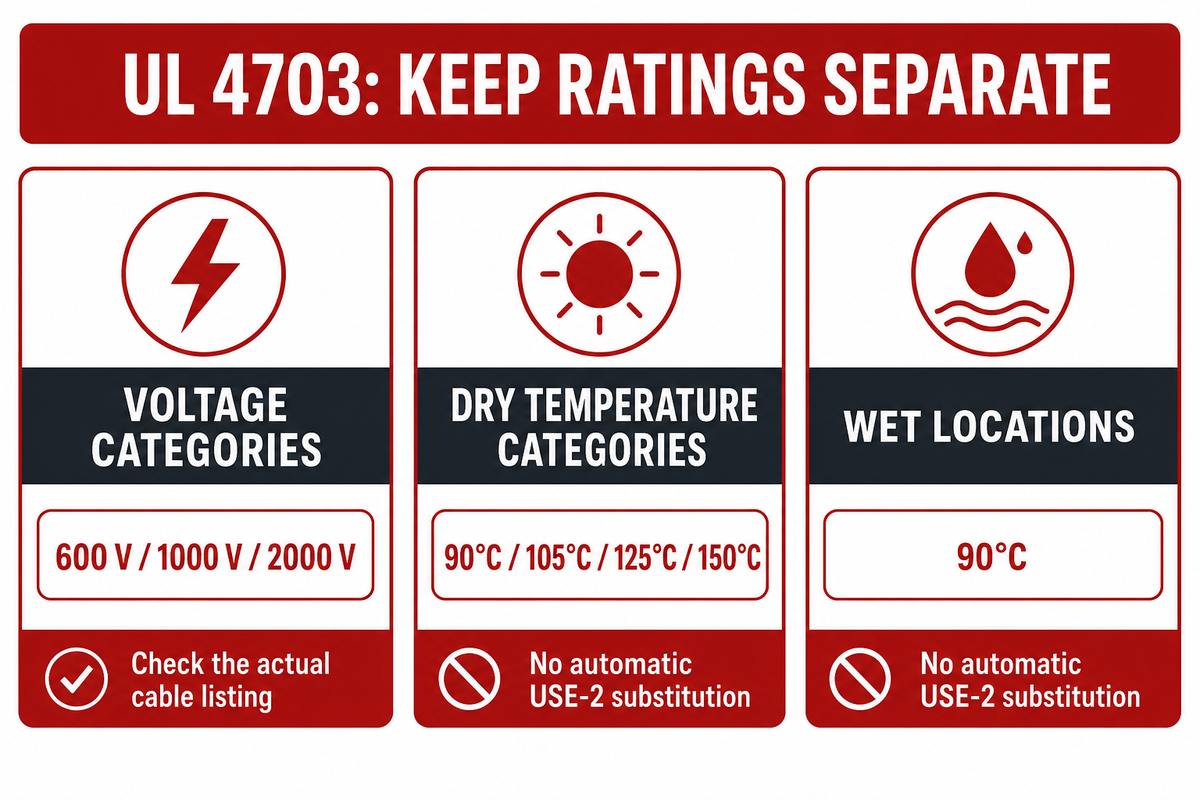
UL 4703 covers single-conductor photovoltaic wire within its stated construction and performance scope. Once rated, it should be analyzed based on installation applications.
‘PV wire’ and ‘USE-2 wire’ shouldn’t be seen as substitutes just because both appear in an application called “solar.”
The UL Standards & Engagement scope for UL 4703 lists 600 V, 1000 V and 2000 V categories. It also lists dry temperatures of 90°C, 105°C, 125°C or 150°C, with 90°C for wet locations. Those are categories within the standard, not a single combined rating to assign to every reel.
Consider a hypothetical specification requiring 2000 V PV wire. A different cable marked 600 V doesn’t meet that voltage description simply because both mention UL 4703. Nor does a higher dry-temperature marking establish the same limit in a wet route. Read each dimension separately.
UL Solutions’ market comparison identifies UL 4703 for the United States and CSA C22.2 No. 271 for Canada. Canadian acceptance needs its own applicable basis. For a proposed USE-2 substitution, the product category, listing and locally adopted wiring requirements remain decisive; this guide doesn’t prescribe a universal substitution rule.
H1Z2Z2-K and PV1-F: reading the cable type
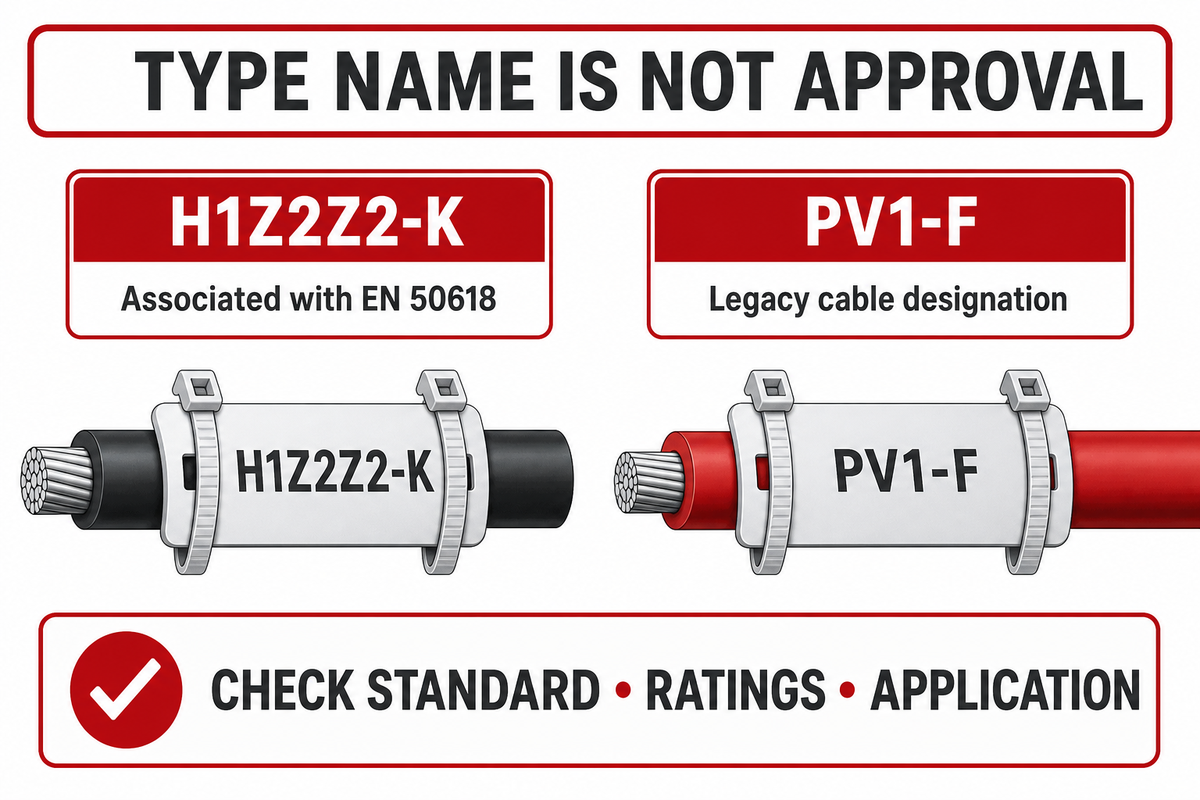
H1Z2Z2-K and PV1-F are cable type references associated with certain standards, not the names of certification authorities.
The references could determine some of the initial parameters around your cable choice but don’t necessarily make it a viable alternative to whatever else currently appears within the plant design specification. An aged cable type could appear beside a more modern reference on a drawing; however, taking that position does not supply evidence of compliance for the newer or existing system.
PV1-F dates to legacy descriptions under 2 PfG 1169, while H1Z2Z2-K appears under EN 50618. TÜV Rheinland’s historical transition notice references an IEC draft in its historical context; the current IEC catalogue lists the published 2017 document in its database.
Reviewing what replaces what requires a distinction between historical and current standards, then checking the modern project requirements rather than taking the history alone as the standard for approval. The age of those older cables alone doesn’t establish whether they are approved.
Do
- Separate the type name from the standard number.
- Read the edition and stated product scope.
- Check the issuer’s current product information.
Don’t
- Turn a certification logo into a standard.
- Assume a new name proves equivalent approval.
- Treat a historical transition as a universal retrofit order.
Conductor and insulation requirements in solar cables
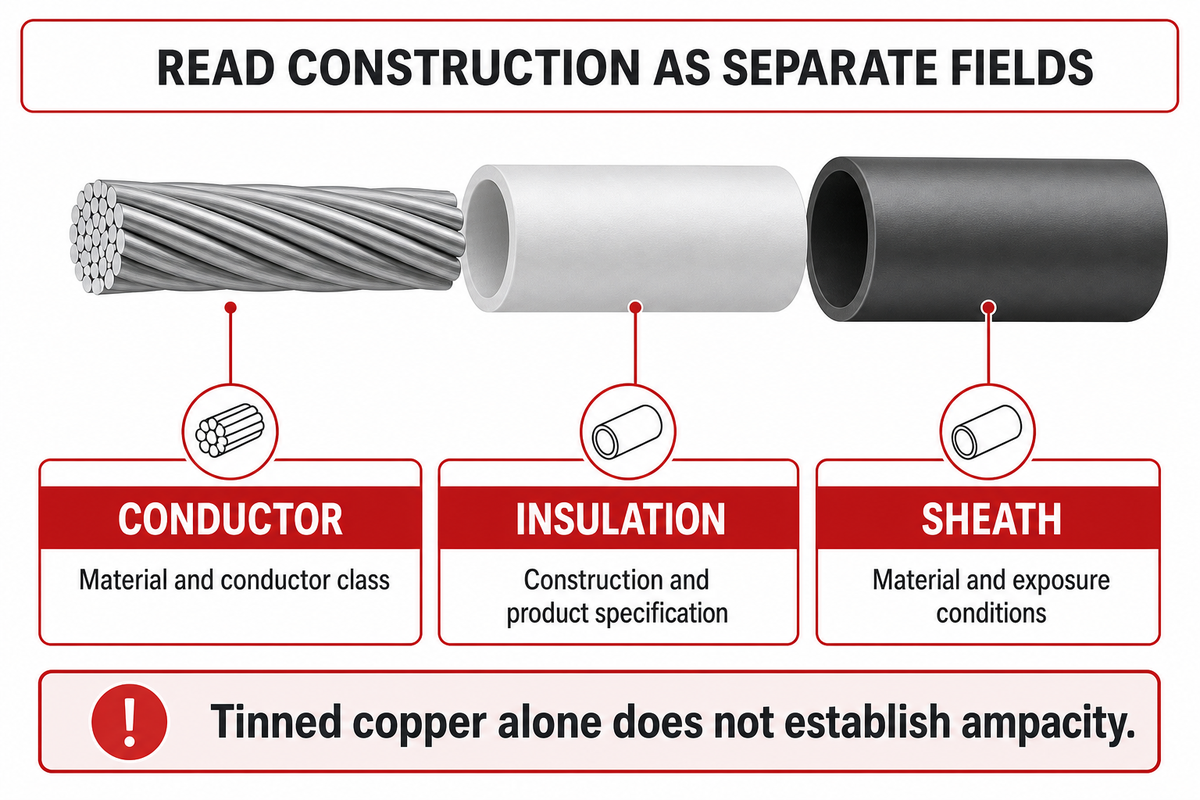
Conductor structure, insulation construction and sheath material are distinct specification fields. A “tinned copper” specification identifies the cable material, but this can’t clarify the overall conductor class or the insulation type.
It always comes down to evaluating the chosen Standard/product along with the individual classification specifications before you’re able to draw any comparisons.
UL Solutions’ IEC and EN comparison illustrates this difference. It describes Class 5 flexible conductors for EN 50618 and a broader conductor scope for IEC 62930. A flexible copper conductor is still subject to bend-radius and termination requirements in its finished cable assembly.
In a datasheet, “tinned copper conductors” or “tinned copper wire” doesn’t say much about ampacity by itself. Similarly, “cross-linked insulation” alone as a material label isn’t a substitute for a product specification. Compare conductor class, insulation and sheath for specialized cables as three fields, rather than just one attractive material label for construction.
This applies most readily when we’re looking to compare outdoor solar power cables. In an EN 50618 cable specification, the material system should also be correlated with exposure and installation, rather than treated as proof that the cable works in any and all solar power system applications.
Voltage, conductor temperature and cable size
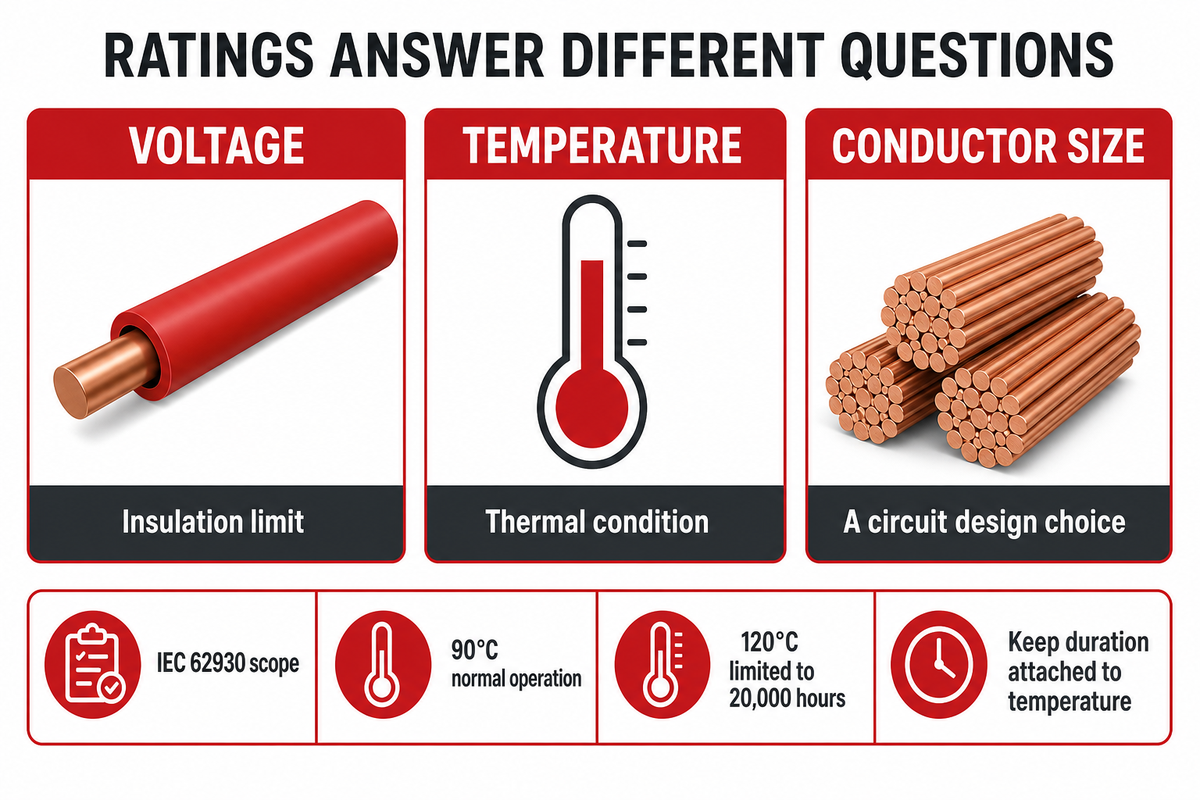
The voltage rating expresses an insulation limit; the conductor temperature a thermal condition. The cable size is a design option in the solar cable selections. While it might say 1500V DC on it, it doesn’t offer any current rating information. A 1500 V DC marking can’t tell you the current a particular cable run may carry, and a high-temperature figure must retain its stated duration and environmental conditions.
The IEC 62930 scope distinguishes normal 90°C operation from 120°C use limited to 20,000 hours. Reading only the larger number changes the meaning. Ambient temperature is another quantity: sunlight and installation can make conductor temperature different from the surrounding air.
Solar Rating Boundary Grid
Use this table when a single rating looks like more information than it is. An interpretation check comes next, not a replacement for engineering design.
| When you read | It answers | Next action |
|---|---|---|
| A DC voltage rating | The declared voltage category | Compare it with the circuit’s design voltage |
| A normal conductor temperature | The continuous thermal condition | Check installation temperature and current limits |
| A higher limited-duration temperature | A conditional thermal allowance | Keep its duration limit attached |
| A dry-location temperature | The stated dry condition | Find the wet rating if moisture is expected |
| A sunlight-resistance statement | Specified sunlight exposure performance | Assess other environmental demands separately |
| A wet-location rating | The defined wet-use scope | Investigate immersion separately |
| Direct-burial suitability | The relevant category or evaluation | Check the wiring method and local requirements |
| A conductor size | The nominal size description | Assess ampacity, voltage drop and terminals |
| A service-life statement | Life under stated assumptions | Read conditions and any separate warranty |
BSI describes an expected 25-year use period under the normal conditions of EN 50618. This isn’t a manufacturer warranty or a prediction for any environment. On desert solar cable projects, for example, high temperatures and exposure need explicit review rather than an appeal to that headline life figure.
Engineering note: I haven’t provided a generic current or voltage-drop % rating for a given size. I also haven’t assumed that selecting cable size can be done without knowing the current, cable length and installation conditions, or that cable size alone can identify a compatible connector with a correct mating interface.
What UV, water and ageing tests can establish
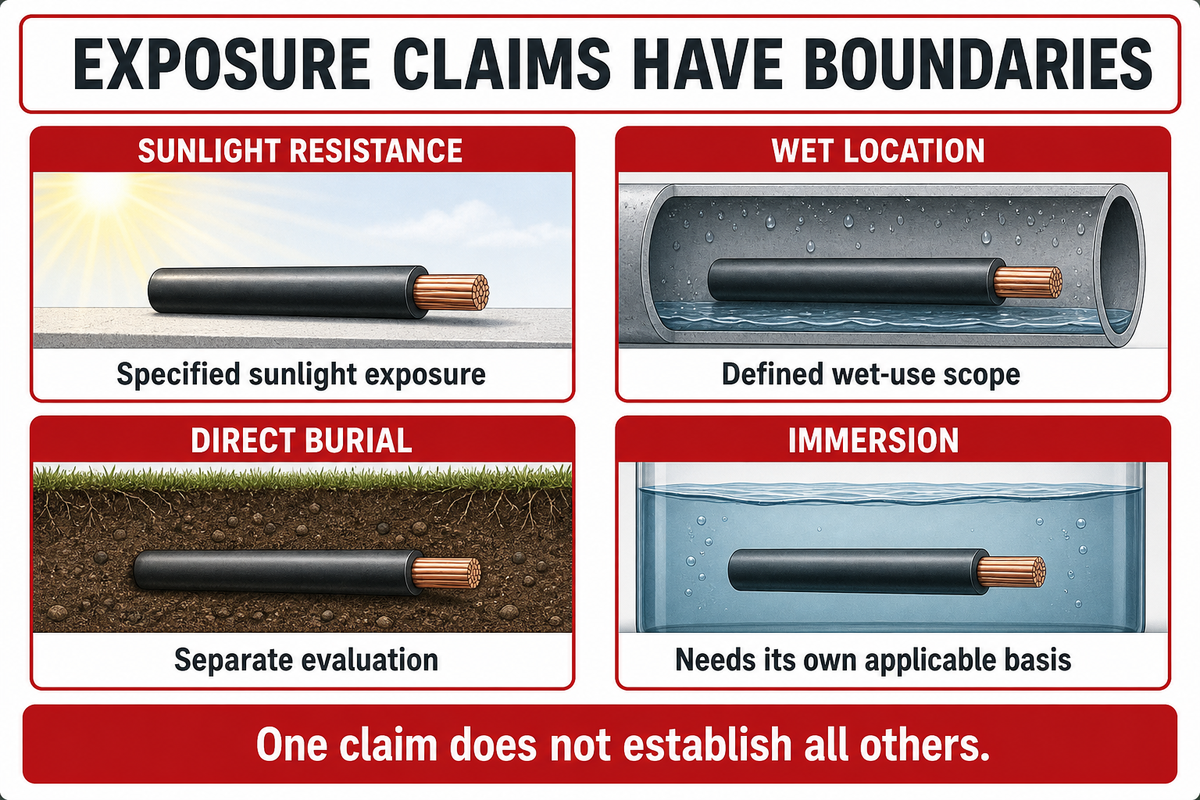
Environmental performance refers to tests based on defined conditions, including UV exposure, wet-location use or direct burial; sunlight resistance describes exposure to sunlight, while the other conditions require their own applicable evaluation. Sunlight resistance, wet/dry temperatures, direct burial and submersible-pump use are separate conditions evaluated for certain classifications. For example, UL 4703’s public scope includes 150°C dry and 90°C wet categories. A dry-temperature marking cannot be carried over to a wet route without checking the cable’s evaluated wet-use rating.
What are the UV resistance properties of solar cables?
UV resistance concerns the cable materials’ performance under specified ultraviolet exposure. It doesn’t mean unlimited resistance to every outdoor stress. UL’s Wire and Cable Guide treats sunlight resistance separately from wet/dry temperatures and burial suitability. Read the applicable product category and supporting information, including reel, tag or carton markings where relevant.
For a hypothetical PV cable route through a wet conduit, I would seek proof that the complete wiring method and specific cable suit those conditions, and wouldn’t stretch that proof into constant-submergence approval. The product classification and supporting markings indicate the evaluated application; they do not describe every possible outdoor arrangement.
UV radiation relates to UV resistance but doesn’t necessarily describe every stress you’ll experience given the environment, such as extreme temperatures or movement in an installation. You shouldn’t extend evidence of compatibility from outdoor and or direct-burial condition over to hot or frigid circumstances; stay focused.
The installation checks a cable standard leaves open
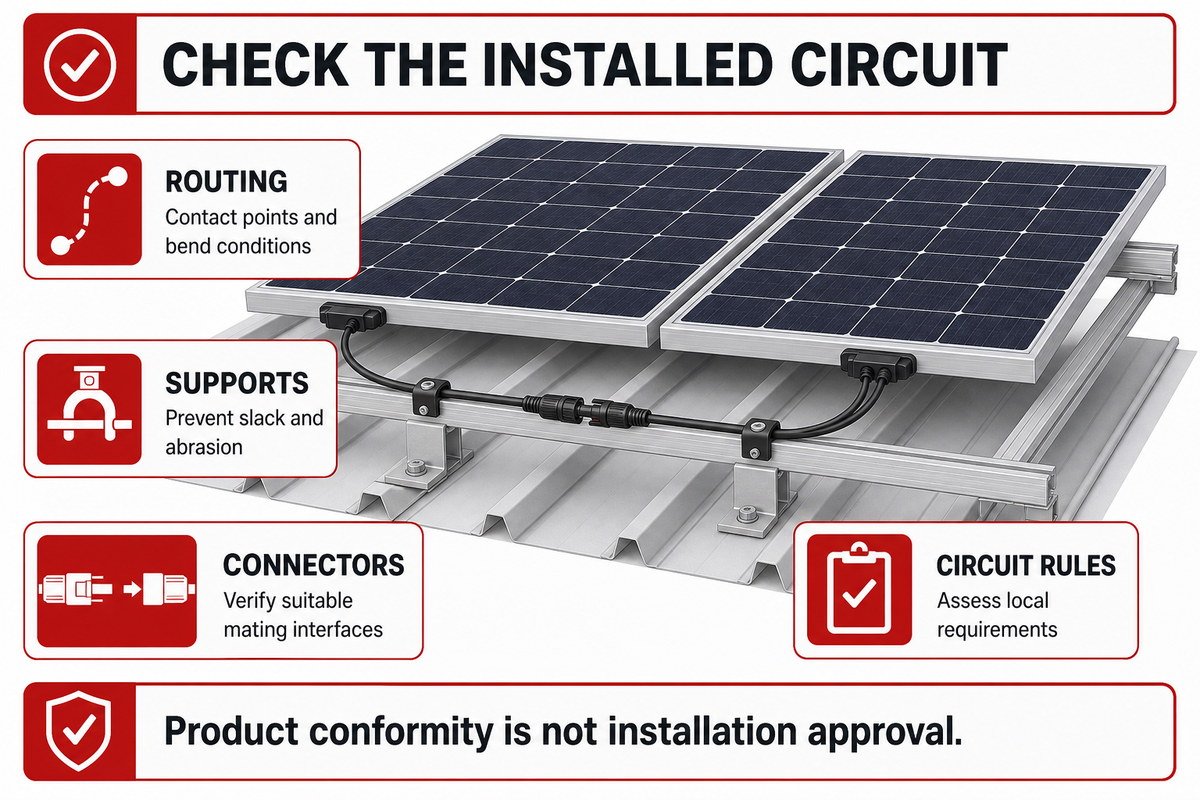
Even the best performing cable needs a route, support system and connector design that allow its intended performance. Product evaluation doesn’t correct poorly terminated or inadequately protected wiring; those defects undermine a successful wiring method and PV system.
IEC 62548-1 addresses PV array design, including DC array wiring; its 2023 edition revised cable requirements, and the catalogue lists a 2025 amendment and consolidated version. Read the edition applicable to the project alongside local requirements. This is the system-design layer beyond IEC standards for cable products.
The US Department of Energy’s DC string cable guidance explains how failed ties and slack wiring can lead to abrasion. It highlights routing, bundling, cable length, bend radius and insulation. For rooftop PV cable applications, consider the route and its contact points as well as the reel specification.
Connectors deserve the same attention. Sandia National Laboratories identifies installation errors, mismatching and material degradation among connector failure concerns. An apparently mating connector isn’t enough to establish a suitable pairing. Tracker movement likewise needs an assessment of the actual cable assembly, bend conditions and repeated motion; flexibility alone doesn’t certify dynamic duty.
Can I run solar DC and AC cables in the same conduit?
There’s no universal answer about shared conduit use based on a PV cable standard alone. The combination of wiring method, circuit configuration, cable insulation ratings, separation requirements and local rules determines the correct conduit arrangement. The AC portion of solar inverters is outside this guide’s scope; the engineer of record should investigate the conduit arrangement rather than infer suitability from identical-looking casings or sheaths on two products.
The same goes for extension cables connecting solar panels. Length, conductor size and connector details belong in the review, and a cable size calculator can’t independently authorize the installation even when its assumptions are reasonable.
All of that only accounts for the process prior to selection; the maintenance of solar cable occurs after it’s been selected. The Department of Energy’s installation and commissioning guidance treats verification as part of the complete solar energy system: product conformity and commissioning answer distinct but complementary questions.
Reading revisions and legacy cable claims
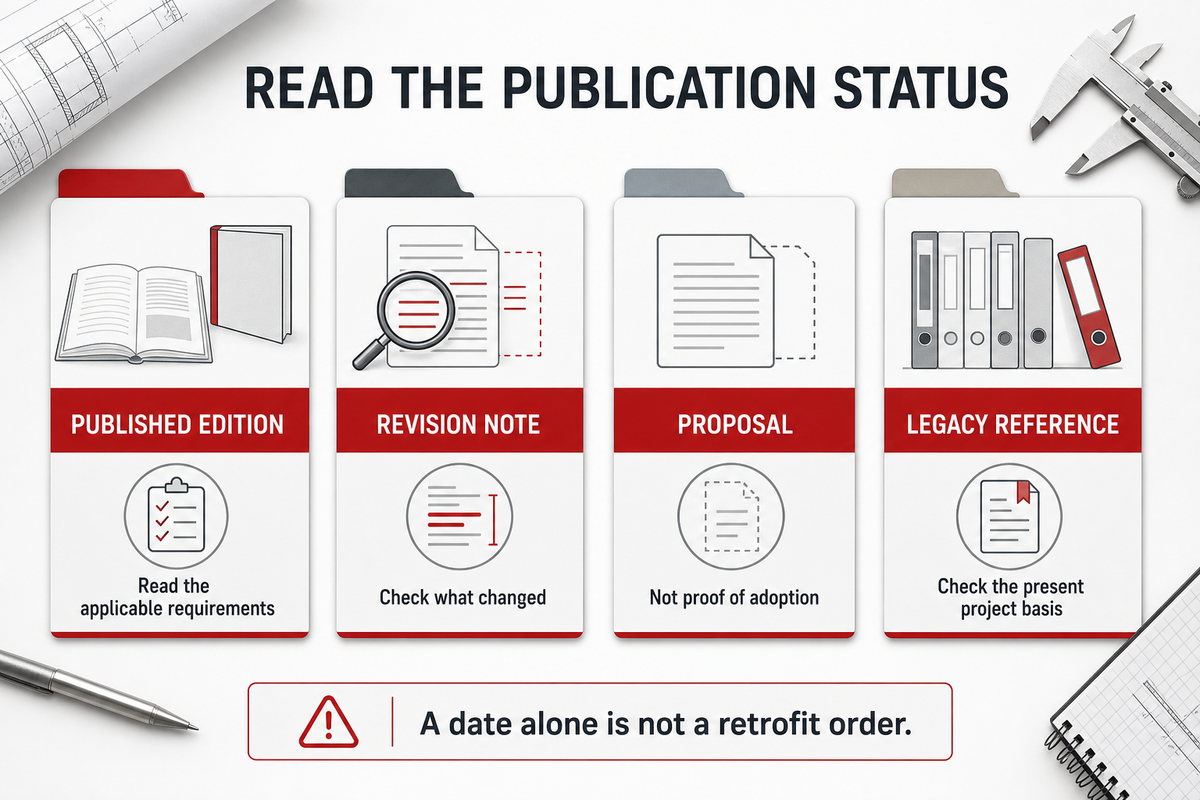
A dated web page, a preliminary proposal and an existing international standard represent distinct documents: consult the standards lifecycle record for the cited publication, then identify the edition and local requirements applicable to the project. You avoid assuming that an old reference has passed muster without justification, or prematurely declaring an existing installation obsolete without a relevant requirement.
The UL 4703 catalogue makes the distinction concrete: its August 2020 revision note says there were no technical changes, while later proposal records do not by themselves establish a new adopted edition. IEC catalogue stability dates also should not be read as product expiry dates.
For an old drawing marked PV1-F, retain the original reference while investigating the proposed cable’s present basis. (The supplier audit and traceability information handles that other topic and this isn’t a lesson in the practice of records management.)
Key takeaway
Choosing the right solar cable means matching the product standard, individual ratings and installation conditions. Compliance with international standards describes a defined scope; it does not remove the need to assess the installed circuit.
Frequently asked questions
What are the typical specifications for solar cable?
Solar cable specifications describe construction, ratings and application conditions.
Typical fields include the cable type, applicable standard and edition, conductor material and size, insulation and sheath, voltage rating, and permitted temperature and environmental conditions. They form a description, not one universal specification for all solar installations. Solar cables must also suit their particular circuit and interfaces. When selecting solar cables, read the ratings together with the project’s wiring requirements, rather than choosing from a voltage marking alone.
Are EN 50618 and IEC 62930 the same standard?
EN 50618 and IEC 62930 are separate standards with overlapping applications, but their material and conductor scopes differ; similar ratings do not prove equivalent product approval.
No. They are separate standards with overlapping PV cable applications and different scope details. The material distinction is useful: IEC 62930 includes halogen-containing as well as halogen-free low-smoke cable, whereas EN 50618 describes low-smoke, halogen-free cable. Their conductor scope also differs. Similar electrical ratings do not establish identical approval, so compare the precise product claims against the standard required for the project.
What is H1Z2Z2-K, and is it a solar cable standard?
H1Z2Z2-K is a cable designation associated with EN 50618.
H1Z2Z2-K is a cable designation associated with the EN 50618 specification route, rather than the name of a certification body or the standard itself. It helps identify the described cable type. It does not replace the product’s rating information or current certification scope. If a specification uses the designation without naming the required standard or application conditions, clarify those requirements before treating the description as complete.
Is PV1-F the same as H1Z2Z2-K?
PV1-F and H1Z2Z2-K names alone do not establish equivalent approval; compare the historical specification with the proposed standard, ratings and intended application before accepting a substitution.
Do not assume the two names establish equivalent present approval. PV1-F appears in legacy cable descriptions associated with an older certification basis, while H1Z2Z2-K is associated with EN 50618. The transition history helps explain why both names appear in solar PV documentation, but it is not a blanket substitution rule. For a replacement, distinguish the old drawing’s requirement from the new cable’s stated standard, ratings and accepted application. Neither a name change nor a similar appearance proves that a proposed cable fits the existing approval. Equally, the legacy name alone is not evidence that every installed cable must be removed.
Does a solar cable standard tell me whether to use 10 or 12 AWG?
Solar cable standards do not select 10 or 12 AWG for a particular circuit; current, length, temperature, wiring method, voltage drop and terminals require their own assessment.
No. An AWG wire gauge describes size. Selecting 10 or 12 AWG wire requires current, length, temperature, installation and voltage-drop assessment under the applicable rules. Cables must also fit their terminals and connectors.
Move from standards interpretation to a product discussion
For model-specific standards, certification scope and project documentation, visit JINYOU Cable’s Solar Cable Standards and project compliance page. The solar power cable project overview covers the broader product and supply discussion.
References & Sources
Public resources referenced: the web pages consulted provide catalogue scope information for the cited sources; they do not replace the published, paid-for standards.
- UL Solutions, Getting Started with UL Standards
- European Commission, Low Voltage Directive
- EUR-Lex, Decision (EU) 2023/2723, consolidated 30 April 2026
- British Standards Institution, EN 50575 construction-use cable scope
- European Commission, Construction Products Regulation revision
- International Electrotechnical Commission, IEC 62930:2017
- British Standards Institution, BS EN 50618:2014
- UL Standards & Engagement, UL 4703 public scope and revision record
- UL Solutions, Photovoltaic Cable Testing and Certification
- TÜV Rheinland, Historical PV cable requirements transition
- UL Solutions, Wire and Cable Guide
- International Electrotechnical Commission, IEC 62548-1 catalogue and lifecycle
- US Department of Energy, DC String Cable Management Best Practices
- Sandia National Laboratories, PV Connectors Research
- US Department of Energy, PV Installation and Commissioning