Australian Standard Solar Cable is not proved by one logo. Purchasing decisions must also consider evidence for the cable product, electrical design inputs, installation routing, and project acceptance records.
Prepared by the JINYOU Cable Technical Content Team. Evidence checked against public standards-body, regulator, certification and first-party sources on 9 September 2026.
Quick Answer
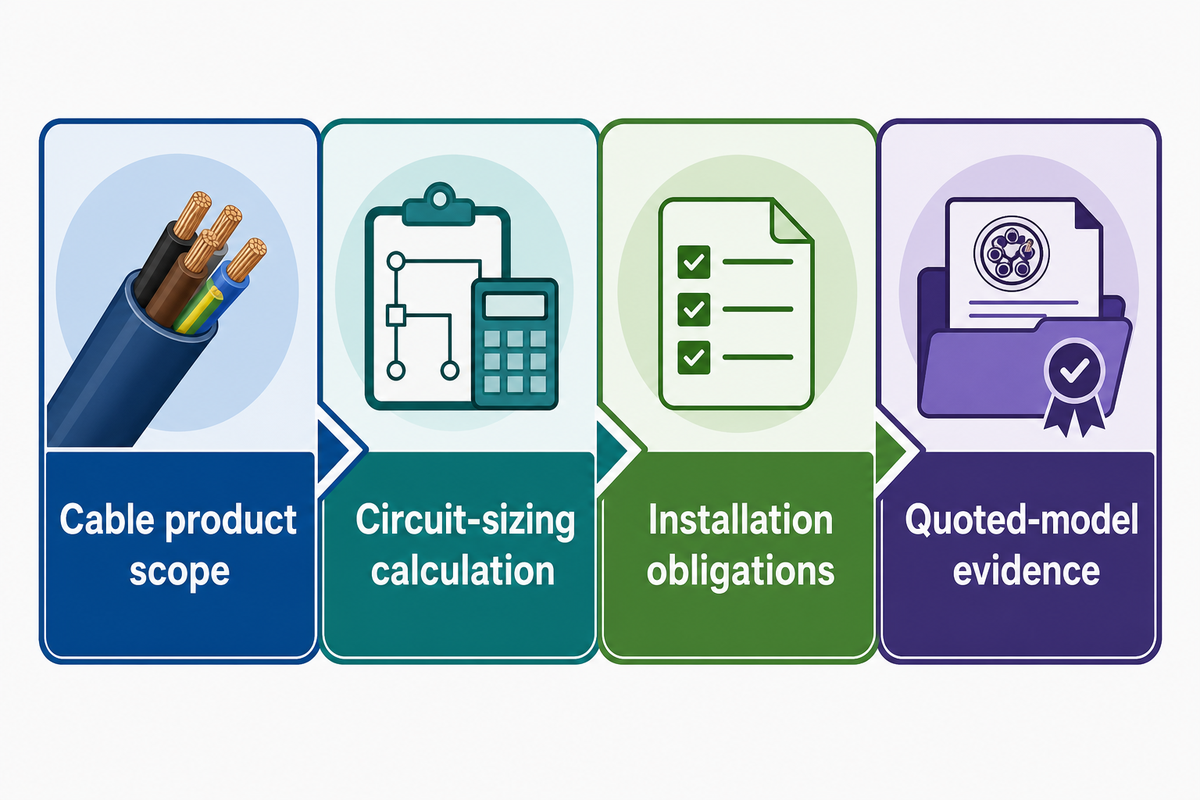
For a new Australian PV project, four layers must be verified: the cable product scope, the circuit-sizing calculation, the installation obligations and the evidence associated with the quoted model. IEC 62930 may answer part of the product question. This, by itself, does not approve the cable size, an underground route, connector mating or the finished installation.
Scope note: this guide helps engineering, procurement and construction teams prepare evidence and request-for-quotation inputs. It isn’t electrical design approval. Licensed designers or electrical contractors must use the purchased standards, project documents, network requirements and state or territory rules to apply the required electrical design.
Australian Standard Solar Cable: The Short Answer
Australian solar cable acceptance needs more than an IEC 62930 reference. The standard describes a PV DC cable product scope, while Australian rules address array installation, wiring and cable selection. The ordered model, conductor, rating, route and evidence must align with the project, and the installed work still awaits inspection.
The practical procurement test is simple. Can supplier documents identify the ordered cable? Does the project team explain why that cable fits the circuit and installation? If either is unclear, place the line item on hold instead of treating a certificate logo as a blanket approval.
Similar care is required when dealing with material claims. IEC 62930 covers both halogen-free low-smoke constructions and cables that may contain halogens. When a project requires a specific sheath, performance with regard to smoke and/or halogen must be further supported with the construction and test evidence of the product.
The 4-Layer Australian PV Cable Compliance Stack
The 4-Layer Australian PV Cable Compliance Stack separates questions that are often mixed together. Layer 1 is concerned with product conformity, while Layer 2 focuses on electrical sizing. Product conformity sits at Layer 1; electrical sizing at Layer 2; installation and inspection at Layer 3; and model-specific purchasing evidence at Layer 4. Order release isn’t ready until each layer has been assigned an owner.
4-Layer Australian PV Cable Compliance Stack
Layer
Question
Evidence owner
Hold trigger
1. Product
Does the exact construction fall within the claimed cable standard and rating?
Supplier and quality team
Certificate or report names another model, size or factory
2. Design
Does the conductor meet current, voltage-drop and fault requirements under the actual conditions?
Licensed designer
Size was selected from system kilowatts alone
3. Installation
Are routing, protection, conduit, connectors, labels and terminations correct?
Installer and inspector
Route or connector system is missing from the review
4. Acceptance
Do the shipment and batch records match the approved line item?
Procurement and project quality
The approved evidence cannot be tied to the delivered reel
Often, if Layer 1 is cleared, the team assumes that the other layers will follow. For example, an IEC 62930-marked cable may still need a separate underground-use check. In the field, an otherwise correct cable may be rendered defective by a connector that does not meet specifications, poor crimping, exposed routing, or other field defects.
Use the stack at design freeze, supplier approval and goods receipt. The same four headings support a smooth transition between the designer, buyer, quality reviewer and installer.
IEC 62930 vs AS/NZS 5033, AS/NZS 3000 and AS/NZS 3008
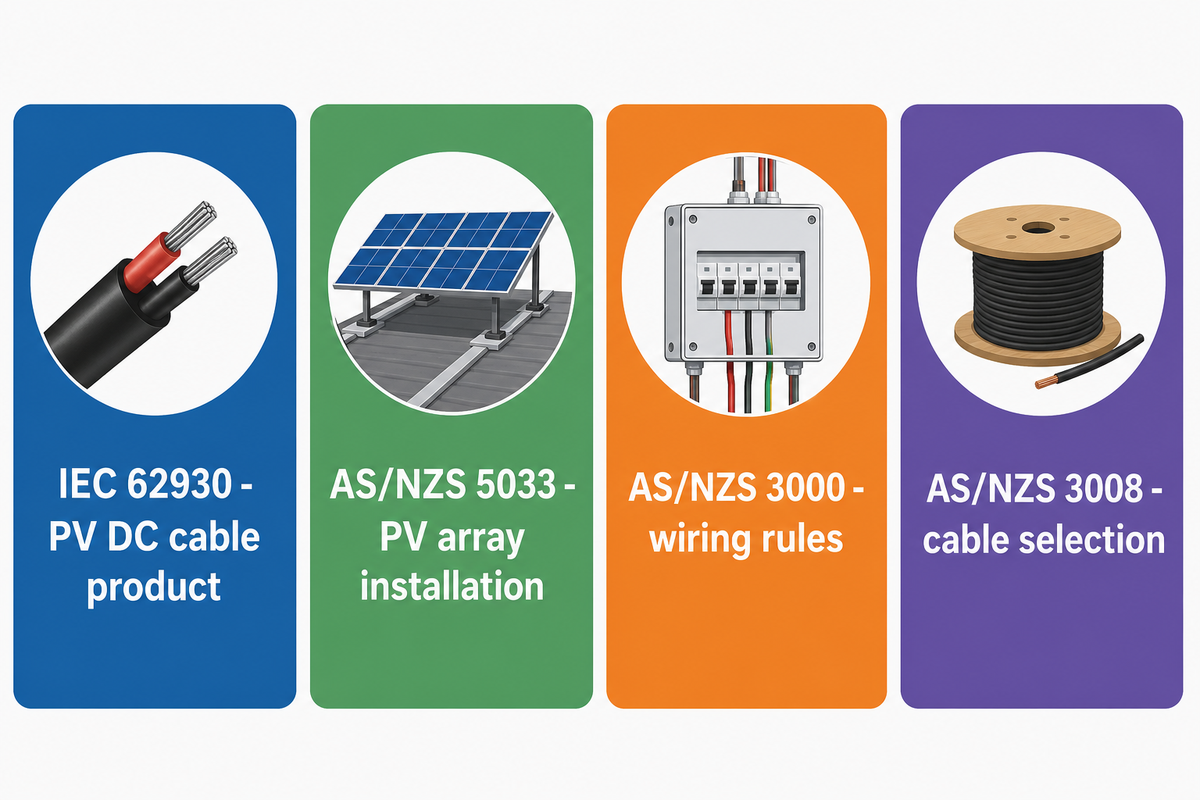
These documents cover different topics. IEC 62930 covers specified PV DC cable construction and service conditions. AS/NZS 5033 addresses PV array installation and safety. AS/NZS 3000 supplies broader wiring rules, while AS/NZS 3008 supports cable selection calculations. Treating the titles as interchangeable creates an evidence gap.
What are the Australian cabling standards for a PV project?
The applicable set depends on the installation, date, jurisdiction and project documents. As of 9 September 2026, Standards Australia lists AS/NZS 5033:2021 as current for PV array installation and AS/NZS 3008.1.1:2025 as current for typical Australian cable-selection conditions. The latter’s public scope extends through 1500 V DC.
Document
Publicly supported role
What it does not prove alone
IEC 62930:2017
Single-core cross-linked PV DC cable scope up to 1.5 kV DC; normal maximum conductor temperature wording of 90 °C
Installed-system compliance, a final cable size or every environmental claim
AS/NZS 5033:2021
PV array installation and safety, including wiring, protection, testing, labels and records
That every cable with a familiar product name fits the project
AS/NZS 3000
Broader electrical installation and wiring context
A supplier’s model-level product conformity
AS/NZS 3008.1.1:2025
Current-carrying capacity, voltage drop and short-circuit temperature rise for stated installation conditions
A result without circuit and route inputs
Terminology is important in search results. The phrase installation and safety requirements for photovoltaic arrays describes an installation scope, not a product guarantee. In PV systems, a solar panel, cable, connector and conduit are each a component of the broader electrical wiring system. A residential rooftop application and a commercial array can impose different route, grouping, protection and maintenance conditions. Cable diameter alone isn’t a substitute for conductor cross-sectional area or designer calculation. Read the cited clause in the purchased standard so the installation can remain compliant and any efficiency claim stays tied to its design basis.
Public summaries are useful for scope and edition checks, but they aren’t a substitute for purchased standards. Ensure that the edition used is recorded in the design file and confirm any adoption or transition requirement with the authority that governs the project.
The 6-Input Size Decision Gate Before Choosing 4 mm² or 6 mm²
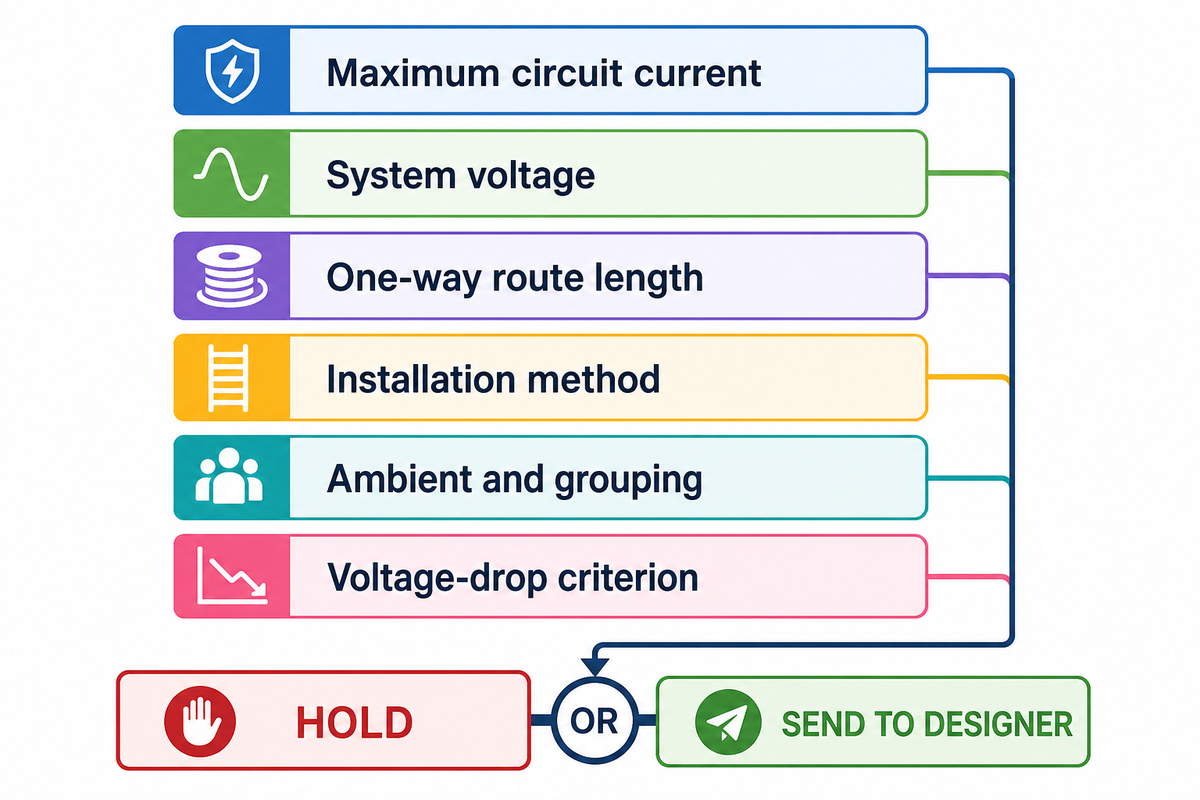
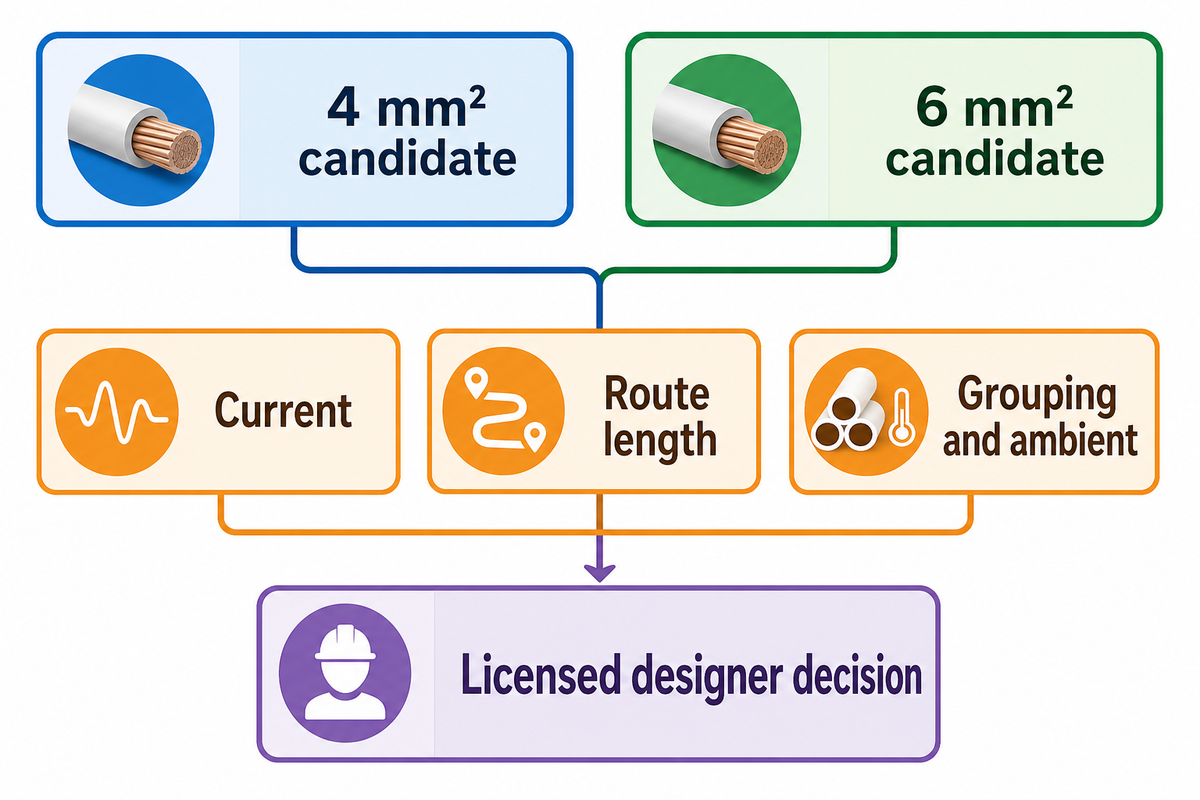
The 6-Input Size Decision Gate prevents a quotation from becoming a dangerous design shortcut. It relies on standard scopes and Australian technical guidance and isn’t a direct transcription of a checklist from one source. When a buyer asks “4 mm² or 6 mm²”, capture the maximum circuit current, system voltage, length of a one-way route, installation method, ambient or grouping conditions and the permitted voltage drop on the project. One missing input means HOLD.
Record maximum circuit current — use the design basis, not the array’s headline power.
Record system voltage — include the operating and maximum-voltage context used by the designer.
Measure one-way route length — use the actual path to the most remote module or relevant circuit endpoint.
Classify installation method — note open air, conduit, ceiling space, wall cavity, tray or underground sections.
Apply ambient and grouping conditions — capture temperature, grouped circuits and other correction conditions.
Set the voltage-drop criterion — use the project rule and current design documents, then calculate both candidate sizes.
Procurement must not assign any of these values. It must complete the input pack and ensure the quote supports the designer’s outcome. JINYOU’s cable-size input checker looks for empty fields before the quote is sent to engineering.
Key takeaway
System kilowatts do not select a string-cable conductor. Six circuit and installation inputs must reach the designer before the supplier receives a size instruction.
Do You Need 4 mm² or 6 mm² Solar Cable?
There’s no universal answer for either option. Under one current, route and installation case, a 4 mm² cable can pass, while 6 mm² may be required when length, grouping, ambient temperature or voltage-drop limits change. Both sizes can be compared using the same inputs; let the licensed designer make the final call.
What size cable is used for a 10 kW solar system?
A 10 kW inverter or array label is insufficient as string arrangement changes circuit current and voltage. Considering a published GSES example, the calculation commences at 38 A, with a 70 °C assumed environment, a 0.63 temperature factor and a 0.80 grouping factor. The adjusted figure is 19.15 A, then 15.32 A after the example’s 1.25 current factor.
That example is useful because of its conditional conclusion. A different correction assumption or parallel strings can yield different results. It must not be detached from its assumptions and reused as a rule for every 10 kW system.
The Clean Energy Regulator’s April 2026 checklist includes DC voltage drop greater than 5% of Vmp at STC from the most remote module to the inverter input. The checklist marks this item “Information only,” so this article considers it an inspection signal, not an automatic failure. That inspection label is not permission to exceed the voltage-drop requirement in the applicable standard or project design.
Do
Compare both sizes under one documented calculation
Use the actual cable route
Keep correction factors with the result
Don’t
Select cable from kilowatts alone
Copy a vendor ampacity without its conditions
Treat larger copper as proof of compliance
The 10-Field Cable Evidence Pack Scorecard
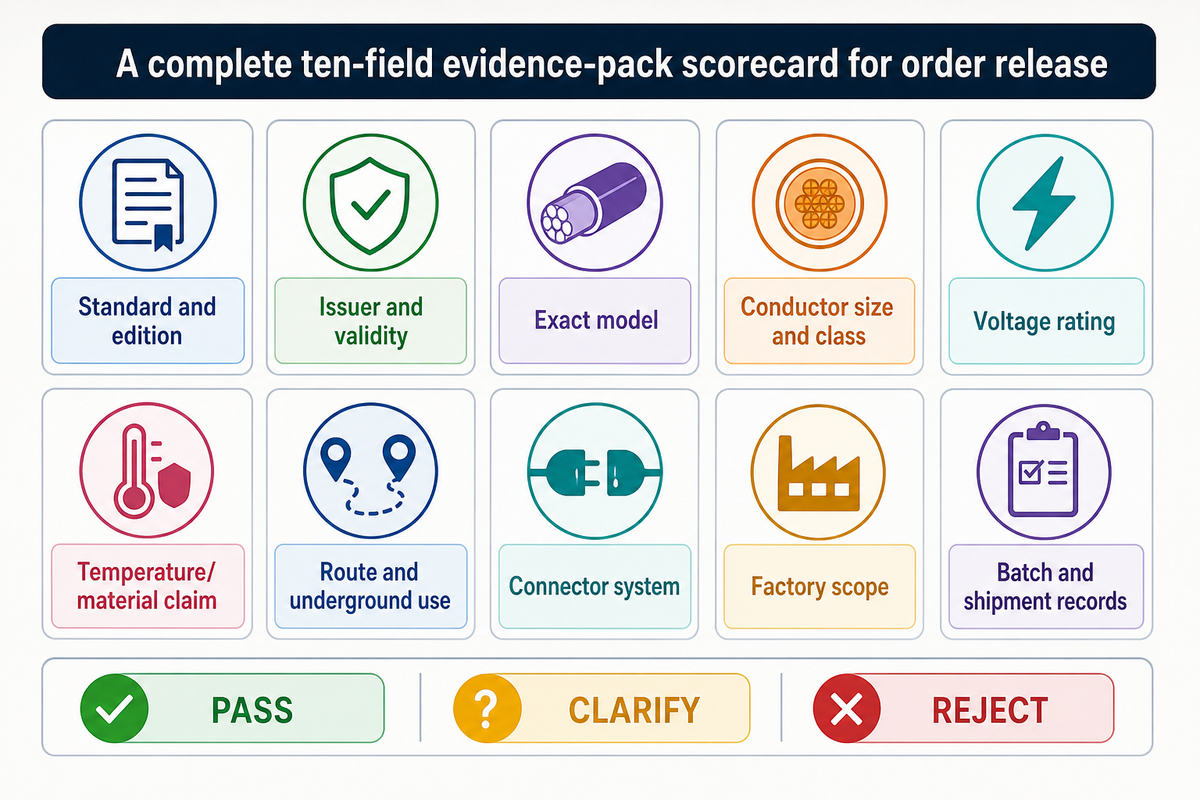
The 10-Field Cable Evidence Pack Scorecard turns supplier paperwork into an order-release decision. Each field receives an evaluation of PASS, CLARIFY or REJECT. An evaluation of PASS means that there’s a match between the evidence and the quote. An evaluation of CLARIFY means that a missing link may still be resolved before purchase. An evaluation of REJECT means that the evidence relates to another product, route or production scope.
10-Field Cable Evidence Pack Scorecard
Evidence type
PASS
CLARIFY
REJECT trigger
1. Standard and edition
Named and relevant to the claim
Edition or scope unclear
Unrelated standard offered as a substitute
2. Issuer and validity
Issuer and current status are traceable
Expiry or verification route missing
Unverifiable document or issuer
3. Exact model
Certificate and quote match
Family named, model absent
Evidence names a different model
4. Conductor size and class
Ordered size/class appears in scope
Class or range ambiguous
Ordered conductor is outside scope
5. Voltage rating
Rating matches design and evidence
AC/DC context unclear
Quoted rating is below design need
6. Temperature/material claim
Construction and test basis are named
Halogen or sheath claim is generic
Marketing claim conflicts with evidence
7. Route and underground use
Route-specific qualification is shown
Buried section not addressed
IEC 62930 alone is offered for underground use
8. Connector system
Mating family, tools and method align
Connector maker or tool missing
Mismatched connector families
9. Factory scope
Production site is covered
Legal name or site differs
Evidence belongs to another factory
10. Batch and shipment records
Reel, batch and report can be linked
Traceability plan not yet issued
Delivered reel cannot be tied to approval
This isn’t a certification system; it’s an acceptance system. Quality assurance holds the evidence decision, procurement maintains the hold, the designer decides on the electrical suitability, and the installer performs the field execution. Separating decisions avoids one decision maker from taking more responsibility than is warranted.
What Installation Inspectors Check Beyond the Cable Certificate
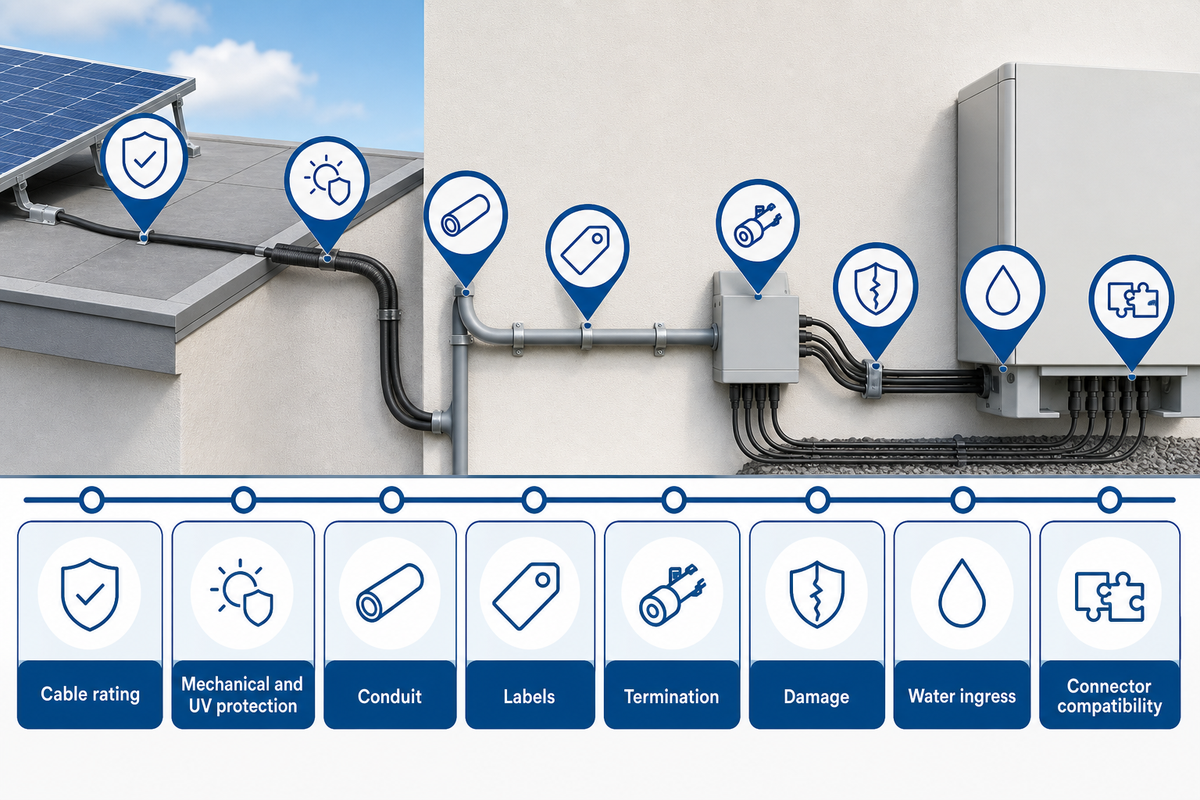
Installation inspectors assess cable as part of a wiring system and not as a document in isolation. Public Victorian audit guidelines cover cable rating, mechanical and UV protection, conduit, labels, termination, damage, and protection against water ingress. The evidence boundary is clear: substituting product documentation for field checks isn’t allowed.
“PV DC cables must conform to IEC 62930 where not installed underground.”
Therefore, underground cable use creates a separate qualification gate. Prior to RFQ release, the designer should identify each buried section and the applicable cable standard. For existing systems, do not assume that every pre-implementation cable must be replaced. The date of installation, cable condition, extent of the modification and applicable directives should be considered.
Another system-level risk is connector compatibility. Energy Safe Victoria guidance states that DC connectors designed to mate and supplied by the same manufacturer must be installed with manufacturer-approved crimp tools and methods. Joining a correct cable to an incompatible connector can still result in arcing and fire risk.
A site walk in this example follows the path rather than the certificate: roof exposure, unsupported spans, penetrations, and ceiling/wall cavities, along with junction boxes, disconnect locations, and inverter terminations. Capture and close each exception against the design and current local requirements.
Australian Solar Cable RFQ Checklist for OEM and Project Buyers
An Australian solar cable RFQ must incorporate the design basis, construction request, evidence package, quantity plan, and delivery terms into a single file. This approach ties the supplier’s quote to the project rather than forcing sales personnel to determine the route or compliance. Copy the following ten rows into the request and name each approver.
RFQ checklist — copy these into your quote request:
Parameter
Required entry
Why it matters
How to verify
Market and project
Australia, site and jurisdiction
Sets the governing review context
Project specification
Circuit inputs
Current, voltage and route length
Prevents a kilowatt-only size guess
Designer calculation
Installation method
Conduit, open air, cavity, tray or buried
Changes rating and qualification checks
Route drawing
Conductor
Size, class and copper finish
Defines the ordered electrical construction
Datasheet and certificate scope
Insulation and sheath
Material, colour, UV and halogen claim
Stops standard-number inference
Construction sheet and test evidence
Print legend
Standard, rating, model and trace code
Links the reel to approval
Artwork and sample photo
Connector interface
Manufacturer, family, tooling and method
Reduces mismatch and crimp risk
Connector-maker instructions
Evidence package
Certificate, report, validity and factory scope
Makes approval model-specific
10-field scorecard
Quantity and packaging
Metres, cut lengths, roll or drum
Controls joints, waste and handling
Bill of materials and packing plan
Delivery and release
Required date, inspection hold and shipping terms
Keeps evidence review ahead of dispatch
Approved inspection plan
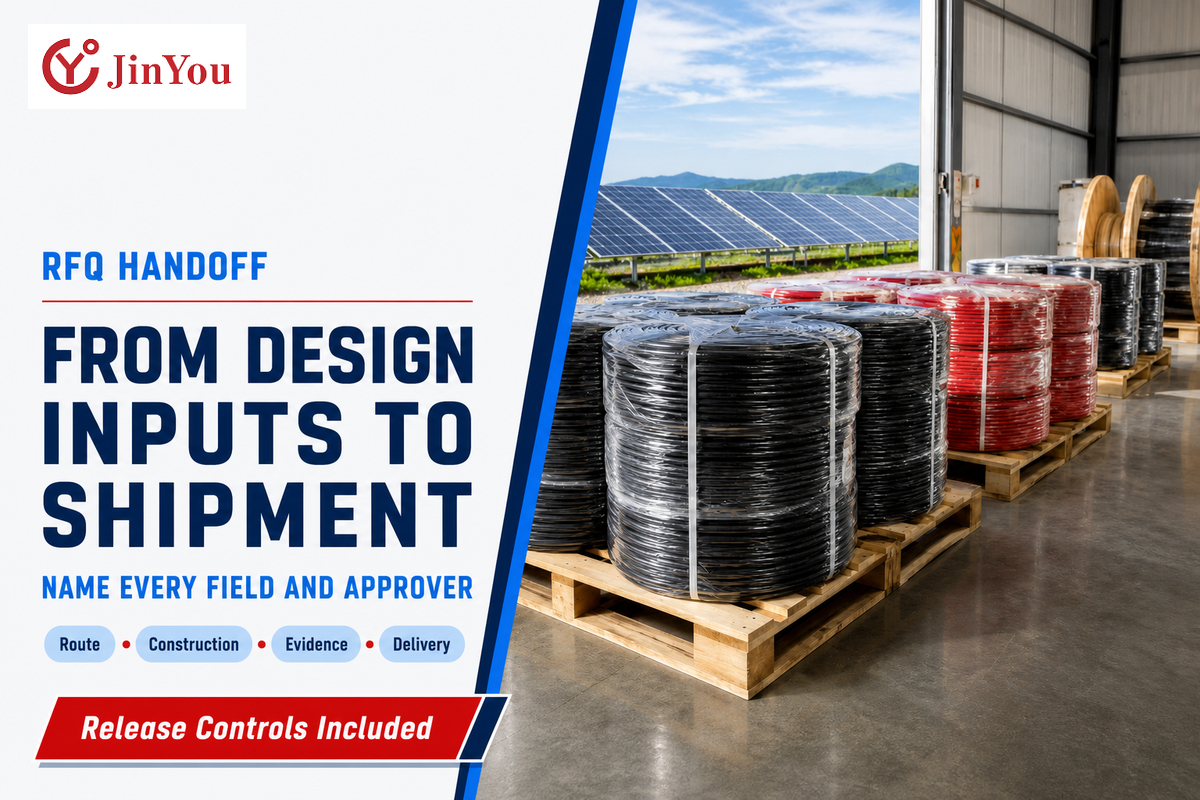
For quantity planning, specify installed length, route allowance, drum allocation, and acceptable cut lengths prior to the purchase order. JINYOU’s quantity and pack planner and RFQ specification brief builder can structure the handoff for this.
How JINYOU Cable Supports Australian-Standard Solar Cable Sourcing
JINYOU Cable can support the product and evidence side of an Australian solar cable request, while the licensed project team retains design and installation responsibility. The Shanghai manufacturer reports renewable-energy cable experience since 2006, custom OEM services and exports to more than 40 countries. These are first-party statements.
A September 9, 2026, research capture of JINYOU’s Australian standard solar cable product page contains the following. Treat these as time-stamped first-party statements rather than confirmed project specifications.
The same capture listed 0.5–240 mm² configurations and packaging such as 100 m or 200 m rolls and 100 m, 500 m or 1000 m plastic drums. Confirm each requested value against the final quotation, authenticated datasheet, and evidence scope before purchase.
Frequently Asked Questions
These answers cover the questions that most often delay a solar cable quotation: which standards apply, whether 4 mm² or 6 mm² is needed, what a 10 kW label means, and which documents belong in the approval pack. Project-specific decisions still require the current standards and licensed electrical review.
What are the Australian standards for solar cables?
IEC 62930 addresses a photovoltaic DC cable product scope. AS/NZS 5033:2021 addresses PV array installation and safety, AS/NZS 3000 supplies broader wiring rules, and AS/NZS 3008.1.1:2025 supports cable-selection calculations. The applicable set depends on the project, route, date and jurisdiction. Check the current purchased documents rather than relying on a supplier label. A supplier may provide product evidence, but the licensed designer and installer still have to comply with the adopted project and local requirements.
Do I need 4 mm² or 6 mm² solar cable?
Provide maximum circuit current, system voltage, one-way route length, installation method, ambient or grouping conditions and the voltage-drop criterion. Compare both conductors under those same assumptions. System power alone can’t settle the decision, and a licensed designer should approve the result. Keep the selected size, correction factors and route drawing together so procurement doesn’t quote from an orphaned number.
What size solar cable is used for a 10 kW system?
There’s no single size for every 10 kW system. String arrangement changes voltage and current; route length and installation conditions change voltage drop and current-carrying capacity. Use the 6-Input Size Decision Gate before requesting a conductor. A result from one worked example applies only when its circuit, temperature, grouping and installation assumptions match the project.
Is H1Z2Z2-K the same as Australian-standard solar cable?
No designation should be treated as automatic equivalence. Match the exact model’s construction, standard scope, rating and certificate to the Australian project documents and installation route.
What documents should a solar cable supplier provide?
Request the applicable certificate or test report, issuer and validity, exact model, conductor size and class, voltage rating, material claims, route qualification, connector compatibility, production-site scope and batch or reel traceability. The 10-field scorecard shows when to pass, clarify or reject each item.
Can a cable certificate prove the installation is compliant?
No. Product evidence and field inspection answer different questions. Routing, protection, conduit, labels, connectors, terminations, damage and water ingress remain installation checks.
What should an Australian solar cable RFQ include?
Include project and jurisdiction, electrical design inputs, installation route, conductor and materials, print legend, connector system, evidence package, quantity, packaging, delivery terms and order-release hold points. Don’t ask the cable supplier to invent missing design inputs.
Must existing cable be replaced if it is not marked IEC 62930?
Not automatically. Public regulator guidance distinguishes new work from qualifying pre-implementation installations, and jurisdictional treatment can differ. Have a licensed contractor assess the installation date, alterations, cable condition and current local requirements before deciding on replacement.
Shanghai Jinyou Jinhong Intelligent Electric Co., Ltd. has focused on new energy cable manufacturing since 2006, supporting solar/PV, energy storage, EV charging, and industrial or special-cable applications.
Use this guidance to prepare a clearer engineering or procurement discussion: operating environment, conductor and insulation expectations, route length, voltage, installation method, and project schedule.
Certificate evidence should be matched to the construction being specified. Public certificate evidence applies to H1Z2Z2-K solar cable constructions and should not be read as blanket certification for every JINYOU Cable product family.
PROJECT BRIEF
Move from article to specification
Share the application, required cable family, target standard, quantity range, and delivery window. The team can help structure the next engineering and procurement conversation.