Get in touch with JINYOU Cable Company

-
CALL US +86 181 1623 2461
-
EMAIL sales@jinyougroup.cn
H1Z2Z2-K Solar Cable — EN 50618:2014 / IEC 62930, 1500 V DC
- Quotation within 24 hours
- 15–30 days production
- 1.5–240 mm² single core
- 500 m minimum order
Two reels of H1Z2Z2-K cable can carry the same designation, the same 1500 V DC rating and almost the same price, and still differ in the one place that decides whether the run survives a 25-year design life. That place is the conductor, and it is invisible once the sheath is on. This page publishes the numbers that make the difference measurable before you buy.
Send the cross-section, core count, colour and drum length. An engineer reviews every enquiry before a price is issued.
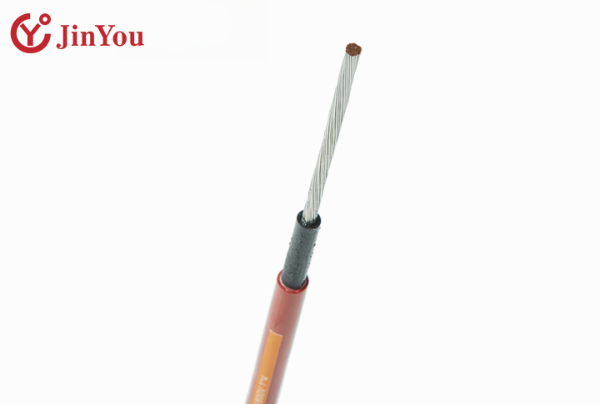
Where the Ampacity Rule of Thumb Breaks
The short-circuit current printed on a module data sheet is a Standard Test Conditions figure, measured at 1000 W/m², air mass 1.5 and 25 °C cell temperature. It leaves things out. The rear-surface current of a bifacial module is not in it, and neither is cloud enhancement or an irradiance spike.
- Bifacial arrays — albedo from the ground adds current the front-side rating never saw.
- Over-irradiance — edge-of-cloud enhancement pushes short bursts above the rated figure.
- Grouping — cables laid together in a tray or trench derate each other.
Size a run straight from the data sheet figure and it comes out too small. IEC 60364-5-52 sets out the correction. Array design sits under IEC 62548.
H1Z2Z2-K on the DC Side: Strings, Combiner Boxes and Inverters
Both EN 50618:2014 and IEC 62930:2017 scope this solar PV cable to the direct current side of a photovoltaic system, and both qualify it for use with Class II equipment as defined in IEC 61140. The interconnection stops at the inverter; everything downstream is a different product family.
Module to module
Series connection of photovoltaic panels in a string, where the cable sits against the module frame and takes the full solar gain on top of its own conductor heating.
String to combiner box
Parallel links between strings and the run into the DC combiner box. Current adds as strings combine. Size the conductor on the combined figure, not the single-string figure.
Combiner box to inverter
The longest DC runs in the array, where voltage drop turns into a yield loss for the life of the plant rather than a one-off installation cost.
One construction serves rooftop solar installations, ground-mounted solar farms and floating solar panel arrays, and at 4 mm² its 5.5 mm outer diameter suits standard photovoltaic connector glands.
Conductor, Insulation and Sheath Material System
Price pressure on solar cable shows up in the conductor first, because it is the most expensive part of the cable and the hardest part for a buyer to inspect. That is where the substitution risk sits, and where a saving of a few cents per metre costs you the run.
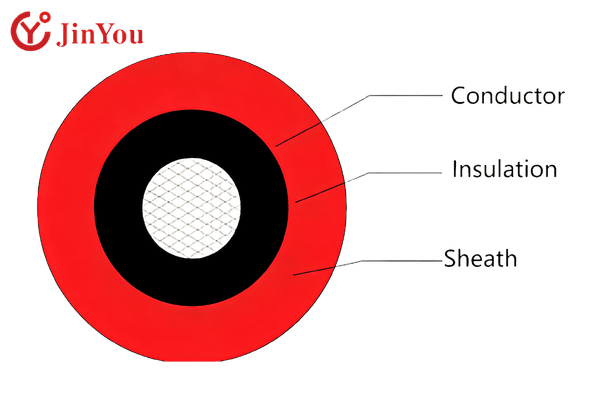
Conductor: Class 5 Tinned Copper
Springy strands are a red flag installers already watch for, because copper-clad aluminium behaves differently under a blade than solid tinned copper, and the numbers below turn that hunch into a measurement.
Resistance alone does not prove the construction. Class 5 and class 6 metal-coated copper share the same 5.09 Ω/km limit at 4 mm²; what separates them is the maximum strand diameter, 0.31 mm against 0.16 mm. Ask for both numbers, not one. The two numbers only mean something together. Publish the resistance and a buyer can check the conductor is copper of the full cross-section; publish the strand diameter as well and they can check which flexibility class they actually received.
Aluminium cables and copper-clad aluminium cores need a larger cross-section for the same duty. A same-size offer at a lower price is not the same cable. Measure it. A conductor resistance measurement on a sample of the delivered cable settles the question in minutes.
| Item | Value | Governing standard |
|---|---|---|
| Material | Class 5 flexible tinned copper conductor, annealed | IEC 60228 / EN 60228 |
| Stranding at 4 mm² | 56 strands of ≤ 0.31 mm | IEC 60228 class 5 strand limit |
| Maximum DC resistance | 5.09 Ω/km at 20 °C | IEC 60228 class 5, 4 mm² |
| Aluminium content | None. No aluminium and no copper-clad aluminium core | — |
Insulation and Sheath for Photovoltaic Systems
Unlike general low-voltage cables, this construction uses cross-linked insulation and a cross-linked sheath, both halogen-free polyolefin cured by electron beam rather than melted into shape. Cross-linking is what lets the material hold its form at temperature instead of softening the way a thermoplastic does, and it is where the sheath gets its mechanical strength.
- Insulation is nominal 0.7 mm at 4 mm², with tensile strength ≥ 8.0 N/mm² and elongation at break ≥ 125 %.
- Outer sheath is nominal 0.8 mm at 4 mm² to the same tensile and elongation minima, black as standard or to your colour.
- Both compounds are low smoke zero halogen (LSZH), halogen-free to IEC 60754-1 with low corrosive gas emission to IEC 60754-2.
- The two Z2 characters in the designation are the ozone-resistance marks for insulation and sheath.
- UV resistance and weathering performance are qualified under the weathering regime of EN 50618:2014.
- Sequential metre marking runs along the sheath, so an installer can read off remaining length.
What the Photovoltaic Cable Designation Tells You
| Character | Meaning | What it commits the maker to |
|---|---|---|
| H | Harmonised | Built to the harmonised European standard rather than a house specification |
| 1 | 1.5 kV class | Rated 1500 V DC, with 1800 V DC maximum system voltage |
| Z2 | Ozone-resistant insulation | Cross-linked compound tested against ozone cracking |
| Z2 | Ozone-resistant sheath | Second barrier of the same cross-linked family |
| K | Flexible conductor | Class 5 stranded conductor, not a solid or class 2 conductor |
H1Z2Z2-K Technical Specification — 1500 V DC Solar Cable
The photovoltaic H1Z2Z2-K cable column below is the 4 mm² nominal cross-section, the size most often specified for string wiring. Other sizes are certified as well. Per-size construction data for the rest of the certified cable range travels with your quotation.
| Property | Value at 4 mm² | Basis |
|---|---|---|
| Nominal DC voltage | 1500 V DC conductor to conductor and conductor to earth | EN 50618:2014 / IEC 62930:2017 |
| Rated voltage, alternating current | 1.0/1.0 kV | EN 50618:2014 |
| Maximum system voltage | 1800 V DC | EN 50618:2014 |
| Conductor | Class 5 tinned copper, 56 strands of ≤ 0.31 mm | IEC 60228 |
| Maximum DC resistance at 20 °C | 5.09 Ω/km | IEC 60228 class 5 |
| Nominal insulation thickness | 0.7 mm, minimum 0.53 mm at the thinnest point | Works construction record |
| Nominal sheath thickness | 0.8 mm, minimum 0.58 mm at the thinnest point | Works construction record |
| Overall diameter | 5.5 ± 0.2 mm | Works construction record |
| Operating temperature range | -40 °C to +90 °C | Works declaration |
| Maximum conductor temperature | 90 °C continuous; 120 °C limited to 20 000 h | IEC 62930:2017 |
| Factory withstand test | 6.5 kV for 5 minutes, no breakdown | Works test on every production length |
| Design life | 25 years | Works declaration |
Conductor Resistance by Cable Size
Maximum DC resistance is the figure a buyer can verify without cutting the cable open. So the whole column is published, not a single line. These are the class 5 metal-coated copper limits at 20 °C that every certified cable size has to meet.
| Nominal cross-section | Max. DC resistance at 20 °C | Core options |
|---|---|---|
| 1.5 mm² | 13.7 Ω/km | Single core |
| 2.5 mm² | 8.21 Ω/km | Single and twin core |
| 4 mm² | 5.09 Ω/km | Single and twin core |
| 6 mm² | 3.39 Ω/km | Single and twin core |
| 10 mm² | 1.95 Ω/km | Single and twin core |
| 16 mm² | 1.24 Ω/km | Single and twin core |
| 120 mm² | 0.164 Ω/km | Single core |
Enter your string current, run length and cross-section to see the drop against the 1 % and 2 % design targets.
Open the voltage-drop calculatorPricing Mechanism, Lead Time and Order Terms
Solar cable is priced from conductor mass, cross-section, core count, sheath colour, drum length and total quantity, against the copper price on the day. There is no fixed price list. A figure quoted without those six inputs is a guess rather than a price.
| What moves your price | Why it moves it | What to send us |
|---|---|---|
| Cross-section | Conductor mass per metre is the largest single cost element | Nominal area in mm², or the string current and run length |
| Core count | Twin core changes the extrusion and the certified range | Single core or twin core |
| Sheath colour | Colour changes are production set-up, not material cost | Black as standard, or your colour |
| Drum or roll length | Longer put-ups cut jointing and offcut waste on site | Preferred length per drum |
| Total quantity | Sets whether the run is a part-load or a full container | Total metres per size and colour |
| Destination | Determines the trade term and the document set | Destination port and required Incoterm |
Order terms
| Term | What we commit to |
|---|---|
| Quotation | Returned within 24 hours on business days, reviewed by an engineer |
| Production | 15–30 days after the specification is approved |
| Minimum order | From 500 m per cross-section and colour |
| Samples | Sample lengths are free of charge; the buyer covers courier freight |
| Payment | 30% T/T deposit, balance before shipment or against a copy of the Bill of Lading; an irrevocable letter of credit at sight is also accepted |
| Trade terms | We ship FOB, CIF, CFR and EXW from a Chinese port, with other Incoterms on request |
Drum length carries a trade-off worth deciding early. Longer put-ups cut jointing and offcut waste on site; shorter ones handle more easily on a roof. Tell us the installation method and we will recommend the length.
Ready for a firm engineering quotation?
Cross-section, core count, colour and total metres are enough to generate a detailed price proposal for your project.
Certification by Number, Type Testing, Documents and Drum Loading
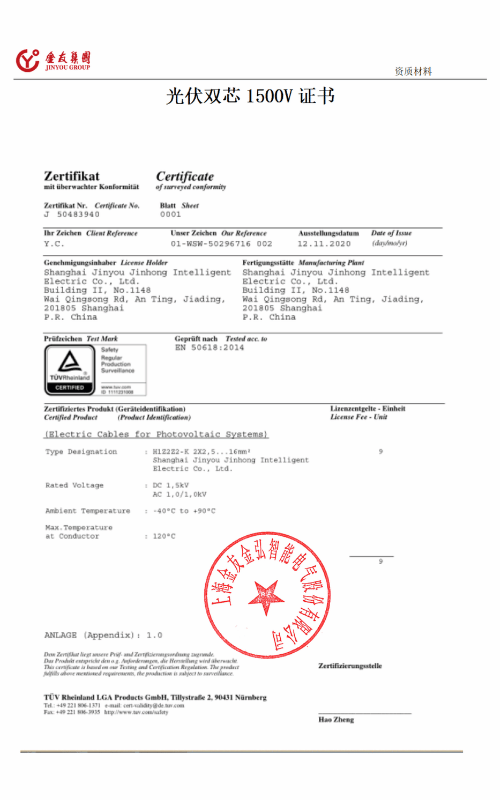
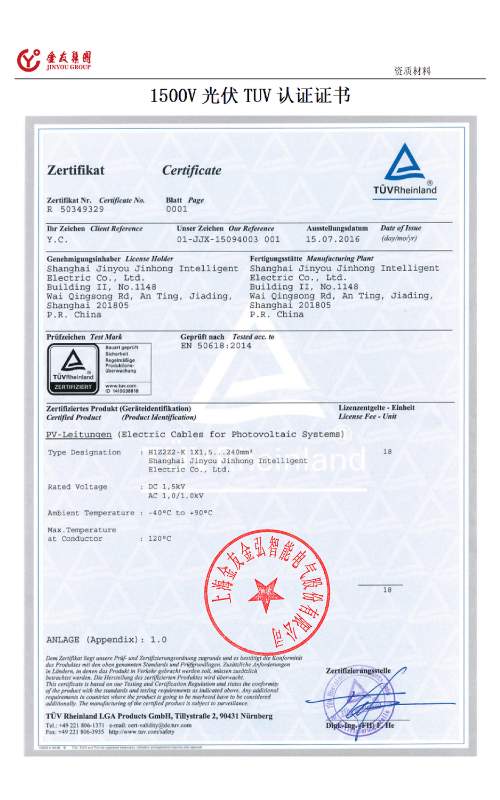
A certificate PDF is not proof on its own. It becomes proof when the number on it resolves in the issuing body’s own database, and every number below does, under the holder name Shanghai Jinyou Jinhong Intelligent Electric Co., Ltd.
| Certificate | Certified model designation | Fulfilled standard | Issued | Type |
|---|---|---|---|---|
| TÜV Rheinland R 50349329 | H1Z2Z2-K, single core, 1.5–240 mm² | EN 50618:2014 | 2016-07-15 | Type approval |
| TÜV Rheinland J 50483940 | H1Z2Z2-K, twin core, 2 × 2.5–16 mm² | EN 50618:2014 | 2020-12-17 | Surveyed conformity |
| TÜV Rheinland R 50482064 | Halogen-free low smoke cable, single core, 1.5–240 mm² | IEC 62930:2017 | 2020-09-25 | Type approval |
| CE AN-50438312 / 15094003-003 | H1Z2Z2-K, single core, 1.5–240 mm² | Issued in conjunction with TÜV Rheinland licence R 50349329 | — | Conformity |
How to check these before you order
The three TÜV Rheinland numbers are searchable in Certipedia, the certificate database maintained by the certification body itself. Four things should agree with the table above.
- Holder name — it must be the registered company, not a trading name and not an agent.
- Product scope, meaning the certified model designation and its cross-section range.
- Standard version, shown as EN 50618:2014 or IEC 62930:2017 with the year.
- Status, since the record itself shows whether the certificate is current.
Certification is not a one-off event. The certification body monitors manufacture at intervals for as long as the certificate stands, and validity is tied to the product remaining as assessed. A certificate confirms what was tested; it does not settle which conformity marking your own jurisdiction requires.
Ask for the certificate numbers against your exact specificationType Testing Behind the PV Cable Designation
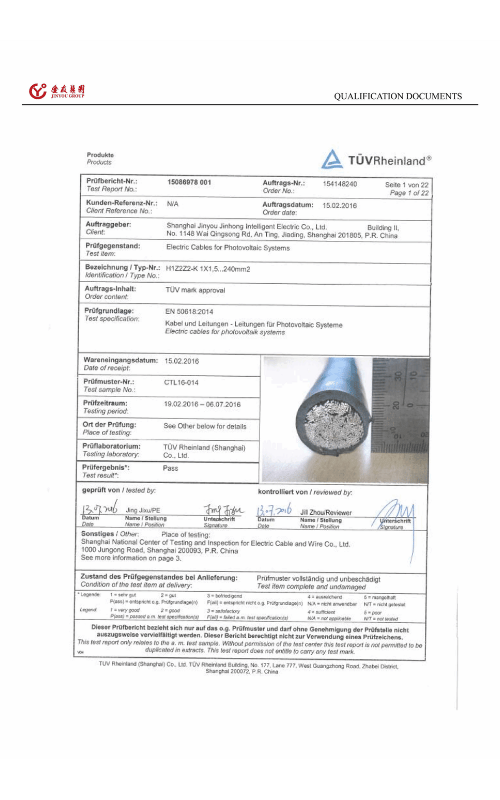
Every finished drum is tested at 6.5 kV for 5 minutes with no breakdown before it leaves the works. That is the factory check. Behind it sits the type test regime the designation itself is qualified against, and that one is a great deal heavier.
| Test | Condition | Acceptance |
|---|---|---|
| Long-term DC insulation | 1.8 kV DC, 240 h, in water at 85 °C | No breakdown, no damage |
| Long-term water immersion | 100 days in water at 50 °C, per EN 50525-2-21 | No breakdown or damage |
| Ozone resistance | 24 h at 25 °C, 250–300 × 10⁻⁴ % ozone by volume | No cracking |
| Thermal endurance | Temperature index at 20 000 h | ≥ 120 |
| Damp heat | 1000 h at 90 °C and 85 % relative humidity | Tensile and elongation change within −30 % |
| Weathering | 720 h, 360 cycles | No degradation of the sheath |
| Cold bend | -40 °C | No cracking |
Documents and loading
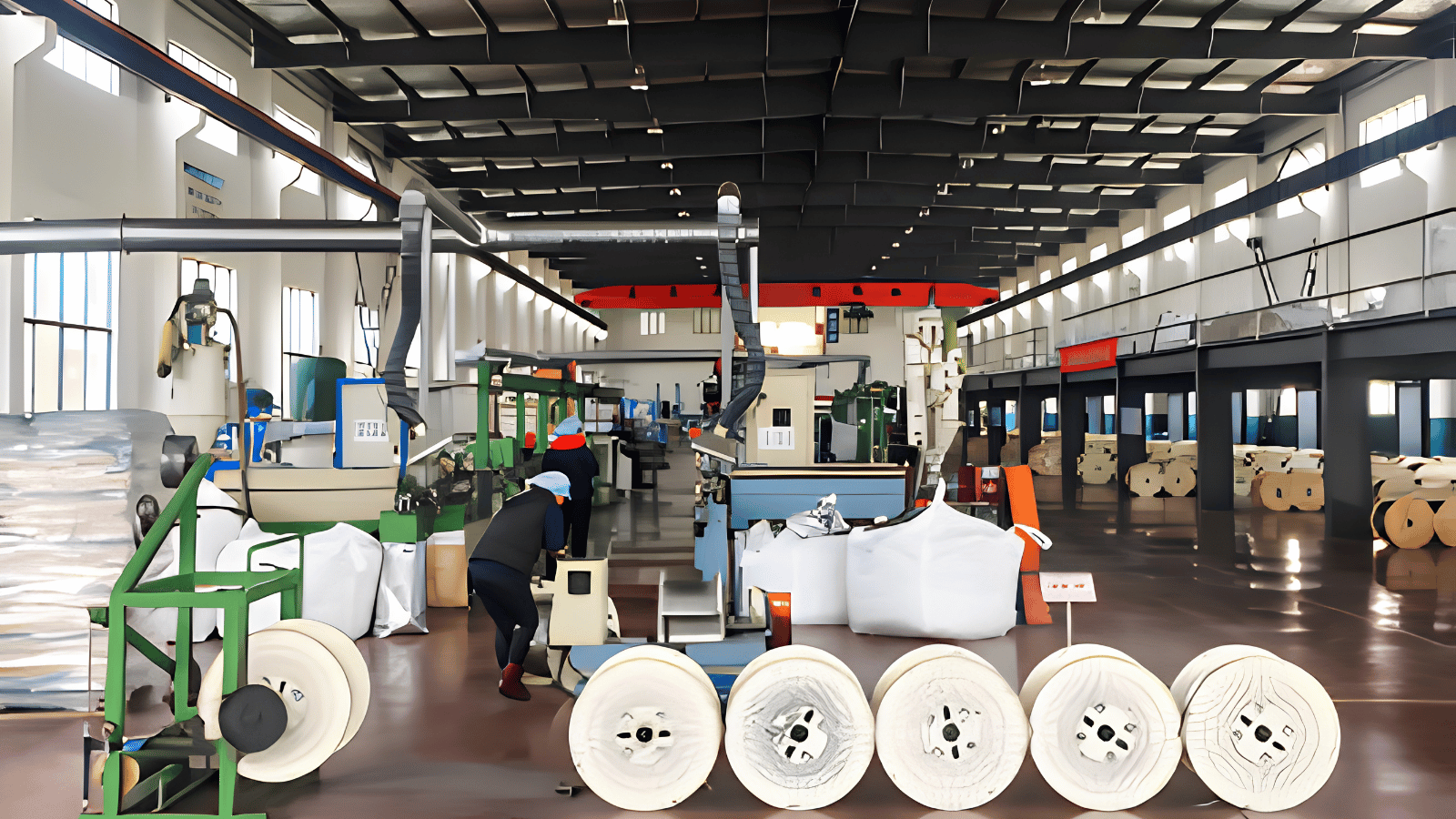
Certificate of origin, packing list, type test report and the product certificate travel with every shipment. Cable ships on plastic drums or in coils. Everything is palletised for container loading.
| Put-up | 4 mm² per pallet | 6 mm² per pallet |
|---|---|---|
| 100 m coil | 176 coils · 17 600 m | 160 coils · 16 000 m |
| 100 m plastic drum | 125 drums · 12 500 m | 81 drums · 16 200 m |
| 500 m plastic drum | 27 drums · 13 500 m | 27 drums · 13 500 m |
| 1000 m plastic drum | 12 drums · 12 000 m | 12 drums · 12 000 m |
Pallet dimensions are 1.12 × 1.12 × 1.12 m. A 20 ft container takes 20 pallets.
Open the drum and container loading plannerOrdering an H1Z2Z2-K Run, Step by Step
01
Send the specification
Cross-section, core count, sheath colour, drum length, total metres, destination port and the standard your project is written against.
02
Engineering review
We check the requested cable size and core count against the certified range and flag anything outside it before quoting.
03
Quotation
Price, lead time, packing and trade term, returned within 24 hours on business days.
04
Sample, where it helps
A short length for conductor and marking inspection, so the construction is confirmed before the full run is scheduled.
05
Specification approval and production
Once the sheet is signed off, production runs 15–30 days.
06
Test, document and ship
Withstand test on every drum, documents issued, then loading and despatch.
What to confirm before approval
- Nominal cross-section and whether single or twin core.
- Sheath colour, and whether polarity marking is required.
- Length per drum and the total metres per size.
- Destination port and the trade term you need.
- Installation method — open air, in conduit, in tray or buried.
- Which conformity marking and document set your jurisdiction calls for.
Utility-Scale, Offshore and BIPV Projects in Jinyou’s Record
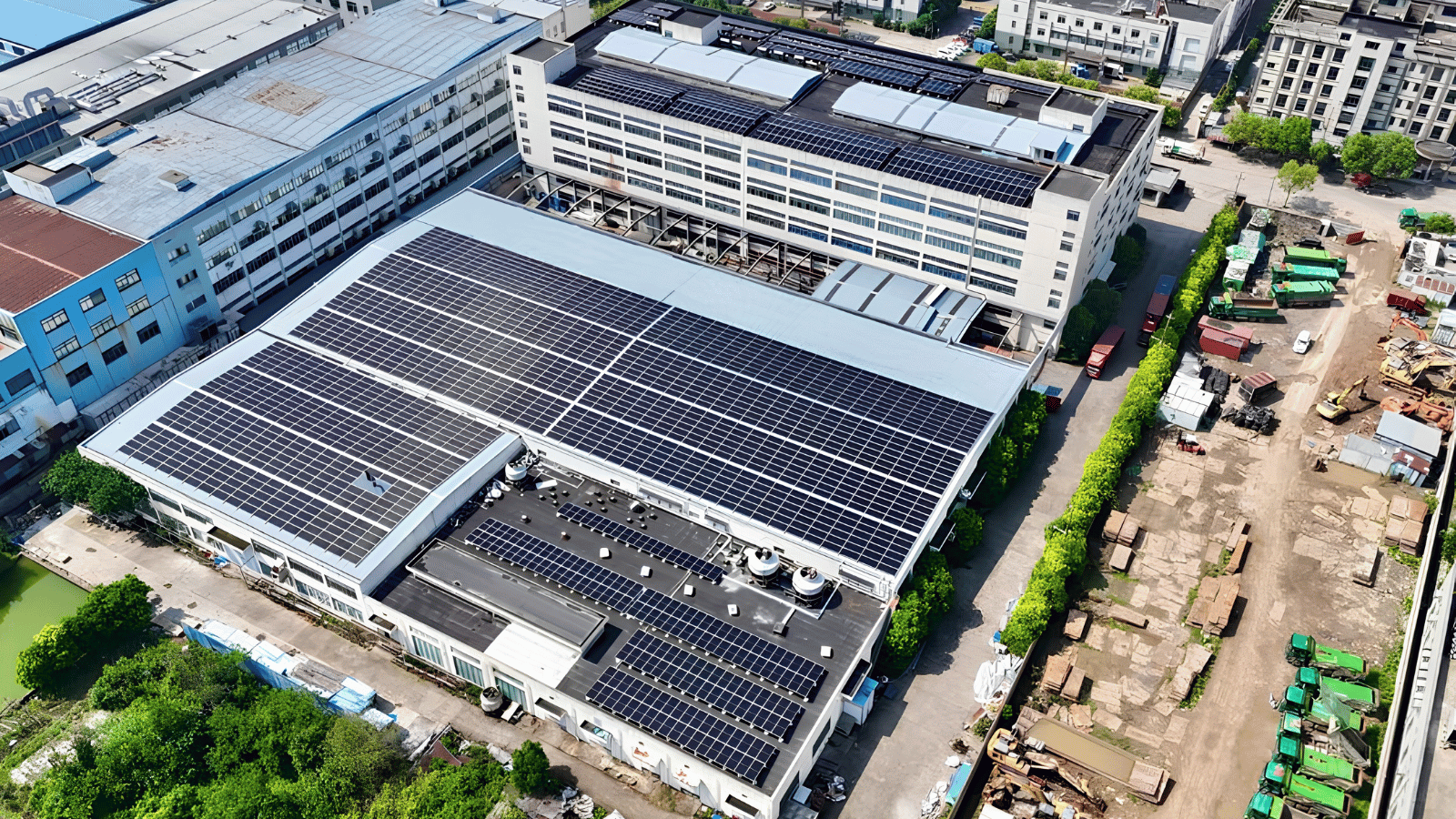
The installations below are part of the company’s participation record in DC-side solar projects and solar power plants of the kind EN 50618:2014 cable is written for. Read them as history, not traceability. They describe where the business has worked, not which reel went to which site.
- CGN Yantai Zhaoyuan, a 400 MW offshore photovoltaic project.
- Huakang Anze New Energy, a 100 MW photovoltaic and storage project in Anze County.
- Guangxi Mona Lisa, an 85 MW building-integrated photovoltaic project.
- Yangzhuang Village fishery and solar complementary project, Liyang High-tech Zone.
- Ningbo Dongmu Beverage Packaging, a 1,249 Wp rooftop project.
- State Power Investment Corporation, a January 2020 contract for the multi-gigawatt renewable energy base in Hainan Prefecture, Qinghai.
The Cable Manufacturer Behind the Product
Standards work
Jinyou Group led the drafting of NB/T 42073-2016, the first Chinese industry standard for cables in photovoltaic power generation systems, released on 8 June 2016.
Track record
The company was founded on 30 December 2006 as a cable manufacturer dedicated to renewable energy and the solar industry. It has been listed on the NEEQ exchange under code 830994 since 14 August 2014, and was named to the first national batch of “little giant” enterprises by the Ministry of Industry and Information Technology in December 2019.
The business serves customers in 20+ countries and obtained China’s first photovoltaic cable certification in April 2010.
Designation Boundaries: EN 50618, IEC 62930, PV1-F and UL 4703
Installer shorthand says PV wire should carry either UL 4703 or EN 50618, as though the two were labels for one product. They are not interchangeable. Each row below is a separate regulatory route with its own rating and status.
| Designation | Standard | Jurisdiction | Rated DC voltage | Water class | Status |
|---|---|---|---|---|---|
| H1Z2Z2-K | EN 50618:2014 | CENELEC Europe, adopted in the UK as BS EN 50618 | 1500 V DC | AD8 achievable | Current; listed by CENELEC for revision |
| IEC 62930 cable | IEC 62930:2017 | International, single core | 1500 V DC | AD8 achievable | Current |
| PV1-F cable | TÜV 2 PfG 1169/08.2007 | Former German specification, used worldwide | 1000 V DC | AD7 | Withdrawn; legacy and replacement use |
| PV Wire | UL 4703 | United States and NEC territories | Per listing | Per listing | Current in its own jurisdiction |
Two differences that get missed
Halogen content
The European standard EN 50618 and IEC 62930:2017 share a voltage rating and a temperature range. That is why they get treated as equivalents. They are not. IEC 62930:2017 admits both halogen-free low smoke cables and cables that can contain halogens; EN 50618 cables are halogen-free only.
Core count
EN 50618:2014 is written for single-core power cables. A twin-core construction is therefore a separate certification decision, not something the scope sentence covers on its own. That is why the twin-core certificate is listed on its own line above.
Ask any supplier which of the four rows their certificate actually sits on and for which cable size range, and expect an answer that matches a database record rather than a logo.
Product standard and installation standard are two layers
- The product standard, EN 50618:2014 or IEC 62930:2017, governs what the cable is.
- The installation standard governs how it is installed. In the United Kingdom that is BS 7671, currently at Amendment 4:2026.
- Cable permanently incorporated into a building falls under a separate document layer with its own reaction-to-fire classification. Confirm the class your building specification calls for at enquiry stage.
Where this cable is the wrong choice
A UL 4703 listing is not a substitute for an EN 50618:2014 certificate, and the reverse is equally true. Three cases send you elsewhere.
NEC projects in the United States
Specify a UL 4703 listed PV Wire instead. The European designation is a different standard family and will not satisfy that inspection.
Alternating current between inverter and grid
Outside the DC-side scope of both product standards. Use a cable rated for that duty.
1000 V DC legacy repairs on a matched system
Where a project is documented to PV1-F throughout, matching the existing designation keeps the paperwork consistent.
SYSTEM / RESOURCES
Engineering Tools for H1Z2Z2-K Solar Cable
DC Voltage-Drop Calculator
Calculate voltage drop against your 1% and 2% design targets by entering string current, run length, and cross-section.
Open Calculator
Drum & Container Loading Planner
Turn required cable lengths into exact drums, pallets, and shipping containers to streamline your project logistics.
Open Planner
PV Cable Designation Selector
Check which standard family applies to your jurisdiction, system voltage, and core count to ensure strict compliance.
Open Selector
Enquiry Process
Request a Quotation for Your Cross-Section and Drum Length
Send the cross-section, core count, colour, drum length, total metres and destination port. An engineer checks the request against the certified range before any price is issued, so a size we cannot certify is flagged at enquiry rather than after the order.
We build DC cable solutions for solar systems and solar energy projects, from single trial drums to full container loads.
Quotations are returned within 24 hours on business days.
Sample lengths are free of charge; the buyer covers courier freight.
Frequently Asked Questions
The harmonised designation H1Z2Z2-K was introduced with the European standard EN 50618. H marks a harmonised standard, 1 the 1.5 kV class, each Z2 an ozone-resistant cross-linked layer, and K a flexible class 5 conductor.
PV1-F was built to TÜV 2 PfG 1169/08.2007, rated 1000 V DC and classified AD7 for water. H1Z2Z2-K is built to EN 50618:2014, rated 1500 V DC and can be qualified to AD8. The older specification has been withdrawn, so new work is written against the harmonised designation.
Single core is certified 1.5–240 mm² under TÜV Rheinland R 50349329 to EN 50618:2014 and under R 50482064 to IEC 62930:2017. Twin core is certified 2 × 2.5–16 mm² under J 50483940.
1500 V DC between conductors and between conductor and earth, with 1800 V DC maximum system voltage, and 1.0/1.0 kV AC. The operating temperature range is -40 °C to +90 °C, and the conductor is permitted at 120 °C for a cumulative 20 000 h.
It is calculated for the run, not read off a single number. The inputs are:
- module short-circuit current, and the number of parallel strings combining into the run;
- ambient temperature correction and grouping correction;
- installation method, the voltage-drop target and the route length.
The correction method sits in IEC 60364-5-52 and array design in IEC 62548, applied alongside the installation standard in force where the plant is built. Send the string configuration and route length with your enquiry and we will size against it.
Both are within the cable’s intended installation conditions, along with open air and tray. Each method carries its own derating factor, so it belongs in the sizing calculation rather than a yes or no.
AD8 is the submersion classification for cable that can sit in standing water, qualified by long-term immersion testing under EN 50525-2-21 and a step above the splash-rated class carried by older designations. It is the cable class that decides floating solar and trenches that flood. Confirm the class against the certificate for the exact construction you are buying, and tell us the water exposure at enquiry.
Two things together. A certificate number that resolves in the certification body’s own database against the correct holder, model designation and standard version; and the factory withstand test at 6.5 kV for 5 minutes recorded on the delivered drums.
No. NEC work calls for PV Wire listed to UL 4703, which is a separate standard family with its own listing route. Specify to the standard named in your project documents rather than to the closest equivalent.
They share the 1500 V DC rating, the 90 °C conductor temperature and much of the test regime, but IEC 62930:2017 admits constructions that can contain halogens as well as halogen-free low smoke cables. EN 50618:2014 covers halogen-free single-core cable only.
Certificate of origin, packing list, type test report and the product certificate travel with every shipment. Tell us at order stage if your customs entry or project file needs anything further.
Orders start from 500 m per cross-section and colour, and production runs 15–30 days after the specification is approved. Quantities below that are quoted from stock where the size and colour are already running.

